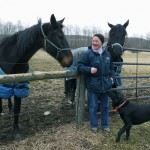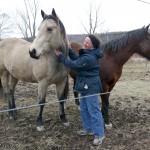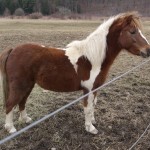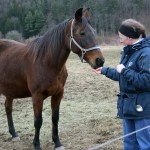
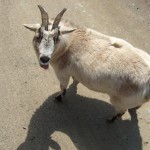
Roxy the Neighborhood Goat

By the time we arrived at the stables the temperature had reached the mid 50’s. The grey sky didn’t deter us since for mid February it was a beautiful day. Emma and I rode through the park taking the usually route. As we swung towards home down Weaver Road near the Slocum place, the familiar bleating of their goat floated on the air. CJ sidestepped away from the fence and swung his head around looking for the goat. Pepper picked up her pace with keen interest on locating Roxy. It wasn’t long before both horses knew exactly where the goat was.

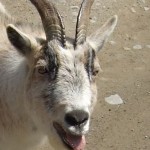
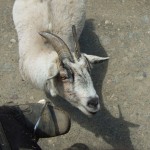
As soon as Roxy saw us, she trotted out of her pasture and came alongside Pepper. Swiftly, the goat ran in front of the horse. Once Roxy blocked Pepper’s escape, the goat repeatedly stuck out her tongue, spat and tried to lick the horse’s leg. Pepper arched her neck, looked the goat square in the eye and quickly stepped aside, urgently trying to evade the intruder. CJ stopped dead in his tracks, but with some encouragement from me moved forward. As we gained ground on Roxy, CJ tried to dodge the goat with a mad dash around her, but I pulled hard on one rein bringing the horse’s head in line with his shoulder, not allowing him to bolt.

In the mean time, Emma and Pepper were trying their own avoidance ploy. Roxie kept trying to block Pepper’s way by trotting in front of the horse and stopping. Pepper struck out with her front leg in a threatening motion. She laid back her ears and threatened to bite the goat as Emma reined the horse in. From where I sat on CJ, it looked like Pepper was too afraid to get close to Roxy so all Pepper could do was made a funny threatening hop which Roxy paid no attention to. Pepper lifted her back leg to kick the goat but again she wasn’t close enough. Roxy stayed near Pepper as if that was where she was born to be. Emma had all she could do to keep Pepper in line and outmaneuver the goat.

We passed the end of Slocum’s pasture. Past encounters with the goat had always ended when we reached the limits of her home. I was sure Roxy would turn around and go back as she had always done before. We swiftly trotted away hoping to leave the goat behind but unfortunately that wasn’t the case. To our surprise Roxy ran very fast keeping up with the horses and came alongside CJ. By this time we were far from the goat’s home turf.

“The goat is still following us,” said Emma looking back down the road.

“I know. We’ll have to walk the goat home after we put the horses away,” I said keeping an eye on Roxy.

Roxy settled in next to CJ. When the goat threatened to walk too close to the horse, I reached down with my short riding crop and gently tapped the goat on her shoulder as a warning to back off. As soon as CJ saw that I wasn’t going to let the goat get too close he relaxed, but kept his head and one ear slightly cocked in Roxy’s direction. Since the goat was shorter than CJ, when Roxy was very close the horse couldn’t see the goat and that made him nervous.

Finally, our strange little group made it back to the barn. Emma swung off Pepper. Roxy immediately ran over to her, placed her hooves on Emma’s chest and started spitting. In the meantime, I dismounted as Emma freed herself of the goat.

“Grab her collar!” I shouted.

“Okay,” replied Emma trying to seize Roxy by the collar.

“Let me hold the goat. You take Pepper into her stall and I’ll wait here. Come back as quick as you can with a lead rope,’ I said.

CJ waited quietly, standing next to the goat. Emma hurried into the barn, locked Pepper in her stall and within a couple of minutes was back with a lead rope.

“Here, hold CJ,” I said handing her the horses reins. “I’ll tie the goat up to the hitch-ring on the barn.

Quickly, I led Roxy to the side of the barn, looped the rope through a metal ring and tied a slipknot making sure I didn’t give the goat too much room to move around and get into trouble. Roxy looked at me with her big yellow eyes, obviously not happy being tied up.

“Ok, let’s get these horses unsaddled and put up for the night,” I said as we hurried into the barn.

I led CJ into the dimly lit barn. We immediately turned a sharp corner and CJ rushed into his stall. Swiftly, the horse’s girths and breast-collars were unhooked and saddles pulled off. Roxy began to bleat causing every horse in the barn to jump and nervously move around in their stalls. Jupiter turned in his stall, looked in the direction of the goat and neighed. In response, all the horses returned Jupiter’s call to danger. The goat didn’t like being tied and started to butt the side of the barn, which set off another round of whinnying.

“CJ calm down. I won’t let Roxie get you,” I said patting the horse.

Within minutes Emma and I had the saddles put away, the barn light switched off and the doors closed. We stepped outside and saw Roxy restless, but still tied. I rapidly walked up to the goat, untied the knot and led Roxy away from the barn.

“What shall we do?” asked Emma.

“We’ll have to walk her back to her pasture. She won’t fit in the car. One of us can drive while the other leads the goat, then we’ll switch,” I replied.

“Ok, I’ll lead the goat first,” said Emma taking hold of the purple rope and walking towards the road.

A slight chill filled the afternoon air. Emma walked briskly around the barn and up the road as I pulled the car out of the driveway. When I caught up with her, I drove slowly behind her as she led the goat up the street. Roxy didn’t mind being lead and walked happily beside Emma. Near the intersection of Weaver and Sutliff, we switched and it was my turn to lead the goat. Suddenly, a dog began barking some distance away and Roxy stopped dead in her tracks.

“Don’t worry Roxy. I won’t let the dog get you,” I said pulling on the rope and trying to inch the goat forward.

“Mom, I’ll walk the goat,” said Emma seeing the goat didn’t want to walk for me.

Emma jumped out of the car and took hold of Roxy’s lead rope. The goat liked Emma and began to walk up the hill. I drove up the road and came to a stop near a pull off on Weaver Road, stepped out of the car and started walking back towards Emma and the goat. In the meantime, a big silver pickup truck stopped near Emma.

“Are you taking that goat somewhere?” the woman driving the truck asked Emma.

“I’m trying to get the goat back to her pasture. We were horseback riding and the goat followed us to our barn,’ said Emma.

“I’m the sister-in- law of the goat’s owner. Maybe we can get the goat in the truck bed,” said the woman.

The middle-aged woman stepped out of the truck and walked over to the goat. Emma and the woman each took an end of the goat and tried to lift the animal into the truck bed over the tailgate. They tried a couple of times but Roxy’s weight prevented them from lifting her high enough to get the goat into the truck.

“I’ll just walk her home,” said Emma.

“I’ll park up next to the pasture and meet you there,” said the woman climbing back into the truck and driving away.

The silver truck passed me as I met Emma in the road with the goat. Roxy stared at a brown Standardbred in his pasture near the intersection. The horse took one look at the goat, snorted and kicked up his hooves, spinning away in a mad gallop. Emma pulled on Roxy’s lead rope and we walked a few yards up the hill until the goat’s pasture came into view. Some distance away, the woman with the truck stood near the Slocum fence waiting for the goat.

“We can let the goat go. I think she’ll just go home now,” I said.

Emma unclipped the lead rope. Roxy, tired from her long walk, took a few slow steps towards the woman in the road.

“Come on Roxy,” called the woman.

Leisurely, the goat walked away from us towards the woman. Finally, the woman grabbed Roxy’s collar and led the goat away. Glad to at last be rid of the goat, we jumped in our car , turned around and headed towards home.

“Boy, that goat is a handful!” I said as we drove away.
Posted in Uncategorized | Tagged , | Leave a comment

Snow Ride


Video by Anne Louise MacDonald at Hug A Horse Farm www.hugahorsefarm.com

Softly in hushed darkness it fell, blanketing villages, farms and woodlands. Delicate downy flakes, crisp and new muffled the sound of a fox hunting mice in an open field. Moonbeams transformed snowflake crystals into a myriad of tiny, frozen diamonds sparkling and shining in those nocturnal hours. Overnight minor streamlets trickling off hillsides became delicate dripping icicles clutching crags, overhanging precipices. Wind mischievously blew the helpless, swirling snow into funny shapes, packing it into little mounds alongside the road.

The mention of snow conjures up many images, some horribly troubling and some downright delightful. Eighty-nine years ago, Robert Frost stopped his horse near a forest, jotted down a few lines about snow filling up the woods and his ageless poem captured our minds and hearts. And what is the poem about, just snow and tranquility or perhaps something more? It’s interesting to note that the poet’s only companion was a restless horse reminding his owner of their need to get on with the trip and back to the barn.

Horses enjoy snow; they roll and run in it, frolicking like children on winter holiday. Obviously when horses and people play snow games together the result can be odd. The sport, skijoring, began in Sweden and is enjoyed across Europe and some parts of America and Canada. Skijoring involves a horse with or without a rider pulling a skier through a race course, which may or may not have ski jumps. What began many years ago as an inexpensive way to travel has evolved into a worldwide sport with prizes and spectators.

Of course, not everyone feels that way about snow. Drivers on a snowy day fear an accident, homeowners complain about shoveling the white stuff off sidewalks, roofs collapse under the weight of it and in cities it turns to a brown crusty mess. Blizzards dump huge amounts of snow knocking out power lines and closing roads and stores. Hapless travelers risk the danger of being trapped along the roadside when whiteouts obscure their visibility.

Last year we had lots of snow. The ground stayed covered, every few days new snow came down adding to what was already there. I rode with Karen and Marilyn last year, while it snowed and after it snowed. Sometimes, I rode alone, just Pepper and me. But the weather has been warmer this year; January with temperatures in the 50’s was more like spring than winter. I missed the snow and its crisp sound beneath the horse’s hooves as we passed through it.

Finally on January 21, 2012, after waiting so many weeks and months, a snowstorm came at night. With the morning’s light, I peered out my window and saw the snow. In all, 4 to 6 inches fell, carpeting everything, decorating the trees with white puffy clumps. It was time for the snow ride. Emma and I headed to the stables, saddled the horses and rode toward the park.

The Slochem ponies ran up to the fence and stuck their heads through the railings while all their other horses pranced and raced in the snow. As we rode by we heard the goat bleating on the other side of the barn. On we traveled, turning up Bobcat Road and into Round Top Park. The snow was fresh, not too deep. We followed the paw prints of some kind of small animal up the road. The erratic tracks of a rabbit or squirrel circled, twisted and in a wide curving arch doubled back on themselves; evidence of either a friendly game or deadly chase. As we turned a curve in the road, suddenly a large doe bounded across our path, out of the woods and down the hillside on a steep mountain trail.

Other people were out enjoying the snow; an older woman greeted us with a hardy hello. I’d seen her before in the fall, always alone but clearly enjoying a bit of solace with nature. A little further on, a middle aged couple came into view, also enjoying the winter beauty on a pleasant Saturday afternoon. Then we came to snowshoe tracks marking where an unknown adventurer had passed earlier in the day.

CJ and Pepper stopped and refused to go on when they saw a pair of park benches, newly installed near the picnic and jungle gym area not far from the baseball field. We urged them forward and made a game of circling the benches, weaving in and out, until being afraid wasn’t any more fun and the horses were ready to move on.

I looked up a snow filled path through a stand of tall, slender Eastern White Pines, remnants of a mighty forest which once covered the East Coast. Long ago the pine forests were clear cut, their straight trunks used for the masts of sailing ships. Looking at them in the snow, so evenly planted and with uniform widths, I could almost imagine hundreds of ships ready to set sail on a windy day. We continued by the pond covered in thick snow and by the stop sign dressed with a little snowcap. The yellow gate came into sight and we walked around it, off the mountain, passed a blue house where two barking dogs were usually tied to trees, but not today. The dogs were gone, taken inside for some warmth.

We came to the last hill before home. The horses extended their stride and zipped up the road passing the rural mailman in his improvised mail car, which was parked momentarily to deposit a few letters. On and on we cantered until we reached the hilltop, and then walked down the other side to the barn where the horse’s hay and grain waited. We brushed them down as they ate, picked out any packed snow and ice in their hooves, then flipped off the barn light and headed home for our own dinner.

For those who have forgotten Frost’s memorable poem – here it is:

Stopping By Woods on a Snowy Evening

Whose woods these are I think I know.
His house is in the village though;
He will not see me stopping here
To watch his woods fill up with snow.

My little horse must think it queer
To stop without a farmhouse near
Between the woods and frozen lake
The darkest evening of the year.

He gives his harness bells a shake
To ask if there is some mistake.
The only other sound’s the sweep
Of easy wind and downy flake.

The woods are lovely, dark and deep.
But I have promises to keep,
And miles to go before I sleep,
And miles to go before I sleep.

By Robert Frost
1923/New Hampshire

Posted in Uncategorized | Tagged , , , , , | Leave a comment

Kim Burris at Sharp Lee Farm

The winter had been unusually warm, rain instead of snow, temperatures in the high 30’s and 40’s instead of dipping down into the single digits and below zero. February was no different. The air felt like early spring, the day I jumped in my son’s Honda and drove up Route 34 on my way to Sharp Lee Farm. I turned left at East Spencer Road, continued for a few miles, pulled into the driveway in front of a single story house and stepped out of the car. The barn was directly across the road and I thought Kim would be there, but before I got very far in that direction, the front door swung open and a pleasant woman greeted me. I stepped into Kim’s comfortable home and sat down.

Backtracking a bit, like so many people I walk in many worlds, usually those worlds don’t meet but sometimes they cross. Besides my deep attachment to the horse world, I confess to being involved with a dedicated group of writing geeks which meet at the Corning Library twice a month. Our enthusiastic leader and writing guru is Michelle Wells. A few weeks ago, Michelle and I exchanged blog sites. I clicked on her website and read Michelle’s post. Shortly, a comment from Michelle appeared below my article about the Unadilla Auction House:

Hi Pat – I actually grew up across the street and a couple houses down from the auction house. Was just up there on Sunday. My sister and I were horse crazy and watched the horses with avid interest. I also walked horses at polo games across the river where they have a huge indoor arena for polo games, Susquehanna Stables. I’m not sure it’s still there but those were some great days. Thanks!

How ironic! One thing led to another and it turned out Michelle’s brother and his girl friend, Kim, were up to their ears in horses. Michelle helped me with an introduction and that’s how I ended up on a fine Wednesday morning in February sipping tea and talking horses with Kim Burris.

Around age 3, Kim’s Dad decided it was time for her to learn about horses. They drove across the border from their home in Winchendon, MA to Jaffery, NH for riding lessons. The stables not only offered riding and driving lessons, they also offered hayrides and sleigh rides through the surrounding scenic countryside dotted with sparkling lakes and rolling hills at the base of Grand Monadnock Mountain. Although, the distance was only about 10 miles, the trip placed Kim on a life path which she never deviated from and instilled an enduring adoration for horses. The stables, Silver Ranch, had a straight forward philosophy based on teaching clear and safe communication between horse and humans. Additionally, they taught their students how to tack, groom and take care of horses. Kim had a long relationship with the stables.

“I was lucky to have parents who cared enough to give me riding lessons once a week when I was a kid,” said Kim.

“Not everyone gets that opportunity,” I replied.

“When I was 11 years old, I wanted a horse so bad, I begged and begged. The stable owner, Alfred Sawyer, told my Dad he might as well buy the horse for me. Alfred said I would get sick of it like all the other girls as soon as I became a teenager and discovered boys,” said Kim smiling. She paused for a moment and sipped her tea, “Dad bought the horse, but I never lost interest. I’ve been riding and owning horses ever since.”

“What type of horse did you buy?” I asked.

“The first horse I owned was a ½ Morgan- ½ Arab mare named Stormy. She was about 12 years old, not much of a jumper. She could jump a 2 foot rail but it wasn’t pretty,” said Kim.

“Where did she come from?” I asked.

“Fairhaven, VT…Stormy was 19 months old and I trained her to ride,” said Kim.

“That’s interesting; she was the first horse you trained and rode in shows?” I asked.

“I used to ride her in open shows and 4-H events. I was horse crazy; I think all little girls are. I loved horses. And was lucky my parents could afford lots of lessons. I’ve ridden trail rides, shows, lots of different kinds of horses. At Silver Ranch, Alfred basically bought horses from the local auction and put the lesson riders on them. There was a turnover at the stables and we got to ride a lot of different horses. I liked all the horses, but my favorites have always been Quarter Horses and Standardbreds,” said Kim.

“The horse I ride is a Standardbred. She’s a really nice little horse,” I said.

“Standardbreds are great horses. My Dad became interested in Standardbreds through a good friend who raced trotters and pacers at Hinsdale Raceway in New Hampshire. When I was 13 years old my Father bought his first Standardbred. We had a track at home and exercised and trained the horses there. I worked at Hinsdale in summers. At 16 I took a job as a groom and moved to the track,” said Kim.

“You lived there?” I asked.

“Yes, the big tracks have a dormitory, community bathrooms, and cafeteria for the grooms and other people who work there. I was struck with the horse bug, quit high school, and went to work as a groom at Hinsdale Raceway. I lived at racetracks during the racing season and traveled the circuit; Foxboro Raceway, Plainridge Race Course, Rockingham Park, all over the Northeast. The season lasted 3 to 4 months and when the tracks closed I went home. Now, the big tracks are open all year long, Monticello, Yonkers….the smaller tracks like Tioga Downs are still open seasonally,” Kim replied.

“So you’ve worked with horses you’re entire life,” I said.

“Basically, I’ve always owned horses; although, I had another job for about 12 to 13 years working in a woodshop making furniture, said Kim.

“What type of furniture? I asked.

“I worked for Bellecraft Wood, located in Winchendon, MA where I was born and raised. We basically worked in pine and made New England style furniture, mostly small tables and hutches. They are still in business,” she said.

“So how did you get from Massachusetts to Spencer, NY?” I asked.

“In 2001 my husband and I moved to a farm in Candor. The next year he passed away,” she said.

Kim, her husband Larry, and a friend were headed for a Standardbred auction in Ohio. With the horse trailer hitched to their truck, they pulled into the auction lot, parked, sat through the sale and bought two horses. One horse, B-Practice, looked like a skinny, wet cat with a big pretty head. They loaded the horses into the trailer and in the late evening headed back to New York State. On the highway, Larry began to have trouble breathing, a blue and white hospital sign not far up the road helped them locate a doctor. A few minutes after Larry checked in at the emergency room, he died of a heart attack.

“It was hard but everyone has tough times and good times. You make the best of it and move on,” said Kim.

“That must have been difficult, so far from home with the horses in the trailer and everything happening so suddenly,” I said.

“It was very hard, but every experience teaches you something,” she said.

Kim brought the horses back to Candor and life went on. She worked at Tioga Downs Raceway in the paddock as a farrier and an exercise driver. When a horse lost a shoe she tacked it on swiftly, within a minute, and the horse went quickly back to the track. A vet worked in the paddock too. Not far off, an ambulance waited hoping a sulky driver wouldn’t be in need of their services, an ever-present sign of the inherent dangers of harness racing. Kim a registered driver with her own colors, Columbian Blue and White, drove horses for qualifying times, and as the days slipped by she continued to train B-Practice. The skinny little horse that looked like a drowned cat and had never won a race began to win races, a lot of races. She won her first 8 starts and went on to win a total of 26 races and earn $30,000. Trotter trade publications printed her picture and wrote her story.

“Training requires daily exercise…jogging in both directions at a pace or trot. Trotters are not allowed to canter. I enjoy working with Standardbreds for several reasons; first they have great endurance, second a wonderful personality, third they’re very smart, and fourth docile compared to thoroughbreds, perhaps because we work and handle them more often,” said Kim.

As it always seems to happen, when everything is rolling along smoothly there is a sudden dip in the road. Without warning tragedy struck, B-Practice and another mare got loose from their pasture, ran out into the road and were hit by a car. B-Practice flipped over the car roof, demolished the vehicle and sustained injuries.

“She recovered from the injuries and I could have retrained her and started her back racing, but I decided to retire B-Practice and breed her instead. She is now 15 years old. Her oldest foal, TalkAboutAPhoto just turned 3 and will hopefully race this summer. I’m building a stable of racers,” said Kim.

Not all horses at Sharp Lee Farm belong to Kim, although they are all in her care. Some are from Tioga Downs Raceway; come to rest and recuperate. While at the track, the horses are stabled and receive exercise either on the track or on a huge treadmill for horses with side gates. The horse walks or trots for about 20 minutes with an average distance of 3 to 6 miles. If a horse needs rest, becomes lame or just needs a few days off to eat some green grass during racing season they are turned out at Kim’s farm.

We left the warm house, stepped outside to the backyard and walked a few feet to the first pasture. Sharp Lee Farm has deep, flat bottom land divided into four large pastures. At the first pasture two dark bay Standardbreds with horse blankets draped over their sleek backs, picked up their heads and pricked their ears in our direction as soon as they saw Kim. With a burst of speed and power the two beautiful creatures ran towards us. Kim bent under the wire fence, greeted the horses with a friendly hello and a treat. It was the same at every pasture, the horses made a mad dash to greet Kim, received a friendly rub on the neck and a treat.

How many horses do you have?” I asked.

“Too many horses… some come and go and some come and just stay,” she said. “I love all my horses. There are no bad horses, just bad training,” said Kim.

I met B-Practicing, her foals and pasture buddies. George, an older horse, and Roci, a mini-horse, both belonged to a neighbor who could no longer care for them due to medical problems, so Kim took the horses in. The mascot for Tioga Downs Raceway, Tioga Ty, a pinto Shetland cross contentedly walked among the larger horses. During racing season on Sundays, he had his own little corral by the grandstands where kids enjoyed watching him.

Currently, Kim is taking a break in training, but hopes to begin anew when the track at the Owego fairgrounds opens again. The devastation created by the 2011 flood, damaged the fairgrounds and the track was closed, hopefully it will open soon. In the meantime, the winter has been mild, the horses pleasant and valley life serene, but it won’t be long before harnesses are hitched to sulkies and Kim will be busier than ever at the racetrack doing what she enjoys; racing trotters.

Posted in Uncategorized | Tagged , , , , , , | Leave a comment

Cowboys at the Rockwell Museum of Western Art

The road zigzagged through geologic oddities, erupting geysers, turquoise hot springs, bubbling mudpots, and fumaroles spewing the sulfur stench of a thousand rotten eggs. Our visit to Yellowstone National Park ended with a final trail ride, and the necessary breaking of camp, which involved stuffing the car with our sleeping bags and orange, two-man tent. The meandering road out of Yellowstone led through breathtaking panoramas of the Grand Tetons where we camped for the night under a starry sky silhouetted by mountains not far away. In the morning, we gathered wood, scrambled eggs over an open fire, packed up our gear and headed for Jackson Hole, Wyoming.
Jackson Hole sits on a high valley surrounded by the Teton Range within the Rocky Mountains. Prior to the 1800’s, the Shoshoni, Crow, Blackfeet, Bannock, and Gros Ventre Indians used the area in summers to hunt buffalo, mule deer, antelope and elk. Mountain men and trappers from Canada and the US followed the Native American trails, and entered the region to hunt beaver for pelts, until the bottom fell out of the beaver fur market in 1845 when silk for hats became the new vogue. A lull fell over the valley for a few years. One or two isolated trappers and their Native American wives made homes there and Indians returned to hunt in summers. The first settlers came in the 1890’s. Finding the land too poor to grow crops, the homesteaders turned to cattle ranching to make a living. Wherever ranches, cowboys and horses dwelled, rodeos soon followed. Around 1912, the Jackson Hole Rodeo opened, with dude ranches ensuing several years latter; both have been going strong ever since.

My husband and I pulled into Jackson Hole on our wandering journey through the American West. Tourism had a strong hold on the town and there were countless things to do and see. The rodeo began at 8 pm; we bought tickets, and climbed into the grandstands to wait for the show to start. The arena was small as rodeos go, which gave everyone a ringside seat, up close and personal.

The first bronco leapt out of the chute flying into the air bucking and spinning, the sound of his hoofs pounding the hard earth like drumbeats. The cowboy on the horse’s back held tight. His hat sailed aloft as the defiant steed kicked and twisted; it wasn’t long before the cowboy’s backside hit the dirt. We could see through railings a row of cowboys lined up on the other side of the arena, crowded around the back of the chute, waiting their turn to try the next horse. Some of the men smiled, most were intent on the event which they were signed up to participate in. They wore cowboy hats, jeans with chaps, button snap shirts and leather boots with intricate, hand tooled designs. The scheduled events, barrel racing, calf roping, bronco and bull riding proceeded until the last rider finished and winners were announced through the loudspeaker, all in the spirit of control, conquest and victory over the rebellious animals.

The crowd dispersed into the warm, summer night, cars pulled out of the parking lot and everyone headed home. We stopped our car at a dirt lot at the edge of town, not far from the rodeo arena. The black sky embraced the Milky Way, constellations and a thin crescent moon. A few days before we purchased fireworks at a roadside stand, and this seemed like a good place to set them off. Moe ignited a cone shaped fountain which lifted a spray of sparks several feet into the sky only to cascade down in a steady stream of silver and gold. He placed a few bottle rockets in a glass jar and lit the fuse. The fireworks sped upward, higher and higher and exploded adding colorful artificial stars temporarily to the sky over our heads. It seemed like a fitting end to a wild, west show and a cowboy kind of day.

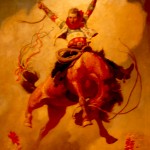
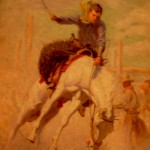
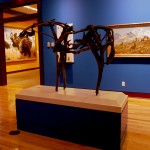
A few decades slipped by, and I found myself in the company of Mary Mix at the Rockwell Museum of Western Art in Corning, NY. We stood in the Cowboy Gallery before an exhibit displaying works by several famous Western artists. Charlie Russell, Charlie Dye, and Harry Jackson, cowboys turned artist in an attempt to capture the drama and beauty they observed on the open range, and Frank Tenney Johnson, William H. Dunton and N.C Wyeth, visitors to the west painting scenes they witnessed. Two splendid rodeo pictures hung depicting broncobusters that could have represented the events I observed at the Jackson Hole Rodeo years ago. We talked about Indians, cowboys, Western history and artists.

“The Western cowboy and cattle drives arose after the civil war with the need to move cattle from ranches to railheads where the animals were shipped to market,” said Mary.

“The Civil War marked a changing point for many things,” I replied.

The image of the American cowboy on his horse, easily visualized and represented in hundreds of books, articles, films and works of art has been indelibly stamped on the American psyche. The cowboy arose from the need to move cattle by trail from the open range in Texas, western Kansas, Nebraska, Colorado, Wyoming, Montana and the Dakotas to railheads where the animals were shipped to slaughter and packing houses in the East. The long, slow movement of cattle created a new culture dependent on skilled horsemen. The average cattle drive took 2 months and consisted of 3,000 cattle, 10 cowboys with 3 horses each, a horse wrangler, and a cook with his chuck wagon. Cowboys were primarily young single men from a variety of ethnic backgrounds; Anglo-American, Mexican, Afro-American, and Native American. They worked and protected cattle on ranches and were not involved in the American Indian Wars which were fought by the US military.

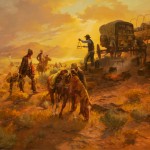
“I give school tours through the museum and often stop at a painting like this one by Charlie Dye. I ask the students to take a close look at the painting. What is the artist trying to communicate through his work?” Mary said turning to the painting of a chuck wagon, cook and cowboys at the end of the day on the open range entitled “Come and Get It”.

“It seems that American Western Art concentrates on the actual story of the West in contrast to Modern Art and other contemporary art forms which focus on an abstract psychological impression of the world around us,” I said.

“Perhaps that is why visitors to the Rockwell Museum have an easier time relating to the artwork. No matter what your background the paintings have something to say to the viewer,” said Mary.

Charlie Dye (1906-1973) was born in Canon, Colorado and began working on cattle ranches as a young boy. By his twenties, he was employed on ranches in Colorado, Calfornia and Oregon. He carried a sketchpad and pencil with him recording the scenes he saw as he worked as a cowhand. At 23 he sustained an injury after being thrown from a horse and while recuperating in the hospital viewed the artwork of the famous cowboy artist Charlie Russell. Russell’s artwork inspired Dye to pursue art as a profession, against his father’s wishes. He left ranch life and attended the Chicago Art Institute and the American Academy of Art. Upon finishing, he moved to New York City and set up a freelance art studio entering the art world as an illustrator. He created magazine covers and artwork for stories in a wide variety of magazines: Adventure, Walt Colburn’s Western, Argosy, Coronet, American Weekly, Saga, Outdoor Life, and the Saturday Evening Post. By the 1960’s, classic illustration came to an end. Dye left the East and moved westward to Seona, Arizona where he setup a studio. He devoted the rest of his life to painting the scenes that first inspired him to become an artist, and in 1965 helped establish Cowboy Artists of America.

Charlie Dye has been quoted to have said,

“Today we can make a living painting. I don’t mean little squirty things, but real work being sold through big galleries. People are buying this stuff because they maybe feel the era of the cowboy is just about on its last legs. People are groping for something that is not so damned mechanical or artificial as life has become. There is no ‘ism’ tied to the tail of my painting. Maybe it doesn’t stack up to much with the Metropolitan Museum in New York, but there is one helluva lot of people buying it in small towns. It doesn’t bother me not to be in a big museum. I don’t paint for the honor of it. I do it because I like to paint and I like to eat! Those that buy my works are cow people and others that believe old Mother Nature knew her oats when she made the West and her finest animal, the horse.”

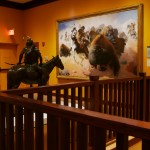
It might surprise Charlie Dye that his paintings are hung in 13 American museums and will be enjoyed for a long time to come. Mary and I turned our attention to the center of the Cowboy Gallery where a bronze sculpture by Harry Jackson sat in a showcase depicting a Pony Express rider, armed with a six-shooter astride a galloping horse.

“Most people don’t realize that the Pony Express only lasted 18 ½ months. The route stretched from St. Joseph Missouri to Sacramento, California. At the time, the Pony Express was the fastest way to move the mail. The average rider was 16 or 17 and of small stature. The mail was more important than the rider who rode 80 to 100 miles at a time switching horses every 10 miles at stations along the way before a new rider took up the trail. It just took 10 days in summer and 16 days in winter to complete the run, until they went bankrupt and became part of the mythology of the west,” said Mary.

“Wow, that’s fast especially considering the terrain and weather,” I replied.

The threat of the Civil War created a governmental demand for fast communications with California to keep the state in the Union. On April 3, 1860, the Pony Express was created by a private company to deliver mail to the West Coast with the hope of obtaining a federal mail contract. The news of the early war was carried in saddlebags across the dangerous western route through a system of relay riders. Even though, riders and horses endured great hardship and peril, in the history of the Pony Express only one mailbag was lost and one rider died. At the company’s peak there were more than 100 transfer stations, 80 riders and between 400 and 500 horses. The Pony Express never received a federal contract to deliver the mail, and when the Pacific Telegraph line was completed in 1861 the company entered bankruptcy; however, the bravery and courage of the riders and their fast horses captured the heart of the nation.

For the Pony Express Centennial in 1960, a reenactment was held crossing multiple states and enlisting hundreds of riders. For a two day period, riders re-ran the Pony Express route in both directions, as towns along the way celebrated with festivals, parades and rodeos. In Salt Lake City monuments and plaques were dedicated to preserve the location of the old trail and to remember the brave riders of the Pony Express.

I thanked Mary and walked out of the museum, into the grey winter afternoon, crossed the street and stopped in the parking lot. I turned and glanced back at the huge brick building housing the Rockwell collection of Western Art and thought how lucky we are to have such a beautiful museum in our area, filled with vibrant history and artwork of the American West. Next time you’re in Corning stop by and see the museum for yourself. You’ll be glad you did.

Note: This concludes my 3 blog series on the Rockwell Museum of Western Art. I thoroughly enjoyed visiting the museum and writing the articles. I hope you enjoyed reading them. I also want to wish Mary Mix the best and a special thanks for all of her valuable help. Happy trails to everyone – Pat

Sources:
http://en.wikipedia.org/wiki/Grand_Teton_National_Park, http://www.jacksonholerodeo.us/, http://www.jacksonholechamber.com/jackson_hole_wyoming/jacksons-history.php, http://en.wikipedia.org/wiki/Cattle_drives_in_the_United_States, http://en.wikipedia.org/wiki/Cowboy, http://www.cliffsnotes.com/study_guide/The-Cattle-Kingdom.topicArticleId-25238,articleId-25174.html, http://cowboyartistsofamerica.com/history/history_two.html
www.askart.com/AskART/artists/search/Search_Grid.aspx?searchtype=MUSEUMS&artist=5867, http://www.pulpartists.com/Dye.html, http://www.so-calleddollars.com/Events/Pony_Express_Centennial.html, http://www.xphomestation.com/index.html
The American West, People, Places, and Ideas by Suzan Campbell with an essay by Kathleen E. Ash-Milby

Artwork credits: “Bronco Rider” by NC Wyeth, “Untitled” by William H. Dunton, “Come and Get It” by Charles Dye, “The Mix Up” by Charles Russell, “Morning Showers” and “Branding” by Frank Tenney Johnson.

Posted in Uncategorized | Tagged , , , , , , , , , , , | 1 Comment

“War Horse” at the Sayre Theater


War Horse directed by Steven Spielberg

Horses in World War I by Naomi Pugh

In mid-January my riding buddies from Ballentine’s Horse Heaven met at the Sayre Theater to view “War Horse”, a Dream Works production directed by Steven Spielberg and advertised for release during the Christmas holiday. Last year Donna Horton organized a movie night for all the riders at the stable. Everyone went to see the movie “Seabiscuit”. Unfortunately, I couldn’t join my friends and missed the movie. This year when Donna said she was organizing another movie night, I marked my calendar determined not to miss it.

The movie date approached. Donna called asking if I’d be able to make it for “War Horse”, the late show on Friday night and of course the answer was yes. I drove over to Anne’s house. Once Anne and her daughter, Stephanie, climbed into the car, I circled around the block and headed for Sayre. We stepped up to the box-office window and were greeted by the manager, Margie Ross, paid our admission and received small, red tickets. The smell of salt, butter and popcorn wafted through the air, permeating the theater. Anne stopped at the refreshment counter to buy a large bucket of popcorn. A few feet away near the movie posters showing coming attractions, I saw Donna and Karen and walked over to meet them.

“I brought some tissues. . . I thought I’d need them,” said Donna smiling.

“Me too, I tried to put the whole box in my purse but it didn’t fit, so I just stuffed in a handful. After watching the movie trailer I thought I better be prepared,” I replied.

The first show was almost over, we walked into the entrance hall and waited next to a small folding table set up for donations to help horses at the Bradford County Animal Shelter. On the table sat before and after pictures of Sham, an Arab stallion recently rescued by the shelter. A huge plastic jug filled with bills rested on the table.

“The money goes to feed the horses we rescue. Since the shelter doesn’t have facilities to stable horses, we adopt them out to farms but the shelter covers costs,” said Anne.

“I hope you raise a lot of money,” I replied dropping a few dollars into the jar.

It wasn’t long before the wide swinging doors to the theater opened. Over the heads of the exiting crowd we could see the movie credits playing, row upon row of red seats, and the gilded ornate plaster surrounding the stage in front of the movie screen. The moviegoers flooded out through the doors, pressed by us, many faces red, streaked with tears, hands clutching a Kleenex or hankie. Most of the people reached into pockets and purses, bringing forth money to stuff the donation jar for the care of abused horses at the Bradford County Animal Shelter.

We found our seats and sat down. I relaxed, the seats were comfy, the company pleasant, and Anne offered everyone popcorn which was yummy. We waited a bit, not many came to the late show. Then Margie Ross stepped in front of the seats, not far from us, and made an announcement about the Bradford County Regional Arts Council which operates the theater. She explained about the fundraiser for the shelter and introduced the film based on a novel by Michael Morpurgo and a British stage play adapted by Nick Stafford.

“The movie will begin shortly…enjoy the show,” concluded Margie.

Suddenly, darkness enveloped us and the movie began. At first events transpired in the usual way concerning protagonists and antagonists until everything went deadly wrong and the horse joined the Calvary, went off to war and horrific things happened. Of course, I don’t want to give away the movie, but I will say it wasn’t what I expected. Graphic scenes of World War I flashed on the screen showing horses pitted against modern mechanized war technology; machineguns, tanks, mustard gas and trench warfare. The dead horses on the battlefield strewn like tossed playthings by a spoiled child were heart wrenching. The terror of war and how out of place horses were on the battlefield was crushing. We all had need of our handkerchiefs.

The movie ended and we stood up and read through the credits displayed on the screen before us. The names scrolled down. We watched for a credit for the horse that played Joey, the War Horse, but there was none so a bit disappointed we left the theater.

It’s estimated that over 8 million horses died in World War I (1914-1918). At the beginning of the war, Cavalry units were considered an essential part of any military force; however, trench warfare, modern machine guns and artillery fire overwhelmed mounted units rendering them ineffective. As the war progressed, horses became relegated to another role throughout the war; transport of troops, supplies, armaments and the wounded.

Even though World War I ended, that did not end the involvement of horses in warfare. World War II (1939-1945) proved equally fatal to horses. Although the number of horses lost in the Second World War is unclear, the German’s alone lost 2.5 million horses. During the war, the Germans and Soviets employed more than 6 million horses, relying on them to pull military transports and artillery on the Eastern Front. All of the belligerent nations employed horses in some capacity. Again, the horse was used to transport equipment and supplies especially on terrain where motorized vehicles could not traverse. Today horse units within the modern military have almost disappeared; now they are primarily used for ceremonial occasions or reconnaissance.

In England on November 24, 2004 at Hyde Park, the Animal’s of War Memorial created by sculptor, David Backhouse, was unveiled to commemorate the fallen horses, mules and donkeys which died while in the service of the British military throughout history. Perhaps considering the great sacrifice horses have made during war a few more memorials should be erected to the unwitting animals which paid such a high price with their lives.

I found the following poem on line by an anonymous author which sums up the situation pretty well:

Look back at our struggle for freedom,
Trace our present day’s strength to its source;
And you’ll find that man’s pathway to glory
Is strewn with the bones of the horse.
~Author Unknown

Sources:
http://en.wikipedia.org/wiki/Horses_in_World_War_I, http://en.wikipedia.org/wiki/Horses_in_World_War_II,
http://warandgame.com/2008/02/26/the-horse-in-the-german-army-in-wwii/, http://www.animalsinwar.org.uk/index.cfm?asset_id=1373, http://www.eisenhowerinstitute.org/about/living_history/wwii_soviet_experience.dot, http://www.historylearningsite.co.uk/horses_in_world_war_one.htm, http://www.amnh.org/exhibitions/horse/?section=howshaped&page=howshaped_bvi

Posted in Uncategorized | Tagged , , , , , , , , , | Leave a comment

Indians at the Rockwell Museum of Western Art

The sun baked the soil where sagebrush and bunchgrasses clung in patches along the slopes of Craig’s Hill directly ahead of the drill team. The leaders, Steward and Johnny, sat astride their horses; their young hands, almost the hands of men, each gripped a long wooden staff. The staff’s end secured by a leather flagpole holder attached to the saddle’s stirrup, the other end of the pole sported a large flag. Stewart, his blond curly hair trapped under a cowboy hat, carried our club’s flag; white with turquoise letters reading “The Hazelwood Peacemakers”. Johnny carried the American flag. His reddish-bronze hands made a tight fist around the flagpole; his thick, black hair almost invisible under his cowboy hat. The Peacemakers sat their horses, paired off; standing side by side in a long line waiting for the opening ceremony to begin. The flags hung flat, no wind or movement made them flap in the wind.

Suddenly in the distance, we saw the Yakima Indians appear at the top of Craig’s Hill. The lead rider wore an eagle feather headdress with an intricate beaded headband and a leather shirt with beaded yoke and fringes. Some Indians wore conical reed hats while others were hatless wearing their thick black hair in long braids. The Indians astride strong noble horses, descended the hill slowly with regal grace, riding single file as they had done since the Ellensburg Rodeo began in 1923. When they reached the entrance to the rodeo arena, their horses turned and were lost from our view. Instantly, loud applause thundered through the grandstands. Finally all was quiet. It was our turn. Our drill instructor, Mr. Hoyt, gave a hand signal for the team to enter the arena. Steward and Johnny pressed their horses into a canter, the flags caught the wind and the rest of the team followed.

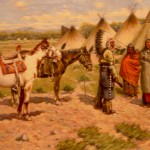
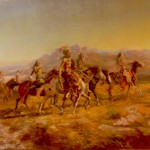
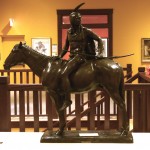
Time marches on, many years have passed since I waited for the Yakima Indians to ride down Craig’s Hill in Ellensburg, WA and begin the opening ceremony for the rodeo. A few weeks ago I met with Mary Mix from the Rockwell Museum of Western Art in Corning, NY. We chatted and one thing she told me that stuck was that the viewer brings just as much to the work of art as the artist. Certainly for me the artwork at the museum portraying Indians on horses evokes personal memories as well as the collective images we all share, spread throughout our culture by mass media, movies, TV, and literature. The Rockwell collection traverses a wide range of Western American subject matter including panoramic landscapes, Indians, cowboys, horses and native wildlife. Additionally, the artwork represents an historical viewpoint fixed in the time period from which each piece was created.

“America has always had a love affair with horses, perhaps resulting from their importance in the development of the country,” said Mary as we walked into the Visions of the West Gallery.

“You don’t often hear how important horses have been to our countries growth,” I replied.

“The horse wasn’t always here. They are not indigenous to the North American continent. The Spanish brought horses with them when they came to the New World,” continued Mary.

In all probability the Indians obtained horses from the New Spain province, New Mexico established by Don Juan de Onate y Salazar, the colonial governor. To set up his colony Onate brought with him thousands of domesticated animals including hundreds of mares and stallions. The Pueblo Indians labored on the Spanish colonist’s ranches, learned to ride and work the horses. When the Pueblo expelled the Spanish from New Mexico in 1680, the tribe captured thousands of horses. Some of the horses the Indians captured were traded to tribes on the Great Plains. Now the stage was set for the horse to became an integral part of the Plains Indian’s way of life.

The horse rapidly replaced the dog as beast of burden enabling the Plains Indians to travel with less toil, transport more possessions, hunt the buffalo with greater ease and fight neighboring tribes from further distances. They became skilled horsemen and the horse began to represent wealth; a valuable possession coveted by tribe members.

Mary stopped in front of a huge painting and said, “The “Buffalo Hunt” by William Leigh exemplifies how the Indian hunted. The painting isn’t entirely accurate as the hunter would not have ridden in the middle of the herd. Instead, the rider circled the herd to prevent being crushed by the buffalo. Before the Indians had horses, they stampeded buffalo herds over a cliff in what has come to be known as the “Buffalo Jump”. At the bottom of the cliff, the women and children cut up the dead buffalo and prepare the meat. More animals died than the Indians could use for food and a lot of meat was wasted. Once the Indians acquired the horse they could use more strategic tactics in the hunt. They primarily hunted the cows as the bulls were bigger and extremely dangerous.”

“That’s interesting. It must have taken an expert rider to hunt buffalo,” I replied.

“The horse also needed to be well trained. In fact, the horse an Indian used for the hunt became his most valued possession. An Indian may have had many horses but the one that was trained to hunt buffalo was his prized horse. They notched the horse’s ear to identify their hunting horse from the rest of the herd. Mustangs, hardy, agile and surefooted, were good horses for the Indians and easy to catch. These wild horses lived on the plains with the buffalo and weren’t afraid of them,” said Mary.

“Mustangs are tough little horses and smart too,” I said.

“They proved to be a good match for the Plains Indian. Another interesting detail in the painting is shown on the far horse in the distance on the right. You can see a symbol painted on the horse’s flank near the tail. The symbol signifies the number of horses the rider owns or how many he has stolen, “said Mary.

“I didn’t know that,” I replied.

“Stealing horses from other tribes became a common practice. The 1700’s was the age of the horse for the Plains Indians. The horse changed Indian culture in many ways, some for the better, making it easier to transport possessions and hunt, but in other ways the horse created tensions, less equality and more warfare between tribes,” said Mary.

“In a sense, the horse represented a new technology for the Indians and with any new technology you can expect change,” I said.

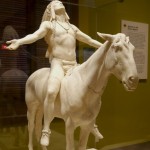
Mary and I walked on through the exhibits and stopped at a sculpture executed by Cyrus Dallin entitled the “Appeal to the Great Spirit”. The sculpture was a large white plaster cast used to create bronze replicas sold by the artist.

Cyrus Dallin was born to pioneers on November 22, 1861 in Springville, Utah. As a youth, he had many friends among the local Ute Indian tribe. His Ute friends showed him how to make sculpted clay animals, which sparked an interest in art. At nineteen he boarded a train on his way to Boston, and met the 1880 Crow Indian delegation on their way to Washington DC to meet with government officials. Dallin became friends with the Crow delegation and the chance meeting made a deep impression on the young man. Dallin never forgot the Indians. As an adult, he used his understanding of the Indians, and their plight to create his artwork. A plaque at the Rockwell Museum contains the following quote explaining his art:

“synthesize in simple and impressive symbols the tragic history & the pathetic destiny of the aborigines of America”.

The “Appeal to the Great Spirit” was the last of a series of four scultptures he created to illustrate this idea.

“Dallin understood the Plains culture. He realized that the stereotypes of Indians as savages were untrue and tried to change the image of Indians through his artwork,” said Mary.

“The history of the Indians is filled with tragedy,” I said.

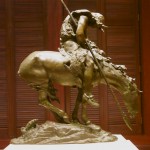
Not far from Dallin’s “Appeal to the Great Spirit” stood a sculpture by James Fraser entitled “End of The Trail” an iconic image of a vanishing race. Fraser’s father, Thomas Fraser, worked for railroad companies in the West that built rail lines into Indian territory. Also, he was part of a group sent out to recover the bodies of the soldiers of the 7th Cavalry Regiment, which General Custer had led to their demise at their famous encounter with the Lakota, Cheyenne and Arapaho during the Battle of the Little Bighorn. His son, James, was born a few months before the historic battle. As he grew up, he saw firsthand how the Indians were pushed further and further west and finally confined to Indian reservations. Mary and I turned our attention to the bronze sculpture he created.

“Today there is a huge resurgence in native languages, traditions and education of tribal culture among the American Indians. Many Native Americans do not like this sculpture because they feel it shows a defeated, subjugated people. The artist meant the sculpture to represent the tragic plight of the Indians,” Mary said.

“It’s interesting how different people see a work of art based on their own personal preconception,” I said.

“Many Indians come through the museum and it’s interesting to speak with them and discover their perspective on the artwork. The museum also hosts selected Indian artists for special exhibits,” said Mary.

“That does sound fascinating,” I said.

“There were hundreds of different tribes across North and South America; however, through stereotypes in the media most people think of Indians as wearing war bonnets and carrying tomahawks. The Indians have long battled to retain their individual cultures and religious beliefs. After the Indian wars, they were pushed onto reservations and many Native American children were forced to attend boarding schools planned to assimilate them into Anglo American culture. Currently, a big issue among Indians is the concept of Blood Quantum,” said Mary.

“I never heard of that,” I replied.

“The Bureau of Indian Affairs requires that for a person to be considered an Indian he or she must be able to prove a percentage of Indian ancestral blood. It has caused a hot debate among the Indians themselves,” said Mary.

“I guess the core question seeks to answer what is an Indian; genetic or cultural,” I replied.

“I suppose time will tell,” said Mary.

I thanked Mary for showing me the works of art at the Rockwell Museum and left with a broader understanding of what the artwork represents. As I walked past the paintings depicting Indians on spirited horses I wondered what the future would hold for the Indian tribes of America.

Note: This is the end of the second blog on the Rockwell Museum of Western Art. Watch for the next blog on the museum: Cowboys at the Rockwell Museum of Western Art. Happy trails to everyone, Pat

Sources:
http://en.wikipedia.org/wiki/Plains_Indians#cite_note-3, http://content.statelib.wa.gov/cdm4/item_viewer.php?CISOROOT=/ellensburg&CISOPTR=291&CISOBOX=1&, http://www.media.utah.edu/UHE/d/DALLIN,CYRUS.html,
http://bronze-gallery.com/sculptors/artist.cfm?sculptorID=65, http://en.wikipedia.org/wiki/James_Earle_Fraser_(sculptor), http://www.allthingscherokee.com/articles_gene_040101.html, http://www.native-languages.org/blood.htm, “The American West”, People, Places, and Ideas by Suzan Campbell

Artwork credits: (from left to right) “The Buffalo Hunt” by Willian Leigh, “The Chief’s Visit” by John Hauser, “Sun River War Party” by Charles Russell, “On the War Path” by Cyrus Dallin, “Appeal to the Great Spirit” by Cyrus Dallin, “End of the Trail” by James Fraser

Posted in Uncategorized | Tagged , , , , , , , , , , , , , , , , | Leave a comment

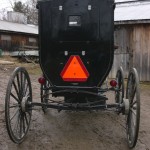
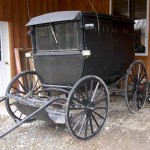
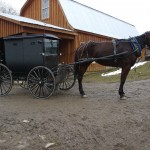
The Amish Carriage

The cold January air dropped a few degrees as soon as the sun headed for the horizon. I brought CJ back to his stall after a short solo ride in the park, took off the saddle and brushed the horse down. The moonless night fell hard across the countryside outside the barn. I looked over at Pepper standing in her stall. She must have rolled earlier on the half-frozen, wet ground in the pasture since a thick layer of dry mud covered her black coat. When I finished with CJ, I stepped into Pepper’s stall and gave her a once over with the curry comb.

The time came to pick up my saddle, pads, brushes and bridle, walk through the barn and stow my equipment in the tack room. Now that the gear was carefully put away and horses brushed down, I switched off the barn light and opened the small side door to leave. An arctic wind hit my face as I tried to adjust to the dark. A single, round light bounced up and down, suspended in mid-air. The lightbeam came closer and closer. Although Connie wasn’t visible, I knew she must be holding a flashlight, heading to the barn for her nightly chores.

“Hi Connie,” I said watching the light draw near.

“Hi Pat,” came Connie’s friendly voice.

“I got your email about the Amish carriage,” I said flipping on the light switch.

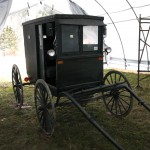
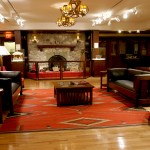
“I emailed everyone. I saw it on Craigslist. Johnn and I went to a farm outside of Wyalusing and bought it. It’s in the new storage shed if you’d like to have a look,” replied Connie stepping into the barn and closing the door.

“I’d love too when it’s lighter out. Who did you buy it from?” I asked.

“A man named John Newhart at Ment2befarms. He’s a horse dealer and dairy farmer near Herrickville not far from LeRaysville. He bought the carriage from another farmer and stored it in his barn.This buggy is a Lancaster style carriage which is different from the style the Amish in LeRaysville use,” replied Connie.

“Lancaster is a couple of hundred miles away. I wonder how the carriage came to Bradford County?” I asked.
“I don’t know. Maybe John could tell you. He said that to get the carriage to his place he arranged for an Amish woman to drive it over. She told him she never wanted to see that carriage again,” replied Connie.

“I guess each Amish group has their own style of carriage,” I said pausing and then continued, “Donna must be excited.”

“As soon as I bought the carriage I called her. She is excited. When spring comes we’ll hitch Sam up and take the buggy for a ride,” said Connie.

A few days later, I phoned John Newhart and asked if he knew where the Lancaster carriage had come from. He didn’t know but the man he bought the carriage from might have an idea. John told me that he knew an Amish man who was building two carriages and if I wanted to come down to see the buggies, I could. Of course I said yes and arranged to meet John the following Wednesday.

The morning light peeked in my window seeping through the cloud covered sky. I dressed, gathered my writing pad, pencil, and camera, stuffing everything into a canvas bag, hurried breakfast and left for Herrickville. The car rolled along Route 220 to the stoplight just north of Ulster where I turned onto Bridge Road, crossed the Susquehanna and headed into unknown territory. The narrow ill-marked road turned and twisted up and over rolling hills through dairy farms, wooded hilltops and creek beds. I made a wrong turn at North Rome and found myself at the Litchfield Volunteer Fire Station where a man gave me directions putting me back on the right road. Finally, I came to the CC Allis lumber yard where I stopped a second time to ask another man for directions to the Newhart farm. He pointed up the road a few yards.

“You’re almost there. Turn at the intersection, go up that dirt road, turn right at the cemetery and you’ll head down a very steep road to the Newhart farm,” he said.

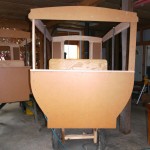
I turned up the dirt road. The man had said the street would become steep, but I could not believe how steep, almost straight down, and sure enough there was a huge dairy barn on the left and a house on the right. I pulled into the driveway as three barking dogs greeted me, and met John and his wife Allison. It wasn’t long before I climbed back in my car and followed John’s huge dump truck up the steep hill. A very short trip took us to an Amish sawmill. We were greeted by a good-natured Amish gentleman. The man showed us his workshop where he was constructing two carriages.

“Is it ok to take pictures of the carriages,” I asked.

“Sure,” replied the Amish craftsman.

“Just don’t get him in the picture,” John said smiling.

“No problem,” I said and began taking pictures. “I understand that each Amish community has their own style of carriage. Is there a problem with using a Lancaster carriage here in LeRaysville?”

“No not really, there have been Lancaster carriages here. If someone moves from Lancaster they’ll come here with their carriage and might keep it and use it for awhile,” he replied.

“How many carriages have you built?” I asked.

“These are the first two. My brother built a few carriages though,” he replied.

“How long will it take you?” asked John.

“That depends.. it might take me awhile since I’m working on them in my spare time, but someone working regular hours would take about 3 to 4 weeks,” he replied.

“You can see that the front is rounder than the one I sold Connie,” said John pointing to the front of the carriage under construction.

“I see. When Connie explained it was more rounded I visualized the carriage being bowed out in front. Now I see what she was talking about,” I replied.

“You’re carriages don’t have a canvas back that snaps off?” John asked the Amish craftsman.

“No, we’d rather have a door that opens in the back. It makes it easier getting in and out without having to work all those snaps,” replied the Amish craftsman.

“The back of Connie’s carriage snaps off?” I asked.

“Yes, the one I sold Connie has snaps,” replied John.

“How far along are you in the building of the carriages?” I asked.

“Oh, not quiet half way I’d say. I still have the sides to finish, the doors, and windows and paint it,” replied the Amish craftsman.

“This is how the sides of the doors are made,” said John walking over to a large wood vise. The claps held identical strips of wood about 1 inch in diameter and bent at the ends.

“That’s amazing! How do you get the wood to bend like that,” I asked.

“I use steam and wet the end where I want the wood to bend then clamp the wood in the vise for a few days,” replied the craftsman.

“You have such a well equipped workshop. How do you run the saws and planer without electricity?” I asked.

“I have a diesel engine which is hooked to a shaft under the floor that runs the tools. The shaft spins and turns belts on a pulley system attached to the equipment,” he replied pointing to a metal shaft exposed and built into the floor near a bandsaw.

“Connie’s carriage has a pedal on the floor which I assume is a brake,” I said.

“Yes, that’s the brake. The one Connie has is hydraulic. You have to add fluid for it to work,” said John.

“Mine isn’t hydraulic. It works on a cable system,” replied the Amish craftsman.

“So you have taillights and headlights on the carriage. How long does your battery last?” asked John.

“About 8 to 10 hours. I only put the battery in the buggy if I’m going to be out after dark, that way I don’t have to recharge the battery so often,” the craftsman replied.

“And what about the wheels, are you going to make the wheels too?” I inquired.

“No, I bought them from a buggy shop near Vicksburg. I just have to put them together,” he said.

“And the carriage has a window and windshield wiper too. Does that run off the battery?” asked John.

“No, the windshield wiper is hand powered,” he replied.

Quickly, the conversation shifted from the carriage to horses. “You want to buy my horse John? He’s 15 years old and getting too old for the carriage,” the Amish gentleman said lightheartedly.

“I’ll give you $10 for him,” said John laughing.

“How long can you use a horse to pull a carriage?” I asked.

“Well, I’d say 3 to 10 year olds are the best, no more than 15. It’s just too hard on the horse when they get up in age,” he replied.

“Show her the type of horseshoe you use in winter,” said John smiling.

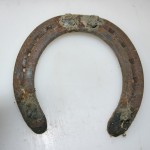
The Amish gentleman picked up a horseshoe from many resting on a shelf and placed it on the table. The shoe had a rough, rounded bit of metal attached to four places on the shoe at the toe and heel.

“We use these most of the year,” he replied. “The shoe grips the road better so the horse doesn’t slip.”

Suddenly an Amish buggy stopped in front of the workshop. We walked outside and met the craftsman’s teenage son. The young man cordially sat in the carriage while I took pictures of his horse and buggy. His carriage had only one seat, akin to a sports car, and in contrast to the family three seat carriage. He made short work of unhitching the harness and took the horse into the barn.

I thanked John and his friend for letting me see the carriages, returned to my car and drove towards home. This time I knew where I was going and which way to turn. The beauty of the quiet Pennsylvania countryside with rolling hills cut by streams sped by until I reached Bridge Street and crossed the Susquehanna at Ulster turning towards Athens on route 220. I drove past the Honda dealership in Milan, and the Dandy Mini Market where people pumped gasoline into their cars. Continuing on, I came to sidewalks and cross streets all the elements of the grid, and although I’ve lived in the “Valley” for many years, I suddenly realized there was an entire world I had never encountered only a few miles from home. I thought how strange it was that minutes away lies a peaceful, quieter existence where horses traverse the road pulling handcrafted carriages.

Posted in Uncategorized | Tagged , , , | Leave a comment

Rockwell Museum of Western Art, Corning NY

I grew up in the Pacific Northwest near the foothills of the Cascade Mountains which stretched to the East and towering Mt. Rainer to the South. The community was destined to become the bedroom for the bustling seaport city, Seattle. Amid that backdrop, like every other kid, I was glued to the couch taking in the drama of the TV Western; watching cowboys and Indians. The bad guys fell to the Lone Ranger and Tonto, Sheriff Matt Dillon kept the streets safe in Dodge City while Ben Cartwright and his three sons worked hard on the Ponderosa; all in the comfort of my living room.

Since I had a pinto pony and several neighborhood girls had ponies too, it was only natural for us to play cowboys and Indians on horseback. Unfortunately, nobody wanted to be cowboys, we all tried to ride like the Indians. My neighbor Karen a few years older than me trained her horse, Ky, to rear like the Lone Ranger’s Silver and rode without a bridle or saddle. We all rode bareback. Once I tried leaving the bridle at home. I took a rope, made a slip knot, tied a few chicken feathers I found near the hen house to the end of the rope near the makeshift bit, then slid the end of the rope through my pony’s mouth and rode off into the woods.

Years passed, I grew up, married and relocated to the East coast. When my husband and I moved to the Southern Tier of NY state we heard that there was a fine collection of art at the Rockwell Museum in Corning. Incurable “museum hounds” made it inevitable that we would visit the museum.

“Norman Rockwell?” I asked my husband.

“I don’t know. Why don’t we visit the museum and see,” replied Moe.

We drove up to Corning, enjoyed Market Street and stepped into the Rockwell Museum. I was thrilled to see some of my favorite artists displayed; Remington, Russell, Moran, Wyeth, Bierstadt, and Leigh to name just a few. Not obscure paintings but skillfully executed masterpieces. The Western theme brought back personal memories as well as thoughts of frontier American history; its adventure, beauty, drama and tragedy. And of course so many of the paintings contained horses; Indian horses and cowboy horses, the noble horse working in partnership with people.

It’s curious how a museum dedicated to the western experience would be located in such an unlikely local as Corning, NY. After all what connection does Corning have with cowboys, Indians, and the Rocky Mountains? Perhaps the most direct answer to that question is Bob Rockwell.

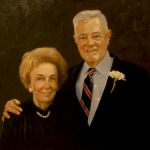
Bob Rockwell, Jr. grew up on his parent’s ranch in Gunnison County Colorado near the small town of Paonia at the foot of Mount Lamborn and the Grand Mesa. The 5,500 acre working cattle ranch consisted of hundreds of steers, 30 horses, a few Texas longhorns, 5 buildings to house the cowboys and their families and the Rockwell family home. Young Bob was immersed in the western frontier experience, rode horses, met cowboys and collected insects, animal skeletons and arrowheads. After high school in Paonia, he left Colorado; first attending Whittier College then transferring to Stanford University. Upon graduation in 1933, he moved to Corning, NY to help his grandfather run the Rockwell Co. department stores returning for summer visits to the family ranch.

The Rockwell Co. department store in Corning kept young Bob Rockwell busy. At the store, he met the charming Hertha Godley who worked as an accountant and they married in 1941. Then suddenly and without warning on Dec. 7, 1941, the US became enmeshed in war when Japanese aircraft dropped bombs on the naval base at Pearl Harbor. The next year, sweeping world events overtook the young man, and he found himself in North Africa with the Seabee’s, 70th Naval Construction Battalion. When the war ended Bob returned to the department store and settled back into civilian life on Market Street.

A passion for collecting and the friendship of Frederick Carder, manager/designer for the Steuben Glass Works in Corning, encouraged Bob to purchase and amass a large art collection of colored Steuben glass. Then in the early 60’s, he met an Elmira art dealer selling a painting by the famous Western artist, Fredrick Remington. He purchased the work of art, and then Bob took it to be authenticated by Harold McCracken, a renowned author, historian and Western art authority. McCracken informed Bob that the painting was a fake. Undaunted, and with McCracken’s help and connections to New York City art galleries; Bob purchased four authentic Remington’s which began the Rockwell collection of Western art.

For many years, the collection hung on the walls of the Rockwell Department store. Every year the collection grew bigger, until Bob and Hertha Rockwell decided to create an art gallery and museum on the second floor of the Baron Von Steuben Hotel. Then suddenly, a natural disaster changed everything. Two storm systems, Hurricane Agnes and a rainstorm from Ohio, headed for the Southern Tier of New York State reshaping downtown Corning overnight. When the two systems met on June 22, 1972 eight inches of rain fell into the Chemung River basin, the dam system failed and water overflowed the river’s banks. Downtown Corning flooded, badly damaging properties including Corning’s City Hall and Fire Station.

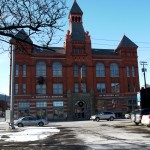
The City Hall building constructed in 1893 suffered extensive damage and was slated for demolition. To save the historic structure, Corning Glass Works purchased the building for $1 and undertook an extensive reconstruction project. Finally in June of 1982, with renovations completed and the interior transformed into gallery space; the Rockwell Museum of Western Art found a new home.

Last week I visited the Rockwell Museum and met Mary Mix, Senior Museum Educator. She graciously gave me a tour of a small portion of the museum’s collection. We walked into the Visions of the West Gallery on the 3rd floor, looked at the huge Leigh painting “The Buffalo Hunt”, the historic George Catlin painting “Breaking the Wild Horse”, and many other remarkable works of art. All the while, Mary pointed out interesting facts about each painting, how the work of art related to Western American history and Native American traditions. We talked about the importance of art to community, how painters interpret a subject, Indian culture and the Pony Express.

“Do you conduct school tours at the museum?” I asked.

“Yes, annually 5,000 students come to learn about the museum from 20 school districts across New York State and Pennsylvania. The museum runs a program for kindergarten, second and fourth graders. Each grade focuses on a different topic.” replied Mary.

“It’s wonderful that kids have the opportunity to learn about art,” I said.

“We also have free activities for kids and teens to make the museum experience an exciting learning experience,” said Mary handing me a booklet entitled Horse Art Pack. “In addition to the Art Packs, the museum offers an Explore the West Activity Booklet, an Art Hunt and Travel Journal.”

“That’s a great way to get kids excited about art and history,” I said pausing for a moment. “Whenever I come here I am always reminded of my own past and feel that I’m in a truly special place.”

“It’s interesting you say that. The Rockwell Museum is a very unique place and the people who visit bring with them their own connection to the American West. After all, art is 50% input from the artist and 50% input from the viewer. Not all people will see a work of art in the same way or even in the way the artist intended,” replied Mary.

“So true,” I replied.

The time came to leave. As I walked through the galleries, I had the eerie feeling of walking through time. The rugged landscapes of the west portrayed through sculpture, pottery, and oil paintings quietly rested on walls or in their cases. Everywhere I looked the horse was depicted; strong, powerful, graceful and enduring. I could almost smell the clear Rocky Mountain air and hear the galloping hoofs of Indian horses hunting buffalo. So next time you’re in Corning stop by the museum and enjoy the experience. Happy Trails to everyone and special thanks to Mary Mix.

Note: In coming weeks look for 2 more blogs on the Rockwell Museum of Western Art; one on Indians and Horses, the second on Cowboys and Horses.

Sources: http://www.cmog.org/dynamic.aspx?id=196#.TxX5729tpyI, http://www.rockwellmuseum.org/Robert-F-Rockwell-Jr-Biography.html, http://corningnyrotary.org/Bob_Rockwell_Biography_w_pics.pdf, http://www.crookedlakereview.com/newsocietygenesee/visits/1197rockwell.html, http://en.wikipedia.org/wiki/Harold_McCracken,
The American West – People, Places and Ideas, Western Edge Press, Santa Fe, NM 2001

Paintings from top left to right: “Hertha and Bob Rockwell, Jr.” painted by Thomas S. Buechner, Sculpture “On the Warpath” by Cyrus Dallin and painting “The Buffalo Hunt” by William R. Leigh, sculpture by Deborah Butterfield, “Untitled” and painting “In the Bighorn Country” by Carl Rungius,

Posted in Uncategorized | Tagged , , , , , , , , | Leave a comment

CJ Treks Alone

Why would a horse, a fairly intelligent animal, want to carry a person around to places consider dangerous in his eyes? Probably not, however, after some persuasion that is just what horses do for us. If you think about it that is pretty amazing. Some big time horse trainers teach a horse to carry a rider in a day. I’m not a horse trainer, but I have worked with several green broke horses. The one thing I have learned is; don’t push the horse beyond his capability. He’ll get there – it just takes time, time in the saddle and time on the trail.

CJ started his “basic training” with Anne Shaffer in the spring of 2007. He learned about saddles, bridles, and how to carry the first rider ever on his back. Then he had a long rest of about 2 years in the pasture, nobody wanted to ride him so he waited. I came along in February of 2010 in the middle of the winter, gathered him up, put the saddle on him, took him back to the round pen and began anew. There were bumps in the road, and when problems arose I asked more experienced people for advice. CJ progressed through the hard spots and we rode on.

The one overarching characteristic CJ possessed was his great curiosity. When I first started riding him in the round pen and arena, he seemed to enjoy going out of the pasture. Perhaps boredom sparked his curiosity or he just wanted to eat the grass on the other side of the fence. Gradually, I went from riding him in the round pen, to riding around the arena, to joining my friends and the other horses on trail rides through the park. CJ dutifully walked behind Pepper, Sam, Jupiter, Shadow or Socks especially when something made him nervous. Occasionally, he became brave and pulled ahead of the other horse leading the way.
Once or twice last winter, I tried riding CJ alone. He walked slowly, head held high apprehensive, mystified and questioning everything he saw. The countryside appeared new to him, he felt alone and unsure. Since his birth CJ’s entire universe encompassed the pasture and barn. Suddenly, a new world opened up for the horse. He doubted and hesitated; the horse froze in the road like a living statue, taking it all in. Perhaps if he stood motionless the boogieman wouldn’t eat him. Nevertheless, I really needed him to move forward. Sitting on a horse in the road wasn’t my idea of a ride in the park, so I gently urged him onward. Again, he stopped, and then slowly walked on only to halt several yards down the road. CJ just wasn’t ready to travel without the other horses; so I stopped riding him alone. Someday he would show me he was ready.

This summer riding with other horses, CJ gradually developed more and more confident. When Emma and I came to the stables on afternoons, opened the barn door and called for the horses, CJ came running through the pasture with Pepper following. All we had to do was open the entranceway and the two horses walked in and found their stalls. Now when we rode, CJ pulled ahead of Pepper boldly taking the lead, not stopping, hesitating or pulling back behind her as he had done a few months before. I watched him in the pasture a few weeks ago as he stood grazing by himself. CJ had gained a new self-assurance and independence he didn’t have before.

The time had come to try riding CJ alone. Winter provides a good backdrop for new steps in training. The horse seems calmer, people hide indoors, no four wheelers screech through the woods and down the road. The hunters have put up their guns. Few people are going places. The park is dead quiet, the bears are sleeping, even the deer have disappeared, the turkey vultures have gone off somewhere and not a living thing stirs. There are no leaves rustling through branches blocking the view. The woods are naked, open and everything easily seen. The quiet and peaceful afternoon blends softly into night.

The only thing I had to worry about was the school bus. The school bus came around 4:00 like a behemoth juggernaut, rolling down the dirt roads leaving only a narrow space for horse and rider to pass. I planned my outing between 3:30 and 5. Luckily, I didn’t have to watch out for the bus because the kids were on Christmas vacation.

So CJ and I were ready. I called for the horse at 3:30, brushed him down, saddled up, stepped outside, and mounted. CJ walked briskly away from the barn not wavering or giving a backward glance. Up the road we trotted, around the bend and toward the park. The sun made its descent toward the mountain tops, but we had time before total darkness fell.

December’s weather, unusually mild served up many days in the low 40’s, yet the inevitable happened by 5:00; night fell hard and thick as molasses. A soft yellowish-gray haze emanated from the sky above as the mellifluous echo of the horse’s hooves tapped on the soft dirt. The road led to a trail which CJ easily turned onto as we climbed the steep rocky path. I took a shortcut through the open woods where the route became deep with mud and water, then the horse twisted through the winding bridle path and we popped out of the forest near the pond. The winter sun nipped the mountain tops as CJ and I circled back toward the barn; night approached. The horse settled into his stall, darkness fell outside, and the light in the barn felt comforting.

A few days later I rode CJ again, traveling in the opposite direction toward the Slocum place. The Slocum horses stood alert watching our progress near their pasture, and then suddenly took off, a herd running with tails held high. The street led through a small wood, and a little way further intersected with Bobcat Road. The horse walked up the park entrance, not too far just to the front gate. CJ didn’t freeze or stop. He knew the place, he’d been there before. Night threatened to come early so we turned and walked back to the barn, hay, warmth and home. It all seemed so easy, so natural now that the horse was ready to ride alone.

Posted in Uncategorized | Tagged , , , , | Leave a comment

The Unadilla Livestock Auction

The November day radiated the late warmth of Indian summer. Anne Shaffer and I chatted over a cup of coffee. Several years ago, she attempted to find information on Shadow’s pedigree and former owner. When she bought the young horse the dealer said Shadow was a Thoroughbred, but Anne never received papers.

“It’s amazing how you tracked down Pepper’s history”. Do you think you could find out something about Shadow’s former owner?” asked Anne. “I called the auction house after I purchased Shadow, but they wouldn’t give me any information.”

“I’ll try,” I replied.

The Jockey Club controls registry for Thoroughbreds, so I called their number for help. I reached an answering machine and left my number. A short time later, Andrew from the Jockey Club returned my call.

“I’m trying to help a friend find information about her horse which she bought at an auction several years ago. Are there DNA tests which can determine breed?” I asked.

“The DNA information we have is given to us by the owners for registration. The breeder sends in a few strains of mane hair taken from the foal. We compare the DNA taken from the mane hair with the DNA information we have on file for the sire and dam,” replied Andrew.

“Then there isn’t a test to determine pedigree?” I asked.

“There is no way to determine the horse’s breed without knowing the horse’s sire or dam. If you get that information, then we can compare the horse’s DNA with our DNA databank. Usually at Thoroughbred auctions the sellers are required to convey papers,” Andrew said.

“The horse was sold at a livestock auction in a rural village in New York State,” I replied.

“Your best bet would be to contact the auction house and see if you can get information from the former owner. If you can find out the dam or sire then we would have something to work with,” Andrew replied.

“Okay, thanks,” I replied hanging up the phone.

James Cain purchased Shadow in Unadilla, NY at the D.R. Chambers & Sons Cattle & Horse Auction. I looked up their number and called. The phone rang a few times and a young woman answered.

“I’m trying to get information on a horse that was sold at your auction house. Is it possible to get the name of the former owner,” I asked.

“It is not our policy to release the names of sellers. They might not like having a buyer hassle them with questions,” the woman replied quickly.

“The horse was sold as a Thoroughbred but doesn’t have papers,” I replied.

“All registration papers would have been given to the buyer at the sale with the vet record of shots. How long ago did she buy the horse?” the woman asked.

“About ten years ago,” I answered.

“She sure waited a long time to try and find out,” the woman said harshly.

“She called after the horse was purchased but basically was told what you just told me,” I replied.

“Surprise, surprise – the answer is still the same,” said the woman in a snide voice.

“Well, you never know..things do change,” I replied.

“Not here,” said the woman.

Basically, I came up with nothing; a total dead-end. Without the names of Shadow’s sire or dam or a tattoo there was no way to trace the ancestry of the horse. I researched the D.R. Chambers & Sons Cattle & Horse Auction and found that a horse and tack auction was scheduled in a few days. On the day of the auction, Emma and I drove up to Unadilla, NY and pulled into the auction’s parking lot.

We sat through the tack auction and then walked through the barn to have a look at some of the horses which had arrived for the sale. Several horses were saddled and stood tied to a railing. A large man rode one of the horses back and forth inside the barn, bending over his saddle to avoid hitting the low beams. We walked on to a long open pen filled with horses, stopping to pet a cute roan Shetland/mix pony. As we left, a group of Amish boys following a beautiful black, bald faced gelding hurried by us, turned a corner and disappeared into the huge barn.

The horse auction wouldn’t start for several hours, so we left and looked for a restaurant to get a bite to eat. When we returned the parking lot was packed with long 24 foot livestock trailers, horse trailers, pick-up trucks and cars. Finding a place to park was difficult; I navigated through ruts and pot holes and found a spot near a line of trailers at the back gate. A group of people stood in a field adjacent the auction house watching a rider try out a chestnut colored Quarter horse. Florescent light shone from inside the auction house, flooding the dark outside with a soft glow. People lingered just outside the entrance, talking, smoking and blocking the doorway. The auctioneer’s voice drifted on the night air creating a carnival ambiance to the place.
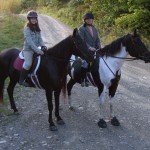
Inside the building a crowd filled bleachers made of wide, wooden planks. We climbed to the top bench and sat down; definitely not a good view. Two doors, an entrance and exit, were situated on opposite sides of the auctioneer’s window. The auctioneer leaned over his microphone trying to sell a horse walking back and forth in a long, narrow corral. Sellers and buyers stood inside the pen watching the horse walk, trot and canter. Quickly, the auctioneer called out numbers, lowering his price until the horse sold. The rider left by the exit door bending over the horse’s neck to avoid hitting his head on the door frame as the next horse came in quickly. The door swung open, and we had a brief glimpse of a long line of horses inside the barn waiting their turn to enter the corral.
A Quarter horse, branded with the letters OK in the middle of a circle, walked into the pen ridden by one of the auction workers. “This is a fine western horse. He neck reins, drives cattle, you name it he does it,” said the auctioneer, his voice filling the room. “He’s 15 years old and has papers.”

The bidding ended. “$375, do I hear $400? No, okay sold, next horse,” said the auctioneer.

“I can’t believe you people!” shouted a man inside the corral leaning up against the railing. “I just came from an auction out west and a horse like that would easily go for $2000. And I’m not the seller here.”

A large, dapple grey horse entered with a young woman riding him. “This is a German horse and trained, trained, trained,” said the woman on the horse. She stopped and quickly stood up on the horses back. The animal remained motionless. “See this horse is great!” she concluded.

“How old,” asked the auctioneer pointing to a worker in the small ring.

The worker opened the horse’s mouth, looked in and said, “17 years.”

Finally, the bidding began; ending at $75 dollars and the huge German horse exited the corral. New horses came through quickly, the bidding started and within a few minutes ended. The Amish bald-faced gelding we had seen earlier came in with the farmer riding the horse bareback. A parade of horses came through the swinging door; Standardbreds off the track, ponies, half starved horses, Quarter horses from ranches out west, horses dislocated because of the flood, even a donkey. They all came in and out; none selling for more than $375 most selling for $50 to $75, some sold for $5.00 and a few never sold. The auction house filled with chatter and the occasional comment from a horse dealer as people enjoyed food from the snack bar.

A couple walked in with a pair of mini-horses in harness. They drove the horses up and down the corral.

“Are you selling them individually or as a pair?” asked the auctioneer.

“I want them to stay together not be sold individually. They are yearlings and have been trained to drive but haven’t been hitched to a cart yet, “ replied the woman.

The bidding started and the minis sold. The next horse came in starved, the rib-cage jutted out exposing the clear outline of bones, the backbone protruded, covered only by skin and hair. The bidding never started; no one wanted the horse.

“How about $5.00? Anyone want a project?” asked the auctioneer. “No? Okay get that horse out of here.”

The small roan pony we petted earlier in the day walked into the pen led by a young woman who worked for the auction house.

“Why don’t you try riding that pony,” taunted another worker standing next to her.

“Okay,” she said letting the man give her a leg up on the pony.

As soon as she sat down, the pony began to buck and spin. The young woman was tossed off, landing on her feet at a run, dodging the flying hooves. The bidding went down from there, but someone bought the pony and the young woman led him out of the ring.

We left the auction before it ended; there were miles to drive home and the hour was late. I came away understanding why Shadow’s former owners would probably never be located. Dealers bring horses to the auction house from all over the country, few records are kept if any and horses may pass through several dealers. Where a horse ends up after the auction is unclear. Some horses are sold directly to people who will give them a home. Many dealers sell the horses they buy to private individuals. The horses a dealer can’t sell are trucked back to the auction house and new horses bought. A few people speculate that some of the horses will end up at slaughter houses in Canada. Where did Shadow come from and who are his sire and dam? He may have come from just about anywhere in the country. Somehow, Shadow ended up at the auction house in Unadilla, NY, a horse dealer named James Cain bought him and sold the horse to Anne. Unless Shadow learns to speak English that is probably all we will ever know.

Posted in Uncategorized | Tagged , , , , , | 2 Comments