Desensitizing Horse to Blanket with TTouch

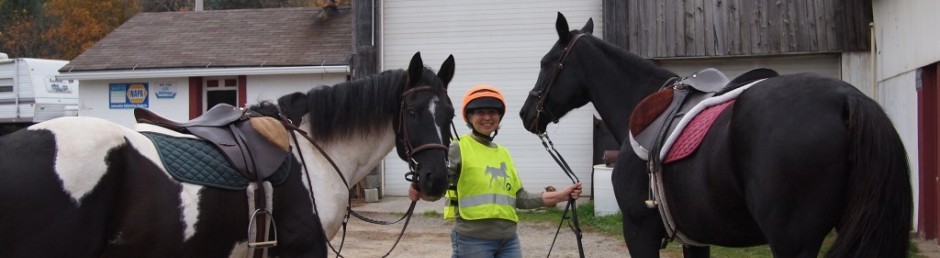
The stable was quiet in the early morning. The weather had been rainy and cold. I found Johnn in his office or doing chores. Since there wasn’t anyone to ride with, I decided to work on CJ and Pepper’s behavior. The task was improving their ground manners during grooming and tacking up.

Usually when I was getting ready to ride with someone else, I hurried. If the horse had an attitude while tacking up, I often ignored it and moved quickly through the task. After all, someone waited to ride with me and I didn’t want to hold that person up. The same with the mounting block, I often just swung onto and rode off. After awhile the horse anticipated this and everything became a routine; including the bad habits of not wanting to pick up hooves, ears pinned and tail swishing while saddling and moving off as soon as my foot hit the stirrup. These little bad habits were annoying and potentially dangerous.

I agreed with the philosophy that whenever you rode or handled a horse you trained the horse. Horses are very smart and fall into repetitive patterns of behavior. Once you have established a routine it takes some time to establish another. CJ and Pepper never liked having the blanket put on their back. Both horses pinned their ears, exhibited a lot of tail swishing and sometimes even attempted to bite you. Once the blanket was up, better not move it around or try to straighten it. If you did, they would become hostile. So my first task was to desensitize the horses to the blanket.

By far, Pepper was better than CJ at tacking up. If you were fast and didn’t pay attention to the horse when putting the blanket and saddle on you probably wouldn’t notice that she didn’t like it. CJ’s training on the other hand was a work in progress.

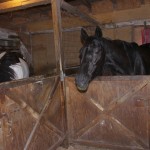
In the early morning, Pepper stood tied to a hitch in her stall. I draped a Navajo western saddle blanket, 32” by 64”, on her neck, and then I ran my hand under the blanket and whispered to her “Good girl.” At one point, Pepper pinned her ears and gave me a nasty look. I reacted by softly taking hold of her halter and said, “Stop it.” I continued, taking the blanket off her neck and placing it on her back and then on her hindquarters. I repeated everything on the other side of the horse paying close attention to her attitude. Any pinned ears, tail swishing, or movement towards me I reprimanded with a gentle tug on the halter and a stern “Stop it.” I folded the blanket down the middle, placed it on Pepper’s back, straightened it and ran my hand under the blanket. I stood next to her and shook the blanket. After a few days, Pepper didn’t mind the blanket or the saddle. I unhitched Pepper allowing her more freedom and did the same blanket exercise with her. She still didn’t mind the blanket.

I executed the same routine with CJ. He improved too, but much slower and needed a lot more work. As I worked with the horses, I realized that they both had several “touchy” areas. Perhaps the horses were ticklish or just sensitive. How was I to get CJ and Pepper to allow me to run my hand across those ticklish areas? On-line I stumbled across an article on the TTouch method designed to relax the horse. I decided to give it a try.

The TTouch method was developed in the 1970’s by Linda Tellington-Jones as a way to communicate, train and heal horses. The massage technique used the tips of the fingers and side of the hand with the thumb placed about 2 to 3 inches from the forefinger. The hand was slightly cupped. The horse was massaged using a circular motion usually clockwise; however, I found counterclockwise worked too. Either work in parallel lines or randomly. There are several levels of pressure which you can apply. I watched Pepper and CJ’s reaction to see what worked best.

The TTouch massage worked well; however, Pepper didn’t want me to massage an area on her belly between the elbow and the flank not far from the girth. I tried simply running my hand lightly and quickly across this area before she had time to negatively react to the movement. I spoke in a whisper with a soothing voice. Gradually, she allowed my hand to stay longer, and eventually, I was able to use TTouch. As for CJ, he had major issues with being touched. He didn’t like the slightest pressure on his belly, girth, flank, croup, breast or back near the withers. I stopped using a stiff brush, and used only my hand in the ticklish areas. CJ improved too but he needed much more time and work before he would get to Pepper’s level of acceptance.

After I brushed the horses and used TTouch, I braided the horse’s mane. To my surprise, CJ and Pepper loved having their manes braided. They lowered their head’s; half closed their eyes and totally relaxed. There are many fancy ways to braid a horse’s mane. I picked the style which I used for braiding my own hair when I was a kid. As well as relaxing the horse, the braided mane helps to keep the animal cooler in hot weather.

Each morning, by the time I left the barn, the sun had risen into the late morning sky. I drove away, winding down Murray Creek Road towards 220. At the Dandy Mini Market, I turned left and headed home. The next morning, I’d be up early again to repeat the same routine until saddling Pepper and CJ was a leisurely activity rather than an ordeal.

Sources: http://www.ttouch.com/howtodoTTouch.shtml; http://www.canberraequinehospital.com.au/Blog/tabid/160/EntryId/71/Are-horses-ticklish.aspx; http://horses.about.com/od/commonproblems/a/dislikegrooming.htm; http://animals.pawnation.com/different-ways-horses-mane-tail-4735.html

Copyright © 2013 Patricia Miran All Rights Reserved
Posted in Uncategorized | Tagged , , | Comments Off on Desensitizing Horse to Blanket with TTouch

Barefoot Horses – Soft Soles and Dry Hooves

The stables have been quiet for the last few weeks. Karen stopped leasing Jupiter, Donna moved her horse, Socks, to another stables, Anne sent her horse, Shadow, for training, Emma left for an internship in Kentucky and I found myself without any riding buddies. To compound the feeling of melancholy, the weather for May has been cold, with a few nights dipping down to the 30’s and even dropping into the 20’s. Although, it has been cool, the countryside bloomed. The blossoms lasted longer than usual, the flowers more profuse and the colors dazzled the eye. The migratory birds returned; blue birds, redwing blackbirds, and gold finches fluttered among the branches adding music to the landscape.

Every morning I was up early and headed for the stables to work on CJ and Pepper’s hooves. Dean Krissler told me that the horse’s hooves were soft due to weather conditions and pasture mud. It seems that every spring it is the same old story: soft and dried out hooves. It was time to toughen them up again for riding. A couple of years ago, Gene Fletcher told me how to toughen a barefoot horse’s hooves. I followed his directions by using bleach diluted with water (50/50) and then applying Venice Turpentine to the horse’s sole avoiding the frog, making sure to clean the sole of bacteria and dirt. Not only did it harden the hoof it also eliminated Thrush.

For the outside of the hoof, I tried applying used motor oil in-between applications of a hoof sealant. However, after reading that used motor oil contained carcinogenic, toxic metals such as benzene, lead, arsenic, zinc and cadmium, I chose to go back to using Shur Hoof also recommended by Gene Fletcher. I decided to use rubber gloves just in case any of the ingredients in the hoof applications might be harmful to my health.

I’m not the fastest at applying this treatment. It took me about two hours to clean and treat the hooves, brush down the horses and then saddle up. One morning, much like all the other mornings, I tacked up Pepper and headed for the park. It was Turkey season in Pennsylvania so I made sure I had on a florescent orange vest. The Pennsylvania Game Commission advised people entering the woods during Turkey season to dress safe: Never wear red, white, blue or black clothing as these are the colors found on mature gobblers.

The park was very quiet except for singing song birds, keenly focused on mating and nest building. I headed into the woods, following a short trail which climbed a steep ravine. At one point I stopped Pepper; a large branch knocked down by a recent storm blocked our way. Carefully, we made our own path through the pine forest, weaving through trees and underbrush until we came to the trail on the other side of the fallen branch. The trees filtered the morning light. The trail, dimly lit, was a rich brown as it zigzagged through the trees, twisting and turning out of sight.

We turned a bend in the trail and Pepper slowed down, almost tiptoeing forward until she came to a complete stop. She stretched out her neck, pricked her ears forward and stared at two dark metal objects stuck in the dirt alongside the trail. The objects were round and very flat, suspended on long metal legs with tiny heads attached to thin floppy metal necks.

‘What the heck are they?’ I asked myself.

Pepper turned her head away from the metal decoys and stared across the trail at a huge evergreen tree shrouded in shadow. She refused to move, but stared and then suddenly snorted. At first I didn’t see anything, and then out of the shadow came the shape of a man. He sat motionless, dressed in camouflage, even his headgear blended seamlessly into the woodlands. Only his forehead, eyes and mouth were visible. He kneeled immobile as if in deep meditation while his powerful rifle neatly rested against the massive tree trunk.

Feeling like an intruder who had stupidly stumbled into a hunter’s trap, I whispered, “I didn’t realize you were here …sorry.”

“That’s ok,” he whispered back.

Pepper quietly walked by the decoys and down the path. Finally, the trail exited the woods near the pond. Sunlight reflected off the cool blue waters of the fishpond and mating birds sang louder than ever as we headed through the park on the gravel road towards home. As Pepper walked in the bright sunlight I thought, ‘I wonder if its going to rain tomorrow?’

Sources: http://www.deq.state.ms.us/MDEQ.nsf/page/Recycling_UsedMotorOil?OpenDocument; http://www.farrierfletcher.com/home_page_DIO3.html; http://www.prnewswire.com/news-releases/pennsylvanias-fall-turkey-season-includes-mentored-youth-176834931.html

Copyright © 2013 Patricia Miran All Rights Reserved
Posted in Uncategorized | Tagged , , , , , | Comments Off on Barefoot Horses – Soft Soles and Dry Hooves

Dean Krissler – Farrier at Ballentine’s Horse Heaven

There are several farriers who come to Ballentine’s Horse Heaven. Gene Fletcher for several years was a regular. He trimmed Pepper, CJ, Jupiter, Sam and Myrtle. Unfortunately, Gene retired due to health reasons. A career as a farrier can be short or long but it is always dangerous. A farrier works on many different types of horses, some better trained than others to pick up their feet. Danger is always close at hand from a horse that easily spooks to one that kicks or bites. The farrier can be knocked over, stepped on, struck by the horse’s hoof, bite on back, neck or head; all resulting in serious injury. Besides the risk of being physically knocked over and walked on, the farrier spends long hours bent over which puts a strain on his spinal cord and joints. Truly being a farrier is not a career for the faint of heart.

Gene recommended Dean Krissler as a replacement, so Connie called him up and scheduled an appointment. Before long Dean was a regular at the stables.

Dean studied to be a farrier with John Jaros at the New England School of Horseshoeing at Tufts University, and completed the program in 1996. Then, he apprenticed to another farrier; shoeing hunt, dressage and show horses for ten years where he lived near Hyde Park and Millbrook, NY. About four years ago, he moved to a ranch a few miles from the Ballentine’s, and for the last two years has been building his farrier business.

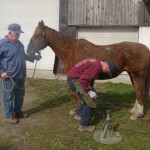
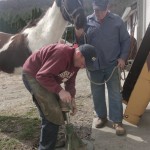
In the early morning a couple of weeks ago, Dean turned his truck into the driveway in front of the barn. He took out his tools and Johnn brought out the horses for their trim, one at a time as I watched from the sidelines. Last time Dean came, he told Johnn that CJ had some hoof cracks which needed attention. For the past few weeks, I put a sealer on the outside of the hoof to lessen the cracking and wanted to know if it had helped.

“What causes the cracks?” I asked Dean.

“The cracks can be caused by a number of things. These are mostly due to the winter weather we’ve been having. The constant thawing and then refreezing sucks moisture out of the hoof and causes cracking, mud also dries out the hoof and causes them to crack,” he replied.

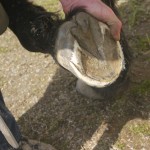
Dean trimmed Pepper’s front hoof and continued, “When the horse steps on uneven frozen ground or a rock, the hoof can crack. Pepper has a quarter crack which I’ll trim and bevel to take the pressure off the crack. That will allow the hoof to grow out without further cracking.”

“So is that the only way to get rid of the crack?” I asked.

“Trimming won’t get rid of the crack, it will reduce pressure. Basically, the hoof has to grow out. The main problem with cracks is that they can lengthen. If the crack reaches the coronary band at the top of the hoof, then you have a real problem.”

“I’ve been putting on a hoof sealant for a few weeks now. Do you think that helps?” I asked.

“The sealant helps, in between applications put on some type of hoof oil. There are a lot on the market. The products you purchase are the best oils to use since they have been tested. Although some people say they have gotten great results with used motor oil, even just baby oil.”

“I heard that you shouldn’t use any petroleum based products on the hoof.”

“That’s true but once motor oil turns black by being burned in the engine there isn’t any petroleum left and its okay to put it on the hoof. You can use a paint brush to apply the oil; just cut off the end and leave about an inch. Another thing to avoid is any product which has alcohol in it. Alcohol will also dry out the hoof.” he said returning Peppers foot to the ground. “If you really want the hooves to grow out fast feed them Biotin. Nutrition is also an important part of hoof care.”

Johnn led one horse after another in and out of the barn for their trim. CJ came out and stood in the sun while Dean trimmed the horse’s hoof.

“Do you think he’s having a hard time with the cracks because he has white hooves?” I asked.

“No, white hoof, black hoof it doesn’t matter. Some people say white hooves are softer, but I think its just because you can see the cracks better on a white hoof verses a black one.”

“That makes sense.”

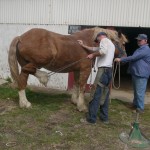
After the last riding horse was trimmed, we moved out of the sun and back into the barn. The two Belgium draft horses waited in their stalls to have their feet worked on. Myrtle and Sam stood like mighty giants as we approached. As a rule, Dean doesn’t work on draft horses, but he made an exception as a favor to Johnn.

Originally bred by farmers, the Belgian horse is still used in agriculture to pull plows and wagons. They are one of the strongest breeds among the draft horses. The Belgian horse weighs approximately 2,000 pounds, compared to a riding horse which weighs in at around 1200 pounds. The average Belgian horse can pull a load of up to 8,000 pounds and work eight to ten hours a day. Their hoof is enormous and presents a difficult job for any farrier.

I looked at Dean’s shoes and asked, “Do you wear steal toed shoes when you work around horses?”

Johnn and Dean almost answered simultaneously, “No!”

They explained to me that a steel toed shoe or boot is dangerous around horses, especially really big draft horses. If the horse should step on the farrier’s foot, the steel in the toe would be crushed and literally cut off the man’s toes. The boot itself would probably be cut off in the hospital and the toes, no longer attached to their owner, would simply be poured out of the boot.

Rings are another safety issue for the farrier. A farrier never wears a ring because if a horse acts up, jumps or startles when shod, the nail can get caught under the ring causing a serious injury. Several months ago, Karen told me her jumping instructors forbid students from wearing a ring. I was beginning to understand why.

Dean began to trim Myrtle until she decided she’d had enough and reared back. Johnn and Dean calmed the horse and the farrier finished up trimming her hooves. Then it was Sam’s turn. Everything went pretty well until Sam refused to pick up his back leg and powerfully stomped down his hoof.

“I usually don’t work on draft horses. Draft horses have their own farriers,” he said.

“How is it different?” I asked.

“A draft horse farrier puts the horse in a stock and restrains the leg so the horse can’t move. These horses are so powerful, they can easily crush you. The safest way to shoe them is to put the horse in a draft horse stock.”

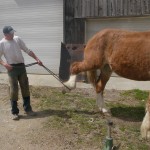
Every time Dean tried to pick up Sam’s back leg, the horse refused and stomped down his hoof hard to the ground. Dean decided to take Sam outside where he had more room to work on the horse. He took a lead rope and slipped it around the horse’s pastern, then pulled the rope back lifting the horse’s leg. The tricky part was grabbing the hoof which Sam did not want to have happen. It took awhile, but finally Dean was able to trim the hoof.

Truly, a farrier’s job is a difficult and dangerous one. Dean packed up his tools and headed home.

Sources: http://www.ehow.com/list_6540274_dangerous-horse-jobs.html; http://www.pamlico-nc.com/horse/articles/holdhorse.htm; http://en.wikipedia.org/wiki/Belgian_horse; http://www.ehow.com/about_6578516_belgian-horse.html

Copyright © 2013 Patricia Miran All Rights Reserved
Posted in Uncategorized | Tagged , | Leave a comment

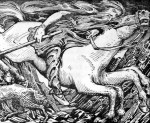
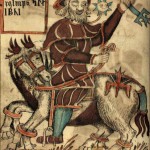
Sleipnir – The Eight-Legged Horse

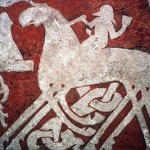
Winter has been long and so far, spring has been cool, except for this week. The weatherman promised temperatures in the 50’s, even 60! As the thermometer climbs, everyone begins to think about the start of ‘horse season’ when the days are warm and long and the riding is easy and fun. During the long winter, I found time to read about horses. One interesting myth I came across contained an eight-legged horse. The first time I read ‘eight-legged’ I thought it might have been a misprint, but no, the horse had eight-legs and his name was Sleipnir.

Of course, you can tell I’m not up on my comic literature or I would have realized that Sleipnir was Odin’s horse. And as everyone knows Odin was Thor’s father. That’s right, Thor, the pagan god of thunder, with the winged helmet and the huge hammer.

It seems that Loki, the trickster god and shape shifter, fathered the eight-legged horse. Loki gave the grey colt to Odin as a gift. According to Comicvine, the remarkable horse grew to over 25 hands high (8’4” at the withers), weighed about 3500 pounds, ran at the speed of light, had human intelligence and could fly. In addition, Sleipnir could travel back and forth to the land of the dead. Truly, this was a remarkable steed. I’m sure that the sight of such an animal would strike fear in the hearts of mortal men and perhaps even the gods themselves. Personally, Sleipnir sounds like just too much horse for me. Can you imagine the time it would take just to clean out his hooves – all eight of them!

It makes you wonder how such an unusual horse arose in the chronicles of the ancient Norse people. David Faux wrote an interesting study based on archeology, culture, history, linguistic, and DNA evidence which theorized that around the 5th Century A.D. a migration of clansmen from the Caucasus and Central Asia settled in Norway and Sweden. These men brought with them a culture based on war faring, shipbuilding and horsemanship. In fact, horses were central to the structure of their society, arts and beliefs. Perhaps, the mythical eight-legged horse was part of the pagan beliefs which these people brought with them to Scandinavia.

Another connection to an eight-legged horse comes from the Gondi people in India. At the funeral of a Muria (distinguished man) a funeral dirge is sung which contains the following verse:

What horse is this?
It is the horse of Bagri Maro.
What should we say of its legs?
This horse has eight legs.
What should we say of its heads?
This horse has four heads. . . .
Catch the bridle and mount the horse.[1]

The verse is really a riddle: What horse is this? The answer to the riddle: The horse of Bagri Maro, in reality, is a funeral precession. The four men carrying the casket provide the four heads and eight legs referred to in the song.

It has been a long winter. Maybe winter seeds the imagination; bringing forth remarkable stories to entertain us as the dark, dismal days march past. However now that spring has finally come, I hope to spend more time outside riding and discovering some new trails through the Endless Mountains.

Happy trails to everyone!

Sources: http://www.comicvine.com/sleipnir/4005-59602/; http://marvel.wikia.com/Sleipnir_(Earth-616); http://en.wikipedia.org/wiki/Sleipnir; http://www.davidkfaux.org/CentralAsiaRootsofScandinavia-Y-DNAEvidence.pdf;

Footnote: (1) Ellis Davidson, H.R. (published 1990), Gods & Myths of Northern Europe (p. 142-143)

Copyright © 2013 Patricia Miran All Rights Reserved
Posted in Uncategorized | Tagged , , , , , , , | Leave a comment

How Horses Use Their Sense of Smell

Saturday turned into a warm day, a reminder of spring. I drove up to the stables and we saddled up Pepper and CJ, and then headed towards Sutliff Hill Road. At the base of the hill CJ picked up his head. He directed his ears towards a large white sign painted with thick black letters and newly hammered into the trunk of a maple tree which stood by a driveway. Immediately, he did a little hip-hop dance indicating he wasn’t going any further past the sign. I figured the best thing to do was encourage him to go up to the sign and take a good smell. That way he could familiarize himself with the object and relax. CJ balked but finally walked toward the newly painted board, and then stretched out his neck, his nostrils flared, he took a deep breath and smelled the sign. That calmed the horse. Even though he didn’t completely trust the new object tacked to the tree, he was ready to return to the road and continued our ride. I assumed that the sign frightened CJ because it was big and new. But could it be that the new paint smell caused some of his apprehension?

We rode up the street. At the top of the hill a man standing near a barn, quite a distance away, lifted a pitchfork full of hay into the air. Then, he heaved the hay into the pasture to feed his horses. CJ picked up his head, took in the smell of distant hay and quickened his pace. Unfortunately he wasn’t invited to dine. On and on we rode, occasionally CJ paused to smell a pile of horse poop at the side of the lane; maybe left by someone he knew. Briefly, I had the sensation that CJ was some kind of really big dog rather than a horse.

Perhaps when it comes to the sense of smell dogs and horses aren’t that different. Amazing as it may seem, a man named Terry Nowacki has been training police horses to track lost people and perform searches much like bloodhounds. He explains that horses can ‘air scent’; pickup a scent simply by smelling the air. Of course, horses can follow the scent by sniffing the ground too.

It may seem odd but horses have a tremendous sense of smell, far better than humans. If you look at a horse’s head, the first thing you’ll notice is the nose. The head is mostly nose and nasal passages. A horse can smell an odor in the air from a substantial distance. They use their sense of smell in many ways from predator detection to herd member recognition. Horses acknowledge each other by touching noses and taking in the scent of the other animal. This is how they greet and recognize people too.

Occasionally, when I ride in the neighborhood someone working in their yard will ask me if they can pet the horse. Before they get too close I speak to the stranger, so the horse can hear that I recognize the person as friend. And then, I tell the person to hold out their hand so the horse can smell it, just as you would when greeting a dog. During this process, I can feel the horse relax as if to say, ‘ok you can pet me now’.

A few years ago, I stood in a stall at Windy Ridge saddling a horse for my weekly lesson. Suddenly, the horse lifted his head straight up and curled his upper lip. At the time I hadn’t heard of the Flehmen response which many animals use to localize the scent of a female in heat. A mare in heat stood a few stalls away in the barn, so I assumed his weird behavior had something to do with mating rituals.

Horses perform the Flehmen response not only for breeding but also when confronted with a new or strange odor. By curling the upper lip, the animal directs the smell to the vomeronasal organ, also called Jacobson’s organ, located near the roof of their mouth. The vomeronasal organ is a chemoreceptor highly sensitive to scents and allows the horse to better analyze smells.

Truly horses are amazing creatures with highly developed sense organs. Their sight, hearing and sense of smell alert the horse to danger. As a rider it can be hard to understand what triggers a horse’s survival instinct, since at times we may not be able to hear, see or smell the threat. Possibly a good first step toward communication between horse and rider is to understand how the horse perceives his world.

Happy trails to everyone and ride safe.

Sources: Sources: http://en.wikipedia.org/wiki/Flehmen_response; http://www.dummies.com/how-to/content/understanding-a-horses-senses.html; http://horsesight.com/taste_smell.htm; http://airscentinghorse.com/home.htm

Copyright © 2013 Patricia Miran All Rights Reserved
Posted in Uncategorized | Tagged , , , , , , | Leave a comment

How Horses Hear

Cold grey clouds covered the sky a few days ago when I saddled Pepper. I pulled on a ski mask, fitted the winter helmet cover’s strap under my chin, slipped on thick fleece lined gloves and headed up the road for an afternoon ride. Pepper briskly stepped into a quick walk, head alert and ears pointed forward. I watched the movement of her ears; every few minutes one ear then the other turned to the side or backward. She alternated her ears as if they were antenna picking up sounds I couldn’t hear. Halfway up the hill, I saw a calico cat slicking through the dried weeds near the edge of the road. Pepper sighted the cat in her peripheral vision, turned her ears and head towards the cat and instantly decided to sidestep a few paces backward.

“Pepper, it’s just a cat,” I said. “Walk past it.”

Pepper complied with my request and quickly walked past the cat which by this time had retreated further into the field. Yet her ears were on guard, rotating and turning in alternate directions attempting to pick up a predator that might be lurking in the field.

Horses have cone shaped independently mobile ears which allow them to funnel sound waves into their ear canal. The equine sense of hearing helps the horse locate sounds which aids in the horse’s survival as a prey animal. Unfortunately for riders, the horse may translate an unknown sound as “get out of Dodge as quickly as possible – ask questions later – save yourself!” Sometimes the result is a major “spook” causing the horse to buck, rear, bolt or employ some other maneuver for self-preservation. To compound the problem, the horse hears much better than we do.

Researchers have discovered that horses hear about 2/3 of an octave higher than humans. Although the horse can hear higher pitched noises, they are not very good at localizing sounds. Often they point their ears forward or rotate their ears to search for the location of the noise. Horses rely heavily on their vision to locate danger. Since horses can see almost 360 degrees around themselves their ears don’t have to be that accurate in pinpointing the sound’s exact location. Once the horse hears a noise, the animal turns his head to see where it is coming from. Generally, horses don’t stop to analyze a scary situation; instead they run away to a safe distance then turn around to see what spooked them.

A couple of weeks ago, I rode Pepper on a very windy day. The gusts blew up to 15 mph and the wind was so loud it was hard for me to hear. Pepper from the start was nervous, often turning her head to look at branches moving in the wind. Plastic tarps and bags blown by the wind startled her. Pepper couldn’t hear very well and that made her jumpy. Since her hearing was limited she had to rely on her vision.

The wind whipped through the valley, across open fields and along the ridges on Round Top Mountain. High winds are not uncommon here, especially in spring. I rode down one hill with no wind blowing at all, no sound, everything still. A ridge or stand of trees blocked the wind, forming a solid barricade, a wall which held back the airstream. Then suddenly, Pepper and I turned a corner and a blast of cold air hit us dead-on. The wind roared so loud it sounded like a truck barreling at full speed down the road. Several times I looked back just to make sure it was only the wind and not something else headed our way.

Pepper and I returned to the stables. I unsaddled the horse and brushed her down. Inside the barn we heard the roar of the wind beating on the outside of the barn. There were other sounds mixed with the wind which I couldn’t distinguish. Of course Pepper’s hearing was better than mine. I really didn’t hear whatever it was that made her pick up her head, prick her ears and listen.

“It’s ok girl nothing’s going to eat you today,” I told her in a reassuring voice.

I walked outside and stopped for a moment. The dark of night was about to fall. I listened to the lonely howl of a pack of coyotes some distance off in the woods near Murray Creek. The howls lifted into the air and were carried away on the wind. Quickly, I opened the car door, climbed in and locked the door. ‘Maybe Pepper knows something I don’t,” I thought as I started the car, pulled away from the barn and headed home.

Sources:
http://www.equinechronicle.com/health/hearing-in-horses.html; http://www.equisearch.com/horses_care/health/anatomy/eqhearing933/; http://www.petcaregt.com/blog/how-do-horse-hear.html

Copyright © 2013 Patricia Miran All Rights Reserved
Posted in Uncategorized | Tagged , , , , , | Leave a comment

Winter Thoughts

Since my last article the Valley area received a little less than a foot of snow accompanied by high winds brought to us by winter storm Nemo. Most of Nemo’s snow was dumped on coastal Northeast, but Round Top Mountain did get a nice covering of the white stuff. Then a few days later came rain and warmer temperatures resulting in most of the snow melting except small amounts clinging to fields, hidden under trees or in the higher elevations on the northwest ridge of Round Top. Along with the rain came high winds, then the thermometer suddenly dipped into the teen’s and everything froze. Needless to say, this type of weather makes riding problematic. I enjoy riding in snow but not so much freezing rain and 20 mile an hour winds. Thus I turned to writing poetry. The following is a poem inspired by my observations while riding on Round Top Mountain. Hope you enjoy the poem.

Close Encounters
By Pat Miran

‘Twas early morning in pale pink light
When a hunter began his weekly hike,
With a long rifle heavy and cold
To a mountain draped in soft white snow,

He paused near a fox’s burrow,
His orange vest mirrored the dawn,
The loyal black lab lagged behind
Tracking vermin in velvety white snow,

At the hilltop near an old home site
The man inspected the rifle’s gun-sight,
Blackjack lifted his muzzle toward the sun
As the man cradled the long cold gun,

Rapidly from deep in the pasture,
Came the rumble of flying hooves;
As horses charged towards the fence,
Dashing swiftly o’er fresh white snow,

The dog howled a strong protest
And the horses stopped dead cold,
All retreated except one,
Standing defiant in pitiful white snow,

The horse snorted and stomped
While the dog barked a ravenous response,
The man scoped the animal within his sights
For a standoff in deadly white snow,

The huge black horse, a real hellfire,
Advanced dangerously towards the barbwire,
The creature snored, nostrils flared
As the horse issued a boldfaced dare,

The man and the dog stood their ground,
The horse looked warily at the hound,
Then spun in midair and galloped off,
Dancing and prancing o’er joyous white snow,

The hunter firmly held onto his dog
As the animal whimpered and whined,
Slowly they turned towards an old cornrow,
And left the horses in soft white snow.

Copyright © 2013 Patricia Miran All Rights Reserved
Posted in Uncategorized | Tagged , , | Leave a comment

Riding in Winter

The weather has fluctuated this January like a yo-yo, first down into the teens then up into the 50’s all within a few weeks. I haven’t taken very many winter rides since along with the ping pong weather, came freezing rain and high winds. A few weeks ago when the temperature reached into the 50’s, I made it into the park for a few hours. The following poem was inspired by my winter ride.

A Winter Ride
by Pat Miran

Neighbors watched as I rode past,
They knew not where I headed though;
My horse stepped into woods so vast
Sprinkled with freshly fallen snow,

Down the path my horse quickly trotted,
Through the woods and round the pond,
Her hooves cut footprints in the snow
Near where the mighty willow stands.

The silent killers tracked small game
And forced prey to cross the trail,
Frightened rabbits, mice and shrews
Skillfully plotted a simple ruse,

As I rode into late afternoon
My heart embraced the backwoods
Until arctic winds began to blow
And cold nipped fingers and toes.

Snow drifted earthward a gentle force,
Quietly touching me and my horse,
As the moon rose big, yellow and round
I headed home safe and sound.

Copyright © 2013 Patricia Miran All Rights Reserved
Posted in Uncategorized | Tagged | Leave a comment

Equine Vision


Night Vision

Several years ago, a group of riders from the stables decided to go for a ‘moon ride’. We waited until dark, and then, when the full moon rose into the sky we mounted our horses and rode into the night. Unfortunately that night thick cloud cover blanketed the moon; however, the moon gave enough light for us to see the road. As we turned into the park deep shadows crisscrossed the gravel road, tree silhouettes surrounded us and in places we found ourselves in total darkness. On we rode, three abreast. At times we had a hard time seeing the way; nevertheless, the horses remained calm and enthusiastically moved forward. Their eyes seemed to possess an inner glow as they serenely walked through the darkness. The horses could see far better than their human companions.

A horse’s eye contains cones and rods which are located in the retina or back of the eye. The horse has two types of cones which permit color vision. The rods allow the horse to see black, white and gradations, as well as, enabling the animal to see in dim lighting. The rods are highly sensitive to light and provide excellent night vision for the animal. However, the horse’s eye does not accommodate sudden changes in lighting very well. This slow adjustment to changes in light explains why horses exhibit apprehensive behavior when transitioning from or to different lighting conditions. It takes about 15 minutes for the horse to fully accommodate radical changes in lighting. So when leaving a well lit barn for a night ride remember to give the horse’s eyes time to correct for the dark. Once their eyes have adjusted, horses can see at night about as well as humans can see during the day.

Equine Monocular and Binocular Vision

It’s a rare trail ride that doesn’t involve at least one ‘spook’. After a while it’s not hard to anticipate what objects scare the horse; a huge rock at an intersection between driveways with trashcans and mailboxes on both sides of the road, a large stack of building materials covered by a piece of plastic, whirligigs or flags flapping in the breeze. But why should such mundane objects cause terror to the horse? Most of the trouble stems from how the horse sees the world.

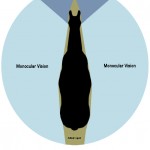
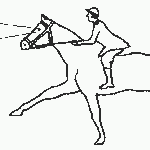
The horse has highly evolved senses which permit a quick escape from predators. The horse’s eye is set far to the side and back on the skull allowing him to see laterally and to the rear with approximately 290 degrees of monocular vision. If you add the horse’s forward binocular vision, the horse can see almost entirely around himself. When the horse holds his head up, there is a narrow blind area behind the rump and directly in front of him. Often if you approach a horse or stand in the horses blind spot he will move his head to see you. The horse’s peripheral vision is highly sensitive to movement, especially movement from behind. It is this ability to detect slight movements or objects within the range of the horse’s monocular vision which contributes to the horse’s flighty behavior.

A few months ago, Karen Sykas and I began training CJ to jump. At first his natural response was to go around or avoid the jump altogether. But since I wasn’t keen on him doing that, he turned back to the jump, raised his head and sailed over the obstacle. Much of CJ’s behavior had to do with the way horse’s see.

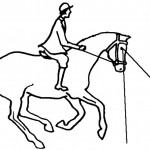
The horse has poor depth perception and it is difficult for him to judge the width and depth of a jump. Add to this problem a 2 to 4 foot blind spot directly in front of the horse’s head and you can see why the horse may prefer to avoid the jump. However, if the horse decides to jump the obstacle, he rotates his eyes to engage his binocular vision and focus on the jump. The horse’s binocular vision covers an area approximately 55 degrees around his head and allows the animal depth perception. The horse doesn’t have a focusing lens like humans, instead to correct his vision he must raise or lower his head. This allows light to fall on the retina which is in the lower part of the eye. As the horse rises into the air to take the jump, there is a point where the horse literally can’t see the obstacle.

The more we understand how the horse sees his world the better we can predict and modify the animal’s behavior. Science still has much to learn about equine vision and perhaps in the years to come more interesting facts will be discovered. In the meantime, we can use the knowledge we have to improve our understanding, safety and enjoyment of horses.

Sources: http://www.horsewyse.com.au/howhorsessee.html; http://www.google.com/imgres?imgurl=http://thinklikeahorse.org/images/horse%2520vision%25202.gif&imgrefurl=http://thinklikeahorse.org/index- ; http://en.wikipedia.org/wiki/Equine_vision; http://www.equisearch.com/horses_care/health/anatomy/nightvision_091003/; http://www.equmed.com/?p=334;http://hyperphysics.phy-astr.gsu.edu/hbase/vision/rodcone.html;’Basic Training for Horses, Eleanor Prince and Gaydell Colleir, published by Random House, 1979

Copyright © 2013 Patricia Miran All Rights Reserved
Posted in Uncategorized | Tagged , , , , | Leave a comment

Do Horses Have Color Vision?

A few weeks ago, Karen Sykas and I began ,training CJ to jump. The first step was getting him to walk over a series of ground poles or cavalletti. At first CJ was afraid of the white poles on the ground but after some work he relaxed and walked over them. Karen suggested painting some poles with red or blue strips. That sounded like a good idea and I painted one of the poles with red stripes. I wasn’t surprised when CJ was afraid of the new pole since when I rode him on the road brightly colored vehicles, especially red cars, frighten him. Sure enough, he didn’t like the new pole. I was convinced that CJ could see red but after doing some research on-line I’m not so sure what CJ really sees.

The research data was scant. Behavioral studies were conducted on a very limited sample group: a few horses owned by the researchers. In statistical terms that wouldn’t be a large enough sample size to base an outcome on. Also, since the researchers owned the horses they may have influenced the results. Another problem is that different horse breeds may see different colors.

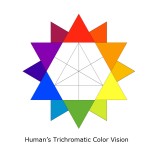
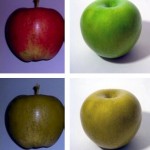
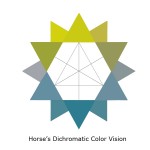
So what do we know about color vision in horses? The current research tells us that horses have dichromatic vision which basically means they see two-colors. On the other hand, humans have trichromatic vision and see all of the colors of the visual spectrum (unless the person is colorblind). Basically, horses have two types of cones in their eyes; a short wavelength-sensitive cone that allows the horse to see bluish-grey and a middle-long wavelength cone which allows the horse to see yellow. This means that colors like red appear greener to the horse.

One researcher, Dr. Carol Hall, found that her horses could distinguish any color from grey. She also found that horses see better at ground level than at eyelevel. Hall undertook experiments when another researcher concluded that horses can’t tell the difference between yellow and white.

“I had a horse that would ignore white lines on the road but had a real ‘spook’ if she came across yellow ones,” Hall said. “Hence when I read that one study … (which) concluded that they couldn’t tell the difference between yellow and white, I felt strongly that this was not the case.”

It’s not a bad idea to design jumps with the knowledge that horses have limited color vision. Many people paint jumps a different color and shade from the surrounding landscape. Studies have shown that it is less likely for the horse to knock the rail down if the jump is painted with two or more contrasting colors. The poles I’m using for jumps are white which has a high contrast to the green of the surrounding landscape. However, it does seem that CJ jumps the red and white pole with more gusto. So in the spring I’ll paint a few more stripes on those white rails.

Although, there is conflicting information in research studies about what colors horses see, the important thing to remember is that horses see the world very differently than we do. If anyone has had a “color” experience with a horse please leave a comment. It’s always interesting to see what other riders have encountered and how they dealt with problems. In the coming weeks, I plan to write more about equine vision. Happy trails to everyone and stay warm.

Sources:
http://www.us.elsevierhealth.com/media/us/samplechapters/9780702026348/9780702026348.pdf;CA Hall, HJ Cassaday, AM Derrington
Journal of Animal Science (2003) 81, 1715 – 1720; Hall http://www.hindawi.com/journals/ijz/2009/721798/;
http://www.sjsu.edu/people/steven.macramalla/courses/c2/s1/Saslow____understanding_the_percetual_world_of_horses.pdf; http://www.thehorse.com/articles/21019/equine-color-vision-research-seeing-things-differently; http://horsetalk.co.nz/2012/11/21/vision-horses-more-than-meets-the-eye/;http://en.wikipedia.org/wiki/Equine_vision;http://www.equineresearch.org/support-files/hanggi-thinkinghorse.pdf; http://www.equineresearch.org/support-files/hanggi-colorvision.pdf

Copyright © 2013 Patricia Miran All Rights Reserved
Posted in Uncategorized | Tagged , , | Leave a comment