Tinsel-n-Lights Holiday Celebration 2012

At 6:30 Moe and I put on jackets and walked out our front door headed for the Tinsel-N-Ice celebration at Muldoon Park in Waverly. The dark winter sky provided a backdrop for orange and red flashing lights produced by a crossing guard at the end of the street and a fire-engine parked nearby at the intersection of Chemung and Lincoln. Up and down the street parked cars and trucks lined the curbs. Horses headed towards us, walking down the middle of the road pulling long wagons filled with people.

“Why don’t we take a wagon ride this year,” I said.

“Ok,” replied Moe as we rounded the corner and entered the park.

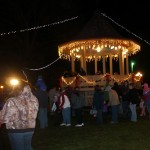
In the park it was wall to wall people. Three different wagons offered free rides to the public; Max Weed and his Haflingers and Al Fargnoli from Sweeney’s Market in Apalachin, NY. We made our way through the crowd to the line of people waiting for wagon rides.The line stretched to the other side of the park. There must have been a hundred people waiting to climb into the horse drawn hay wagons for the ride around the block.

“The line looks pretty long,” said Moe.

“Why don’t we have a look at the ice sculptures?”

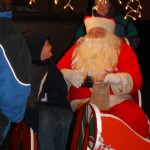
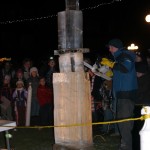
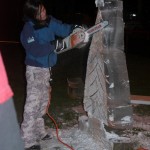
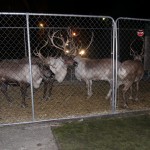
We walked in a huge circle around the park, pausing at the chain link fence which held Mike Cary’s reindeer. I looked for James Steffen, the young man I met last year, but didn’t see him in the enclosure. A little further on, we saw Santa in his sleigh inside a small pavilion. He handed out red and white striped candy canes and listened to children’s Christmas gift requests. We continued walking and briefly stopped to watch the ice sculptors begin their creations.

“It’s really crowded out here. Why don’t we listen to the Jazz Band concert at the Presbyterian Church?”

“That’s a good idea,” I replied as we turned towards the church, walked up the stairs and entered the massive building.

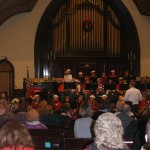
As soon as we entered the church, we met Cristina and her friend Caleb. All of us stood, listened and watched from the back row near the door; most of the seats were already taken. In front of the towering pipe organ, the members of the Waverly High School Jazz Band played swing music from the 1940’s. Jazzy Christmas music filled the old church. The bright, brassy sound produced by trumpet players mingled with the raspy saxophones and soft woody whispers from the clarinets. The drums supplied the rhythm and the conductor‘s baton delivered the tempo. The air filled with familiar holiday melodies which were enjoyed by old and young alike.

It wasn’t long before I found myself back home again. Going back to the house for a bite to eat wasn’t supposed to take long. However, before I knew it time had escaped me and clock read 8:10.

“Oh no, I hope I still have time to get some more pictures of the celebration,” I said grabbing my coat, camera and hurrying out the front door.

The mood on the street was very different from earlier in the night. The street, almost deserted, all the parked cars wedged next to the curb were gone; although, the fire-engine still sat next to the stop sign at the corner of Chemung and Lincoln and the crossing guard still swung his huge yellow light to stop traffic. When I arrived at the intersection, I knew something was wrong. Huckle’s tow truck was parked behind the fire-engine and one of the volunteer firemen carefully poured gas into the vehicle’s gas tank.

‘They must have run out of gas’, I thought and hurried down the darkened street. A few families strolled towards me, walking away from the park. A tired team of Belgians and their owner headed for a horse trailer. The sculptors from Sculpted Ice Works finished up their work as a few people watched. I stopped at Mike Swingle’s ‘Christmas Bear’ and bumped into Neil Trimper.

“So which sculpture is yours?” I asked.

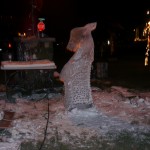
“Mine is over there near the reindeer enclosure. It didn’t come out as planned. I had wanted to make Rudolph with a large set of antlers but the antlers didn’t adhere well and broke off. So now we’re calling the sculpture ‘Rudolph’s Girlfriend’” he said good-naturedly.

“That’s too bad, but I’m sure it’s still a nice sculpture.”

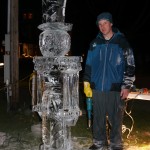
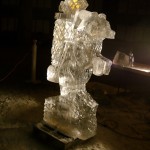
Now that the crowd had left, I was able to speak to the sculptors and take pictures of their creations. I walked across the park to where John Hanson stood finishing his sculpture ‘Toy Soldier’. Not far from where he worked, Lora Borer evened up the base of her ‘Christmas Tree’.

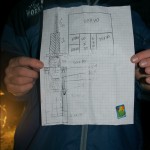
“So how did you come up with an idea for the ice-sculpture? Do you sketch it out first?” I asked John.

“Yes, we draw a sketch and work out how many blocks of ice we’ll need for the sculpture,” he replied pulling a piece of paper from his pocket. John unfolded the sketch and showed me the blueprint for his work of art. “It’s important to know how the blocks of ice will fit together before we start carving. My design is a combination of 3 different objects; one nutcracker and two toy soldiers. I began with two 20 X 40 blocks of ice, frozen at 16 degrees.”

“So how do you get the blocks to stick together?” I asked.

“First we make sure the ends are flattened, and then a small amount of water is put between the blocks. This glues the two blocks together. If the temperature isn’t cold enough the blocks won’t freeze and tonight was warm. We were a bit worried. It takes about 30 minutes for the blocks to set up. We started with Lora’s and ended with Neil’s.”

“Do you think the ice for Neil’s sculpture wasn’t quiet set up?”

“I think that might have been the problem. It’s warm out here tonight and his project was intricate with a massive rack of antlers.”

“How many days before the sculptures melt?”

“They’ll last about four or five days.”

“Have you worked a long time for Sculpted Ice Works?”

“For 5 years, I’ve done a lot of jobs there, carpenter, ice harvester, design program, and now ice carver.”

I headed back across the deserted park. Mike Cary loaded his sleigh onto the back of his truck and the reindeer waited to return home. The street lights made the ice sculptures shine in the dark as light reflected off their shiny surface. I stopped for a moment in front of Neil’s sculpture. Even without the antlers it was a nice piece of artwork. I thought, ‘sometimes we have to push the limits even if we fail, for with every failure comes knowledge of how to succeed next time.’

I turned toward home and walked down the empty street. The barricades blocking off Chemung Street were gone and the fire engine had left. The street returned to how it was before the festival only the ice sculptures lingered as a reminder of the night’s celebration.

Copyright © 2012 Patricia Miran All Rights Reserved

Posted in Uncategorized | Tagged , , , , | Leave a comment

How to Teach a Horse to Jump – Part I the Cavalletti

Karen Sykas and I often rode through Round Top Park. Occasionally, we took a trail through a secluded pine forest. Carefully, the horses made their way into the deep woods, down a steep hill to a stone filled creek. Over many years, the creek had cut a small gorge through clay and rock. Towering evergreens bordered each side of the ravine and ferns clung to the rocky sides of the gully. Once we crossed the creek, the horses traversed a sheer bank to connect with the trail on the other side. Pine needles carpeted the ground underneath the trees, muffling the sound of the horse’s hooves. Tall dark trees blocked out the sun offering a secluded canopy. It wasn’t long before we came to a huge, moss covered log that crossed the path providing an impromptu jump. CJ always popped over the log without a problem.

“He’s a natural jumper,” Karen often said.

“He certainly seems to like it,” I usually replied.

“We should set some jumps up and train him,” Karen said on more than one occasion.

“That would be fun. Connie said when CJ was about one or two years old he jumped the fence between the pastures, visited the horses on the other side, and then jumped back into his own pasture.”

For a long time that was about as far as we went with CJ’s training; just talk. Where to get the jumps and where to put up the jumps always proved a stumbling block. The old arena at the stables didn’t offer much room; Ballentine’s Horse Heaven was a place for trail riders, although there was a round pen. We thought about setting up some kind of jump in the park. There were plenty of ditches and logs I jumped CJ over but as far as formal training we were in a fog as to how to proceed.

In early August, I told Karen that I was going to build a jump from some boards left over from my husband’s building project. I figured there was room in the old arena for one or two jumps. Moe’s pile of scrap lumber would provide plenty of material to build the jumps; a couple of 4 X 4’s, some 2 X 6’s and plenty of 2 X 4’s. Besides the boards, I had a half can of white paint left over from my own summer project; painting the porch.

“I have a book that I’ll give you which explains how to train a horse. The book has a good section on teaching a horse to jump. I used it when I trained my mare. And I’ll help you when you’re ready to start,” said Karen.

“Thanks that will come in handy and your help is greatly needed.”

Karen not only gave me the book entitled ‘Basic Training for Horses – English and Western’ by Eleanor F. Prince and Gaydell M. Collier, she loaned me ‘The Manual of Horsemanship of the British Horse Society and The Pony Club’. Both books contained a wealth of information. I turned to the section on jumping and read that the first step in teaching a horse to jump was using ground poles and small jumps called cavalletti. The overarching concept of cavalletti was to gradually prepare the horse to the concept of jumping. The exercises allowed the horse to gauge distance, maintain an even stride, develop muscles, and balance needed to actually take a jump. This approach takes the fear out of jumping for the horse.

I had never heard of cavalletti; although, I was very familiar with ground poles. After reading a few pages I realized that I needed to change my design for the jump. Instead of making one big jump, I constructed a series of small jumps using 2 X 4s; ending up with a total of seven cavalletti jumps.

A day or so before Karen and I were to begin training CJ, I loaded the end pieces and poles into my SUV and headed for the stables. When I arrived at the arena, I arranged a line of poles on the ground, evenly spaced apart, and then saddled CJ. As soon as I rode into the arena, he picked up his head and stopped. CJ saw the white poles lying in the grass and the poles scared him. It took a lot of encouragement to get CJ to approach the poles and finally walk over them. Back and forth we walked, up and down the line of poles. Finally, he lost most of his nervousness, relaxed and simply walked over the poles. Once he did that, the lesson was over and back to the barn we went.

I met Karen once a week and we worked with CJ. Karen stood near the cavalletti, gauged CJ’s stride, arranged the ground poles and gave me valuable advice. She took videos of CJ and I jumping and later sent them to me in an email. The videos were a valuable learning tool. I concentrated on getting the horse to walk down the center of the poles. CJ needed to step squarely in the space between each pole, without hitting a pole with his hoof. This meant that the poles needed to be spaced according to his natural stride. Karen determined that distance for CJ was approximately 5 feet between poles.

‘The Manual of Horsmanship’ listed 6 Stages in training the horse to cavalletti with 4 basic jump heights: ground level, 10”, 15” and 19”. We worked with CJ on the first 3 Stages:

Stage 1: Simply walk down the line of ground poles, gradually raising the poles to about 10” off the ground. I had 2 X 6″ blocks which I placed under each pole. This lifted each pole about 5” off the ground and required that CJ pay attention to where he stepped in order to not hit a pole.
Stage 2: The horse trots down the line of poles. The poles are gradually lifted to a maximum height of 10”. Again, we used blocks which lifted the poles to about 5” off the ground.
Stage 3: At a trot, introduce a small jump at the end of a line of 6 ground poles. The jump can be gradually widened and raised in height and the distance from the last cavalletti shortened or lengthened.

We experimented with this jump, sometimes making it wider by placing two cavalletti next to each other to make a spread jump or staggering the jumps so the first cavalletii was at about 15” and the second one higher at 20”. Here we made sure our approach to the jump was from the side with the lower cavalletti; due to the fact that the horse can’t see the lower jump. Our aim was to develop CJ’s ‘bascule’ or the arc his body makes as he goes over the jump. Ideally, he should ascend through his back and when he reaches the peak of his jump, stretch his neck forward and down. The horse’s withers should be the highest point over the jump. A small spread jump which is wider than tall allows the horse to develop and achieve the bascule and use his neck and head correctly.

Approaching the jump, I often felt CJ’s indecision as he shifted under me; to jump or not to jump seemed to be his internal question. When he tried to dodge the jump I reined him back towards the cavalletti and over we went. Once he completely stopped in front of the jump and bent his nose down to have a closer look. I urged him forward and even if he hesitated CJ jumped. Many times in the beginning he “popped” over the jump going straight up and down and much too high This propelled me backwards and ‘left me behind’.

“Hold on to the mane! That way you’ll stay with him over the jump,” Karen shouted above the sound of pounding hooves.

“Ok.” I grabbed the mane with both hands and CJ and I jumped some more.

Karen suggested painting some of the poles with red or blue stripes. I tried painting one pole with red stripes. I introduced the new pole into the line of cavalletti. As soon as CJ saw the red striped pole he became afraid. He refused to walk over the line of ground poles. Definitely, he could see the color red and didn’t want anything to do with it. Nevertheless, after some gentle persuasion CJ walked and then trotted over the poles, even the red one.

One day, I came up to the stables to work with CJ by myself. This meant getting on and off the horse every time I needed to move the poles. CJ was very good about that, I carried the pole and he was happy to quietly follow me around as I set up a jump or moved a pole. I set up the usual cavalletti jump at the end of a series of ground poles. CJ jumped the obstacle but once knocked into the pole with his hind leg bringing down the pole. We jumped a few more times and called it a day. When I dismounted and took off his saddle I noticed blood dripping down his back leg. He wasn’t limping, the cut didn’t seem to hurt him when I washed it out and applied Wonder Dust, but I felt bad. I decided to buy some boots to protect his legs.

What type of boots to buy? Luckily, after a conversation with a new boarder, Ashley, I purchased open front jump boots. The boots are designed to protect the horse’s tendons but still let the horse feel the pain of hitting the pole when he misses the jump. I put the jump boots on along with CJ’s Old Mac boots and started jumping again.

The weather turned cold. Colorful fall leaves left their branches, blown away by the chilly whisper of the coming winter. Thanksgiving came. The approaching darkness marched into our lives, bringing sunset earlier and earlier until by 4:30 the day was done. Karen and I stopped working together with CJ. Early December brought frigid weather but occasional a day or two in the 50’s. The ground hadn’t frozen yet. I continued to work with cavalletti jumps to help CJ stay in shape and not forget what he had learned. Advancing into new learning for CJ was put off until spring when the days grow longer and warmer. Then, we’ll move on to Stages 4, 5 and 6, and maybe even try the cavalletti configuration called the ‘Box’.

Sources:

‘The Manual of Horsemanship of the British Horse Society and The Pony Club’ published by the British Horse Society, 6th edition, reprinted 1971, pages 33-52
‘Basic Training for Horses – English and Western’ by Eleanor F. Prince and Gaydell M. Collier, published 1979, Random House, pages 192-216
http://en.wikipedia.org/wiki/Bascule_(horse)

Copyright © 2012 Patricia Miran All Rights Reserved

Posted in Uncategorized | Tagged , , | 2 Comments

Rescued Ponies Find New Homes

With Halloween just around the corner, Hurricane Sandy, nicknamed ‘Frankenstorm’ roared through New York City and the Jersey Shore. Ahead of the storm, Mayor Bloomberg, NJ Governor Chris Christie and President Obama made announcements on all the major networks. They ordered mandatory evacuations and designated areas where people could seek shelter. Atlantic City casinos, the NJ Boardwalk, NYC subways, Amtrak, major airports, the NY Stock Exchange and public schools were all closed. The storm barreled onto the NJ coast bringing a storm surge during high tide, flooding and destroying property in the process. Protective levees broke, half of Hoboken, NJ was underwater and four towns in the northern part of the state had water as high as 6 feet, 50 homes in Queens burned, NYC subways flooded and 8.1 million homes lost power across several states.

In the Valley, people braced for a repeat of last year’s flood which left Athens in ruin. This time around people weren’t taking any chances. When I went to Wal-Mart to buy emergency candles, I found that the store was sold out. People crowded the aisles, filling their carts with bottled water, food, flashlights and batteries.

By Tuesday, we knew that the center of the storm had veered west of us missing our area by a few hundred miles. The Valley experienced high winds, some rain and power outages, but no major flooding. Anne Shaffer called and asked if I would like to visit one of the rescued ponies and of course I said ‘yes’. A few minutes later, Anne stopped by and we traveled down Route 220 along the Susquehanna River. A few fields were flooded, mostly by rain, but I didn’t see any place where the river overran its banks.

“Did you lose power?” I asked.

“No we still have lights, but there are a lot of people without electric,” replied Anne.

We traveled into Ulster, PA following the Susquehanna River Basin and passed Bishop’s Restaurant where several electric company trucks stood in the parking lot. Then, we climbed a mountain slope and headed towards Monroeton. It wasn’t long before Anne turned at Marcy Hill Road and stopped in front of Dale Cole’s garage.

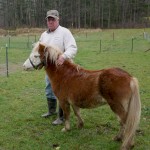
An eight year old Shetland pony named Spitfire stood quietly in a box stall, which took up one corner of the garage. Just outside the stall there was an opening leading into a pasture. Dale, a recently retired dog warden and police officer, agreed to foster the little stallion for the Bradford County Humane Society. The Shelter’s policy was that stallions would not be available for adoption until they were gelded. The other two ponies, Misty and Princess, rescued with Spitfire had already found homes.

“Do you have a lot of experience with horses?” I asked Dale.

“I grew up on a dairy farm just outside of North Gent. As a teen I owned a saddle horse, but most of my experience with horses comes from working a team of Belgian draft horses; skidding wood, pulling a bob sleigh or wagon,” replied Dale.

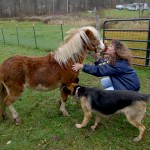
Dale opened the stall gate and let Spitfire loose in the pasture. The little horse walked a short distance and then began eating grass. “When he first came he was hard to catch and kicked if cornered, but after a few weeks he settled down. Now he allows people to walk up to him in the field. He’s a good little pony, gets along well with dogs and enjoys interacting with my grandkids.”

The wind picked up and a few snowflakes fell from the sky. I took some pictures and Anne played with the pony.

“How was it being the dog warden and working at the shelter?” I asked.

“Being a dog warden was a challenge. The worst was seeing the disgusting way people treated their animals,” said Dale.

“But you only saw the worst cases,” I said.

“Maybe, but I saw some really sickening things,” said Dale.

“He’s right, in this job you see some horrible cases of neglect and cruelty,” said Anne.

We walked back inside the garage to get out of the cold and Dale’s dog, Spirit, followed us. Dale showed Anne a few bales of straw which he planned to use for Spitfire’s bedding. Outside grey clouds covered the sky.

“What happened to the other two ponies?” I asked.

“The pony which lost the eye, Princess, went to a home with kids. She was a well mannered pony and let the kids get on and ride her. The other pony, Misty, was a bit standoffish and shy. She was adopted by a family with four kids. They ride her bareback and she’s adjusting well. The family has other horses too,” replied Dale.

“So Spitfire is the only one not adopted,” I said.

“The shelter has a policy of not adopting out stallions. Once he’s gelded, Spitfire will be available for adoption,” said Dale pausing for a moment then continued, “The vet is coming tomorrow.”

Anne and I climbed into the truck and drove back up Route 220, winding through the countryside along the Susquehanna towards Waverly. The aftermath of Hurricane Sandy was evident in the trees and branches toppled by the storm. We passed the electric company trucks pulled off the road, fixing downed power lines.

A few days later, I received a call from Anne Shaffer; Spitfire had found a new home in Yonkers, NY. On November 11th, Laura Hawbaker, the Humane Officer at the Bradford County Humane Society Shelter, drove to Yonkers to inspect the property; making sure it was suitable for the pony. A few days later, the little piebald pony named Spitfire left Dale Cole’s home and boarded a horse trailer headed for a new life far from Ulster and the Endless Mountains.

Epilogue: The horse world can be a very small place sometimes. An interesting footnote to the story about Dale Cole is that his uncle Erle Cole sold Myrtle, Johnn’s Belgian, to the Balentines many years ago.

Copyright © 2012 Patricia Miran All Rights Reserved

Posted in Uncategorized | Tagged , , , , | 2 Comments

New Horses at the Stables

September 13 proved to be a typical, pleasant autumn day. The sun shone and the crisp air filled our lungs as Emma and I drove up to the stables to ride and greet newcomers at the barn. A shiny, aluminum horse trailer in front of the stables told us the new herd members had come. In fact, the horses were already unloaded and standing in their stalls eating hay. I pulled my SUV into the driveway and saw Ashley and her father chatting with Connie. It wasn’t long before we stepped out of the car, joined the group and were introduced to the newest members of Ballentine’s Horse Heaven.

The horses belonged to Ashley and Scott; a young couple looking for a temporary place to stable their animals for winter. Samson, a bay Percheron-Thoroughbred mix 16.3 hands high, belonged to Scott. The horse had suffered a hind leg injury and could no longer compete at horse shows. Formally a lesson horse, the gelding now enjoyed trail rides with his owner. Freya a 6 year old mare, 16 hands high and trained to race at the track, now performed dressage and enjoyed jumping with Ashley.

“I’m training CJ to jump with the help of Karen Sykas. She has experience with show jumping, so we’re beginning with Cavelletti exercises. I’m thinking of getting boots for his legs so he won’t get hurt,” I said.

“You’d be better off with splint boots they’re better for jumping. You can borrow mine if you want to try them out,” said Ashley.

“Ok thanks. We’re going to bring in CJ and Pepper and saddle up,” I said wishing the newcomers well.

“Good luck with that,” said Ashley as she gathered her things and left with her father.

We led the two horses through the barn and passed Samson’s stall. Freya’s stall bordered Pepper’s and was across the aisle from CJ. Right away I knew there was trouble. As soon as CJ was released into his stall he raised his head, circled nervously and whined. Pepper felt she had to protect her grain bucket, even though there wasn’t any grain in it. She laid back her ears, squealed and immediately turned her rump towards Freya threatening a kick. Freya snored; half reared and headed for her stall gate setting herself up for a jump to freedom. Emma and I stood in the aisle between stalls watching and waiting for the horses to settle down.

“Emma, be careful she’s going to jump!” I picked up a crop and ran over to the stall gate preventing Freya’s exit. Samson and Freya kept whining to each other and Freya circled her stall. Again the large horse set herself up for a massive leap over the gate. I looked outside the open barn door and saw Johnn near the woodpile. “Emma run and tell Johnn that Freya’s going to jump out of her stall!”

Johnn came in and Freya settled down. Before long Connie arrived to protect the gate. Johnn went to find a stall guard to fit above the gate which would block the horse’s attempts to jump out of her stall. In the meantime, CJ and Pepper were both nervous; whining and circling their stalls.

“Let’s try saddling up Pepper outside and then we’ll come back for CJ,” I said.

We led Pepper quickly past Freya and tried to tie her to a hitching ring on the side of the barn. Pepper kept moving, fidgeting and whining making it impossible to saddle her.

“Ok, let’s give her some distance from the other horses. We’ll take her to the arena and saddle her,” I said.

Pepper settled down once she entered the arena and was able to eat some grass. Emma saddled the horse and I asked, “How about we just work on Cavelletti with Pepper?”

“Ok,” said Emma.

“I’ll run back to the barn and put CJ out to pasture,” I said leaving the arena and hurrying back down the road to the barn.

Connie had troubles of her own. Freya repeatedly tried to jump out of her stall; in fact she reared high enough for her front legs to come over the stall gate. Luckily, the horse was still in her stall. I grabbed a brush and entered CJ’s stall in an attempt to calm him down. After passing the brush over him to get his attention, I opened the stall gate and quickly led the horse past Freya. It wasn’t long before CJ stood in the pasture with the other horses.

Emma and Pepper practiced taking a small jump at the end of a series of poles. Before long it was time to unsaddle Pepper. This time we didn’t make the mistake of bringing her into the barn with the new horses. Instead, Emma took off her saddle in front of the barn. She quickly walked Pepper past Samson to the barn door and released her into the pasture. In the meantime, Johnn had moved Freya closer to Samson and put up a stall guard.

A couple of days later, I came up to ride expecting to see some dramatic action in the pasture. Horses chasing each other, kicking and biting.

“How is the new horse doing?” I asked.

“Fine,” Johnn answered.

I gathered Pepper’s lead rope and halter and headed out to the pasture where everything was quiet. Freya and Samson were tighter than fleas on the backside of a dog as they stood eating grass. The other horses weren’t far from them and they too ate grass. I walked up to Pepper, put on her halter and walked out of the pasture thinking ‘boy that was easy, nothing like when Sam came.’

Posted in Uncategorized | Tagged , , , | Leave a comment

Farewell to Roxy the Neighborhood Goat

It was just before 9:00, Monday morning, when I pulled my SUV into the parking space beside Donna Horton’s car. A morning fog hung over the mountainside as Socks and Shadow waited in their stalls. Donna stood in Socks’ stall brushing off caked dirt and mud from her horse while several kittens ate breakfast from a huge bowl near the grain barrels. Before long, farrier Kenny Bellis pulled his vehicle into the space just in front of the barn.

Pulling shoes marked the end of riding season and signaled winters approach. Anne would have been there but she had to work unexpectedly and asked me to sub for her. Donna brought Socks out of his stall and Kenny went right to work. The shoes came off quickly. He skillfully filed the hooves, evening the rough edges. Before long it was my turn to get Shadow, bring him out of his stall and hold the horse so the farrier could take off the metal shoes.

“So how has everything been for you Kenny?” I asked.

“Busy, we went to the Congress in Columbus, Ohio for about a week.”

“The Quarter Horse Congress?”

“Yah, it was great. They have all kinds of venders there. Events are going on constantly for weeks. I bought three air pads at a very reasonable price.”

“I heard it’s supposed to be really exciting,” I said as I tapped Shadow on the muzzle for nibbling at my hand.

“Just let him chew on the leather lead. It calms him,” said Donna and Kenny simultaneously. I took their advice and the horse immediately relaxed.

The sun’s warmth infiltrated the barn and the thick fog rose into the sky. Two kittens scampered past Shadow and made their way outside to the log pile. Kenny picked up Shadow’s hoof, pulled the shoe and smoothed the edges with his file.

“You know I was riding the other day and Cassandra stopped her truck to speak to me. She said the goat was getting more and more aggressive and suffered a broken jaw,” said Donna.

“Oh, that’s too bad, but I’m not surprised,” I replied.

“Roxy just doesn’t act like a nanny goat. She’s more like a Billy goat, and that’s probably from a hormonal imbalance of some kind.”

“Really?”

“Lady had something like that once. She would growl and kick the side of her stall. The vet said it might have been tumors on her uterus.”

“Well, Roxy is certainly aggressive with the horses and chasing us,” I said.

“Cassandra said she took Roxy to a goat sanctuary, so no more Roxy. They may remove her bloated utters which might help reduce the aggression,” said Donna.

“I haven’t seen Roxy for weeks and wondered what happened to her. I’m glad the goat found a good home and won’t be chasing us down the street anymore.”

“That goat was a handful,” said Donna.

Kenny finished pulling the shoes and we wished him well. Donna returned Socks to his pasture and I lead Shadow through the barn and released him back to his pasture buddies in the field. I put a halter on Pepper, brought her into the barn, saddled up, and then we rode up Oakfield Drive. I planned to circle around the block past the Slocums, but when I reached Highland Drive a barricade crossed the street with a sign that read ‘Road Closed’. In the distance, I heard heavy earthmoving machinery and decided to take another route back to the barn.

For several days all the sky gave us was rain. On Thursday morning, dark, low hanging clouds threatened more drizzly rain, but by afternoon the clouds departed replaced by clear skies. The afternoon sparkled as orange and red leaves caught the sun’s rays and filled the hills with a radiant glow. I threw my tack in the back of my SUV and drove to the stables, found CJ and saddled up for a ride. I thought, ‘might as well head up past the Slocum’s since Roxy isn’t there anymore.’

I reined CJ towards Weaver Road turned up Bobcat Lane and entered the park. We slipped into the woods. Leaves blanked the trail, covering puddles and concealing mudding patches. Wind from the rainy days denuded some of the trees, but the forest still glowed yellow, orange and red catching the pink in the late afternoon light. The sun vanished over the edge of the mountain, and the woods were quiet except for the gentle fall of the horse’s hooves; nothing stirred, not even the wind.

Since I didn’t have to worry about the goat, I circled back and headed for the barn down Weaver Road towards the Slocum place. When I rode toward their pasture, floating through the twilight came the familiar bleating of a goat, like a distant memory. I glanced across the pasture where a group of horses waited to go into their stalls for the night; just outside the indoor arena. Behind the arena’s gate, I saw a goat pacing back and forth and heard her familiar bleating. I took a deep breath and rode on thinking, ‘Roxy is back!’

Posted in Uncategorized | Tagged , , , | 4 Comments

How to Convert a Standard Breast Collar into a Pulling Collar

Until a few weeks ago, I had never heard of a pulling collar. While searching YouTube videos, I stumbled upon the ‘Functional Horse Man’ explaining how a pulling collar worked. Wow, that made total sense! I have a standard breast collar which crossed CJ’s shoulder muscles and attached to the saddle’s front rigging rings. I often found sweat marks where the breast collar rubbed against the horse’s shoulder blades after a long ride. Even though CJ didn’t seem to mind it, I thought it looked uncomfortable.

A pulling collar allows the horse’s chest muscles free movement providing full range of motion. The standard breast collar or plate crosses over the horse’s shoulder and restricts the chest muscles, limiting movement. People working cattle or high performance riders prefer the pulling collar. As a trail rider, I use the breast collar to keep my saddle from moving when traversing steep hills, otherwise the breast collar isn’t doing much. Even so, it seemed to me that the pulling collar was comfortable for the horse, which meant a more relaxed ride.

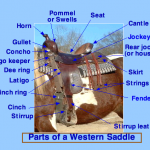
I checked into some on-line stores and found that pulling collars are a little pricey, a bit more than a standard one; however, I already had a breast collar. I did some more searching and stumbled across a comment by Smrobs on horseforum.com. She explained how she fashioned an old pair of reins into straps which when fitted to her saddle’s swell and gullet converted her standard breast collar into a pulling collar. What a great idea!

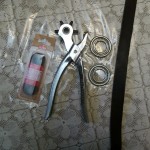
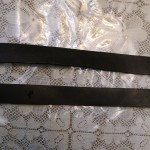
Unfortunately, I didn’t have a set of old reins, but I did have an old leather belt which would work. Lucky for me, the belt had two large dee rings. All I needed was a smaller dee to slip through the bigger one. That didn’t seem too hard. I went to Tractor Supply but found their rings were too big, too expensive and they didn’t carry dee rings. I drove over to True Value and also didn’t see any dee rings, but found some machine washers which I thought would work. However, I decided against purchasing them after talking to the man in the hardware section. He explained that the flat machine washers would cut into the leather over time, but a round, solid metal ring would not. The round rings were 0.75 cents each. Now all I needed were some 72” leather shoelaces which I purchased at Walmart for $4.00.

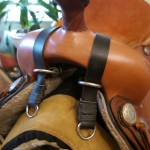
I drove to the stables and made some measurements. Before I cut the belt I wanted to make sure that the strap would be the right length. Once I determined the correct length, I cut the belt and looped each end around a ring. I used a small ring at one end and a large one at the other. I cut each shoelace in half and punched holes in the belt near the rings. Then, I threaded the shoe leather through the holes and wound the remaining shoelace around the belt. I ended up with two leather straps with metal rings at both ends.

I went back to the stables, saddled CJ, and pulled the straps around the saddle’s swell and through the gullet. Then, I feed the smaller ring through the larger and attached my breast collar making sure it wasn’t too tight. Not only did it look more comfortable for CJ, it looked good too. I don’t think anyone would notice that the straps were homemade. I took a ride through the park and my adaptation worked great. The straps might not be the best for high-performance riders and cowboys, but for the simple trail rider, it worked pretty well.

One word of caution; make sure that the rings and leather are strong enough for the job. If you decide to use an old belt like I did make sure the belt is real leather and thick enough to be used on a horse. The same is true of the rings. The last thing you want is for the strap to break, so like all equipment, check it before you saddle up. Also, if you can’t find a piece of leather to use ask your saddle repairman or shoe repairman. They might have a piece of leather that will work and can sew the ends for you.

Thanks to Smrobs and the Functional Horse Man for a great idea.

Posted in Uncategorized | Tagged , , | 2 Comments

The Cooley Blacksmith Shop – Corning, NY

The morning temperature was pleasantly warm on August 31st, but by noon the thermometer reached into the 80’s and beyond. I pulled off Highway 86 at the Corning exit around 10:00 in the morning, drove down Denison Parkway, turned at Bridge Street, crossed the Chemung River, and turned left onto W. Pulteney Street. The Benjamin Patterson Inn Museum’s parking lot was empty except for one or two cars. The museum consisted of several restored 19th century buildings which included the Benjamin Patterson Inn (c. 1800’s), Starr Barn (c. 1800’s), Cooley Blacksmith Shop (c. 1870), Mack Family Log Cabin (c. 1855) and Browntown Schoolhouse (c. 1878). I stepped into the Cooley Blacksmith Shop and met Leon Golder, a board member for the museum. Leon told me the story behind the blacksmith shop.

White Cooley moved from Tioga County, PA to Beaver Dam, NY in the early 1860’s. Public records held by the Schuyler County Historical Society listed him as a horse dealer in 1868. He built a blacksmith shop on his farm between 1870 and 1875. The privately owned shop served White’s personal needs well, allowing him to shoe his horses, make farm equipment repairs, fix buggy tyres and craft other metal items needed for the farm. Overtime, people in the area hired his services as a blacksmith. His business grew; there was no other blacksmith shop in the area. Local farmers and people traveling through the area stopped by his shop to have their horses shod or equipment fixed.
“An important job for a blacksmith in those days was repairing buggy tyres,” said Leon.

“Tyres?” I asked.

“The metal rim which surrounds the outside of the buggy wheel is called a tyre. It was common for rocks to work their way between the tyre and the wooden buggy wheel. When this happened the metal rim became loose and had to be repaired,” replied Leon.

“How would they repair the tyre?” I asked.

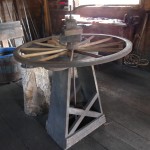
“A wheelwright or blacksmith would tighten the metal tyre by using a tyre shrinker. He heated up the metal rim, placed it into the clamp which reduced the circumference. This made the tyre smaller. Then, the metal tyre was pulled snuggly into place, back on the wooden wheel,” explained Leon.

“And what is the difference between a wheelwright and a blacksmith?” I asked.

“A wheelwright made and repaired all parts of the buggy wheel. The blacksmith often worked for a wheelwright or did farrier work. Cooley did some rim repair. Wheelwright equipment was found in his shop when the museum purchased it,” replied Leon.

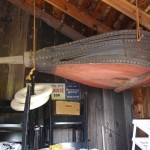
At the end of the 1800’s mechanized farm equipment rapidly replaced the horse, and White Cooley adapted to the changing times. Somewhere between 1885 and the early 1900’s White began selling a brand of motorized farm machinery called ‘Champion’ manufactured in Syracuse, NY. He sold hay mowers and manure spreaders. He continued to do blacksmithing; now he repaired motorized farm machinery. His place was near the railroad tracks which helped his business. When his son, Charles, was old enough; he helped his father in the shop. At some point White replaced the bellows with a blower to increase airflow to the forge. The bigger blower meant a hotter fire which increased the capacity of the forge.

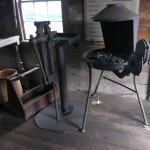
“Important to blacksmithing is the type of coal used. Home owners used Anthracite, a hard coal, to heat their homes. Bituminous, a soft coal, was important to the steel industry,” said Leon.

“Why is that?” I asked.

“Bituminous coal burns slower. It has many impurities, such as oils, methane and other gases produced from rotting plants trapped millions of years ago in the rock. However, Bituminous coal, once burned turns into coke which produces a much hotter fire than Anthracite. The fire burns from a reddish, orange to a yellowish, white somewhere between 2200 and 3,000 degrees, which is perfect for blacksmithing,” explained Leon.

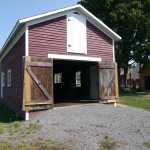
As technology, industrial output and mass production in America intensified, the blacksmithing business died out by the late 30’s and early 1940’s. The Cooley Blacksmith Shop remained on the farm in Beaver Dam; unused and neglected for many years. In 2006, the current owner of the property, Kenneth Blanchard, auctioned the blacksmith shop. The Benjamin Patterson Museum sent several board members including Leon Golder to look over the building. After negotiating a price, the museum bought the structure. There was a hole in the roof and many missing boards. The museum held a fundraiser to cover the cost of repairing the building. The roof was fixed, the missing timbers repaired and the blacksmith shop cleaned in 2007, and then everyone waited until Corning’s Community Planning Board approved the zoning.

The bureaucratic red tape took approximately 1 ½ years, but once the museum received approval things happened pretty fast. Many people volunteered to help out; Dresser Rand Trucking Co., Southern Tier Express Co., Keith Swarthough, Jr. (a private contractor), Marshall Conklin (a farrier/instructor at Cornell Vet School) and Dean Stuart from Long Crystal Valley Farm.

First the building needed to be supported so it wouldn’t be damaged when it was lifted onto the truck bed. Once the blacksmith shop was on the truck, the building traveled toward Corning. The huge truck transporting the Cooley Blacksmith Shop pulled off W. Pulteney Street onto Flint Ave and into the museum’s parking lot. The men hoisted the structure off the truck and placed the shop onto its present location. Although some tools were original to the building, many families donated additional tools to complete the restoration.

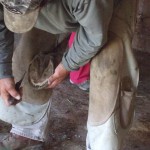
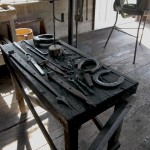
A blacksmith creates metal objects from wrought iron or steel by using tools to bend and cut the metal. A farrier shoes horses. The two professions can be one in the same when a farrier uses blacksmithing techniques to create shoes for a horse. As blacksmithing died out as a profession, many smithy’s turned to farrier work. Cornell University’s Vet School had a long history of training farriers and blacksmiths. Marshall Conklin, a farrier at the Vet School for over 15 years, trained many farriers. He and two of his students, Mike Hutter and Jim Hunter, volunteered to give presentations to the public on blacksmithing at the Cooley Blacksmith Shop.

“Beginning in the spring of 2012, the museum offered lessons in blacksmithing. The classes are small, only 2 students per class. Classes are given from April through November, dependent on the weather. The temperature needs to be between 35 and 40 because there is no heat in the building except for a portable propane heater,” said Leon.

“That sounds interesting,” I replied.

If you come to the Whingblinger Heritage Festival at the museum next week you can see Mike Hutter and Jessica Hadlock demonstrate blacksmithing.”

“I’ll plan to come.”

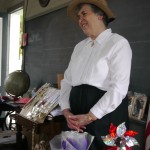
The following weekend, on September 8th , I made the trip back to Corning and the Benjamin Patterson Inn Museum. The Whingblinger Heritage Festival was in full swing. There was a civil war tent with soldiers, log cabin, donkeys, a bee keeper selling honey and lots of yummy cookies and pasteries for sale as a fundraiser. I stepped into the one room school house where I met Barbara Rhodes, a docent, dressed as a 19th century school teacher. She helped parents work with their children on a number of projects.

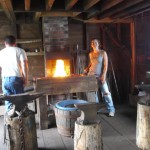
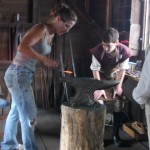
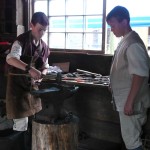
From there I walked the short distance to the Cooley Blacksmith Shop. The shop was crowded with many onlookers as Mike Hutter, Jessica Conkling, and Christopher and Benjamin Burns worked pounding and shaping metal.

After the crowd dispersed I took pictures and asked Jessica, “How long have you been doing blacksmithing.”

“I’ve been blacksmithing for 10 years. I was in Leon Golder’s last class and plan to open my own metal arts business,” Jessica replied.

“And how long have you two boys been doing blacksmithing,” I asked.

“We just started this year,” replied Christopher.

I left as a light rain fell from the sky. There are not many places where you can witness, up-close, a working blacksmith. Although some farriers use blacksmithing skills to craft horseshoes, most do not. Years ago, I remember our farrier driving to the farm with his small forge built into the back of his truck. It’s nice to know that there are still some blacksmiths working as farriers. If anyone is interested in taking blacksmithing classes call 607-937-5281 and ask for Leon Golder.

Sources:
http://en.wikipedia.org/wiki/Blacksmithing

Posted in Uncategorized | Tagged , , , , , , | Leave a comment

Tioga Point Museum in Athens, PA

Founded in 1895, the Tioga Point Museum began as a small collection housed at the old Athens Academy. People within the local community donated items to the museum located in the school. In 1897 the Spalding family contracted the architects, Albert Hamilton Kipp and Harry Charles Child, to build a structure in the Colonial Revival style to provide a place for the Spalding Memorial Library and the Tioga Point Museum. The stately brick building with Indiana limestone trim and Ionic order columns was constructed on 1.3 acres, directly across the street from the Athens Academy. The museum moved into its new quarters on the second floor in 1898 and has been there ever since.

The museum’s collection encompasses local history of Athens and Sayre, natural science and archeology. Open Tuesday and Thursday from noon-8 and Saturday from 10:00 to 1:00; closed Thanksgiving, Christmas and New Year’s Day, admittance to the museum is free. The Tioga Point Museum is a fascinating place to spend a few hours on a quiet afternoon, so a few weeks ago I decided to stop by.

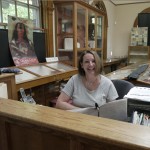
Nineteenth century fire engines and the horses that pulled them seemed like an interesting topic for an article and I thought the museum would be a good place to begin my research. I pulled open the huge wooden doors and was greeted by a charismatic woman, Maddie Opalenik, the Assistant Curator at the museum. I handed Maddie my card and explained my blog. She gave the card a quizzical look and said, “I think I’ve been on this website before.”

“Really,” I replied surprised.

“We have a wonderful volunteer, Ella Louise Johnson, who works here. She’s a friend of Donna Horton. Ella told me about your adventures with the goat,” she said.

Maddie began working at the Tioga Point Museum 3 years ago, in October of 2009. She fell in love with her job and enjoyed the fascinating people who visited the museum. Three days a week, she helped people explore the museum, lent a hand to scouts seeking merit badges and coordinated museum activities. When I explained that many of my blog articles described events which happened at Ballentine’s Horse Heaven, Maddie immediately said, “I know Johnn and Connie.”

“You do?” I asked amazed.

“Yes, I’ve known them for years,” she said.

Not only did she know the Ballentines, she had visited the stables, knew the horses, remembered Pepper’s rescue and CJ’s birth. Before Maddie and her husband moved to the Valley permanently, they often stayed at their week-end home in East Smithfield. When she was in town, Maddie bought fresh farm eggs from the Ballentines for her co-workers back home in NJ.

“You know the chickens were stolen,” I said.

“No way,” said Maddie.

“Yes, I went up to the stables one morning to ride and Johnn told me all the chickens were stolen in the middle of the night. Not one feather was left behind,” I said.

“You’re sure an animal didn’t get into the hen house,” Maddie said.

“Nope, there wasn’t any blood or chicken parts, the chickens were just missing,” I replied.

“I’ve never heard of such a thing,” said Maddie.

“Me neither, I guess there is a chicken thief loose in the Valley,” I said.

She thought for a moment, gave me that quizzical look and said, “I’m not sure if we have anything about the fire horses, but there may be some photos with horses in them.”

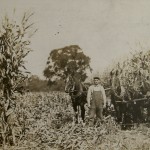
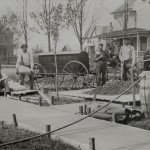
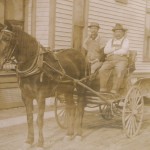
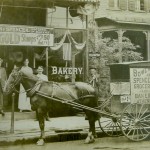
Maddie pulled from the museum archives several long cardboard boxes. Carefully, she opened each folder and we examined the photos and postcards inside. Sure enough there was a fire engine pulled by horses, several pictures of blacksmith shops, a grocery delivery wagon, and several other interesting photos with horses in downtown Athens. Unfortunately, there wasn’t much information attached to the photographs.

I thanked Maddie, not sure what I would do with the photos. One picture entitled ‘Millard’s Cornfield 1913, Murray farm, West Athens’ looked interesting. Could that be Ballentine’s Horse Heaven? After some inquires the answer came up ‘no’. Even though the road in front of the stables is Murray Creek Road and Murray Creek runs through the property, the stable was never owned by the Murray family.

The photo of the blacksmith shop in downtown Athens looked intriguing. After some research on-line, I discovered a reconstructed, functioning blacksmith shop in Corning, NY. I called the Benjamin Patterson Inn Museum, made an appointment and met Leon Golder. He told me the story of the Cooley Blacksmith Shop. The following week-end, September 8th, I attended the Whingblinger Heritage Festival and saw a live demonstration on blacksmithing. The complete story about the Cooley Blacksmith Shop follow the link.

The photos at the Tioga Point Museum are a bit of a mystery. If anyone knows anything about the photographs, recognizes the people or horses in the pictures or has a story to share please leave a comment. Happy Trails to everyone – stay safe.

Sources:
Photos courtesy of the Tioga Point Museum, Athens, PA; http://en.wikipedia.org/wiki/Spalding_Memorial_Library-Tioga_Point_Museum; http://encyclopedia.jrank.org/articles/pages/4745/Murray-Louise-Shipman-Welles-1854-1931.html; http://www.bradfordhistory.com/index.asp?pageId=103

Posted in Uncategorized | Tagged | Leave a comment

Horseheads, NY

Like everyone else in the Valley, I take Interstate Highway 86 to the Arnot Mall in Horseheads. Historical markers are planted at intervals on the old highway, 17C, which parallels 86. The plaques tell of the American Revolutionary War, Sullivan’s March and the battles fought between the Continental Army and the Iroquois. A few miles past Newtown Battle Field, 86 comes to an overpass/onramp, constructed a couple of years ago. You will briefly glimpse the image of horses and the name of the town, Horseheads, embedded into the cement which supports the overpass/onramp as you pass through.

Two hundred and thirty-three years ago, the Commander-In-Chief of the Continental Army, George Washington, issued General John Sullivan orders to take his troops into hostile Indian Territory and totally destroy the settlements of the Six Nations of Iroquois. At the same time, General James Clinton received orders to move and assemble a brigade at Schenectady, NY. He moved his men westward to Otsego Lake with the objective of destroying Indian villages and joining General Sullivan’s troops at Tioga Point in Pennsylvania (now Athens, PA). Meanwhile, General Sullivan and three brigades marched from Easton, PA to Tioga Point, built Fort Sullivan and waited for General Clinton’s troops to arrive.

The generals combined force totaled approx. 4,000 men and 250 pack horses. The army set out on August 26, 1779 from Fort Sullivan. The soldiers moved along the banks of the Chemung River, destroying Indian villages and burning the Indian’s crops and orchards. Sullivan’s March continued until the army reached present day Cuylerville, NY. On September 15th, the troops turned around and headed back to Fort Sullivan. However before they reached the fort, Sullivan’s army was forced to stop a few miles from the Newton Battle Field. Many of their horses, sick and disabled after traveling approximately 450 miles, weighted down with heavy military equipment and with insufficient food, had reached the end of their physical capability. The horses could not go any further and were shot by the soldiers. The carcasses were left to rot as the men continued on to Tioga Point and then quickly left the area for winter quarters in Morristown, NJ.

The Iroquois fled to their British allies at Fort Niagara and camped outside the fort. The destruction inflicted by the Continental Army left over 5,000 Iroquois homeless and without food, many starved or froze to death during the harsh winter. Sometime later, Indians made their way back to the area where the horses’ bones lay exposed on the ground and positioned the skulls alongside the trail. The Iroquois called the area ‘The Valley of the Horses Heads’.
American settlers quickly moved into the region. They discovered the large number of horse skulls bleaching in the sun and decided to name the settlement ‘Horseheads’. Through the years many stories have circulated in the village telling of the number of horses which died there; some said 30 others placed the number in the hundreds. At Hanover Square, the place where the horses died, a plaque on a large stone commemorates the fallen military pack animals and tells the role horses played in the American Revolutionary War.
I often drive through Horseheads, but have never seen any skulls. After such a long time, they must have dried up and blown away or perhaps were eaten by rodents. The town tried to change the name to ‘Fairport’ when it was incorporated, after all the Chemung Canal was in full operation by 1837 and it seemed to make sense. However, the residents preferred Horseheads and in 1845 the name returned. Now it is inscribed in the cement supporting the overpass on Interstate 86, for all to see, although many motorist passing through may not have heard the story of the military horses which died there a couple of hundred years ago.

Sources:
http://www.joycetice.com/articles/hms01dh.htm; http://www.horseheads.org/index.php?n=about.history;
http://www.horseheadshistorical.com/#;www.horseheadshistorical.org; http://www.dcnr.state.pa.us/topogeo/gsaabstr/sullivan.aspx; http://en.wikipedia.org/wiki/Sullivan_Expedition
Fitzpatrick, John C (1931–1944). “Instructions to Major General John Sullivan”. The writings of George Washington from the original manuscript sources, 1745–1799. Electronic Text Center, University of Virginia Library. http://etext.virginia.edu/etcbin/toccer-new2?id=WasFi15.xml&images=images/modeng&data=/texts/english/modeng/parsed&tag=public&part=165&division=div1. Retrieved 2007-11-14.

Posted in Uncategorized | Tagged , , , | Leave a comment

Barn Cats at Ballentine’s Horse Heaven

Cars and trucks travel too fast past the barn. A few weeks ago, Chloe, a feral black and white cat, was hit by a car and left in the ditch alongside the road. Donna saw the stiff dead cat when she rode past on Socks. Later that afternoon, Connie walked down Murray Creek Road and retrieved the lifeless cat. She dug a grave in her garden where other pets lay decaying in the earth.

There are always cats in the barn, most are hiding and unseen. Feral cats born in the woods, looking for a warm, safe place to live; they are the wild cats which hunt for mice and hid in the barn. And then there are the other cats which come to the barn in the middle of the night. These cats are dropped off at the parking lot or near the hayloft, unwanted and abandoned.

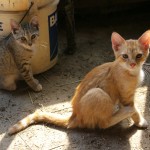
Last week, someone secretly walked into the barn, stepped quietly by the tack room and deposited 7 tiny kittens near the water barrel just outside Myrtle’s stall. In the morning, I came up to ride CJ and was greeted by a kitten, and then I saw two more hidden behind a saddle stand next to my tack box. A few minutes later Connie drove up and came into the barn.

“Someone dropped off a bunch of kittens. Johnn saw them this morning,” said Connie.

A few minutes later, Johnn arrived, climbed down from his tractor and said, “There were 7 this morning.”

It wasn’t long before we located the kittens. The little furry animals came hurrying out to see us wanting to be picked up and petted. They walked around our feet and vied for our attention.

“These aren’t feral cats,” said Connie pouring dried cat food into a feeder. “They must have come from somebody’s home. They’re just too tame.”

“What will you do?” I asked.

“I’ll make some calls. There used to be a feral cat program but that folded and the animal shelter is full; they aren’t taking anymore cats. It’s not really fair to expect kittens used to living in a home to live the life of a barn cat. They’ll have to be neutered and spayed otherwise, in a month or two they’ll start breeding and we’ll have more cats than we can count. The barn already has 21 cats,” Connie said picking up the bag of cat food.

Some farmers do nothing about barn cats. The farmers just let them breed and expect the cats to live off the mice and rodent population. The animals die from accidents, disease and natural causes. Johnn and Connie have a different approach; control the cat population and keep the cats healthy. They feed the cats and make sure the animals get their shots; otherwise, the cat population could pose a health threat to people and other animals in the barn.

Cats reach reproductive age around 6 months old and breed twice a year. It is estimated that one female and her offspring in 7 years can produce 370,000 kittens. Instead of facing a living nightmare of multiplying cats, Connie traps any feral cat which comes on the property and has the animal spayed or neutered. Now Connie and Johnn are faced with a huge bill for the 7 kittens someone dumped off at the barn. The expense out of pocket for Connie and Johnn to spay or neuter each kitten Connie estimated somewhere between $60 to $100, multiply that number by 7 and the total cost comes to between $420 and $700. Not a small sum of money to take care of somebody else’s kittens.

Meanwhile, the kittens were everywhere in the barn darting in and out of the stalls. I saddled CJ up and one kitten ran in behind the horse and then ran back out under the stall gate. Two kittens ran into Peppers stall and sat down under the horse’s water pail, a third kitten ventured behind the horse and sat down next to her back foot until Emma shooed it away. The little rascals were playing and wrestling each other in Myrtle’s stall, darting out into the pasture under the barn door and running back in, their backs arched and ready for play. Outside, the kittens climbed the stacked logs waiting to be split and crawled into small places near the burn barrel.

Emma and I mounted up and turned toward Oakfield Road. Donna had just arrived and we met her walking down to the barn. “Did you see the kittens?” I asked.

“Yes, yesterday they all climbed up on top of the folding barn door. I had to get them all down before I closed it.”

“They aren’t used to horses.”

“I know. I hope they don’t get hurt,” Donna said.

Connie put a notice on the bulletin board at her job to find homes for the kittens. A few days later, I came to the barn and some of the kittens were missing. Three kittens were adopted and found homes inside where its warm and where they can be petted and loved by a human friend, sleep on someone’s lap and enjoy life. However, their brothers and sisters are still in the barn waiting for a home.

Many people believe the myth that farms need cats and that cats can make it on their own in a farmer’s barn. This leads to people dropping off unwanted cats at barns in the middle of the night and placing an unwelcome burden on the barn owner. As a result, there are now 4 very tame and friendly kittens still waiting for homes at Ballentine’s Horse Heaven. Hopefully someone will call. If you are looking for a bundle of furry joy and interested in adopting a kitten call Connie at 570-888-2024. For all those people who thought about letting their cat retire to the country in a nice barn please think again – ask the barn owner if they need or want another cat. You may find out that the barn is already full.

Source: http://www.peta.org/issues/companion-animals/spay-neuter.aspx

Posted in Uncategorized | Tagged , , , , , | Leave a comment