Pepper’s Rescue

Connie owned several horses over the years. In 1999 her loyal Tennessee Walker, Ruth, died. Connie bought a 15 year old Quarter Horse named Sally. She wanted her vet, Robin, to check over the horse. The woman selling Sally refused to allow Robin onto her property and insisted that her vet look over the horse which he did.

“The horse is 15 years old and in good shape. You’re getting a sweet deal and a good little horse,” said the woman’s vet.

Connie bought Sally. As soon as the horse was brought into the barn and fed some hay Connie noticed that Sally was balling hay. Half chewed chunks of hay fell out of Sally’s mouth when the horse tried to eat. Connie called her vet, Robin, and was told that the horse must be over 30 years old. Sally didn’t have any back teeth in her jaw!

Connie rode Sally with a hackamore since Sally didn’t have enough teeth to hold the bit. A few months later Sally was lying motionless in the pasture. Fluid had built up around Sally’s heart; she suffocated to death from congestive heart failure. Johnn dug a grave behind the barn and old Sally was put to rest.

Again Connie was in need of a horse to ride. She called up Annie Shafer and the two women went to look at a horse in Monroeton, PA. A 4-H leader had a beautiful palomino Tennessee Walker for sale. The horse was as calm as a kitten and Connie agreed to buy the horse.

The palomino was trailered to Horse Heaven and right away there was a problem. The mare was wild and she wouldn’t let anyone near her. When Annie tried to ride the horse it just jumped and spun around like a lunatic. She had a hard time getting off the wild spinning palomino.

The logical conclusion was that the horse had been drugged; a common problem when purchasing an unknown horse. The horse acts calm and well trained when the buyer goes to take a look at the horse but when the sedatives wear off the true nature of the steed becomes apparent.

Connie called the owner of the beautiful palomino and explained the problem she was having with the horse.

“My ten year old daughter rides that horse,” shouted the woman into the phone.”

“Then could your ten year old daughter please come over and show us how to ride this horse?” said Connie annoyed.

Of course the ten year old never came to Horse Heaven to ride the wild horse. After many phone calls back and forth between the owner and Connie with a lot of explaining, yelling, threats, and whining the woman agreed to give Connie half her money back. Connie came away with a new policy: Never buy a horse outright – take the horse on a 2 week trial. If the person doesn’t agree to a trial period walk away and look at another horse.

Connie still didn’t have a horse to ride. She heard about a rescued Standardbred at Marlene Lantz’s place in Litchfield PA. Marlene ran a horse rescue which was associated with The Harness Horse Retirement & Youth Association located in Loganton, PA. Ten newly rescued horses had just arrived from an estate outside of Youngstown, OH.

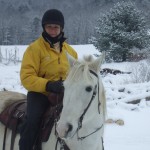
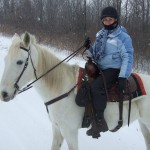
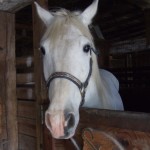
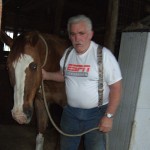
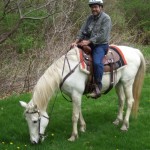
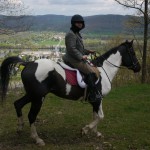
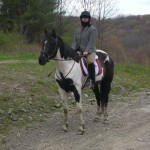
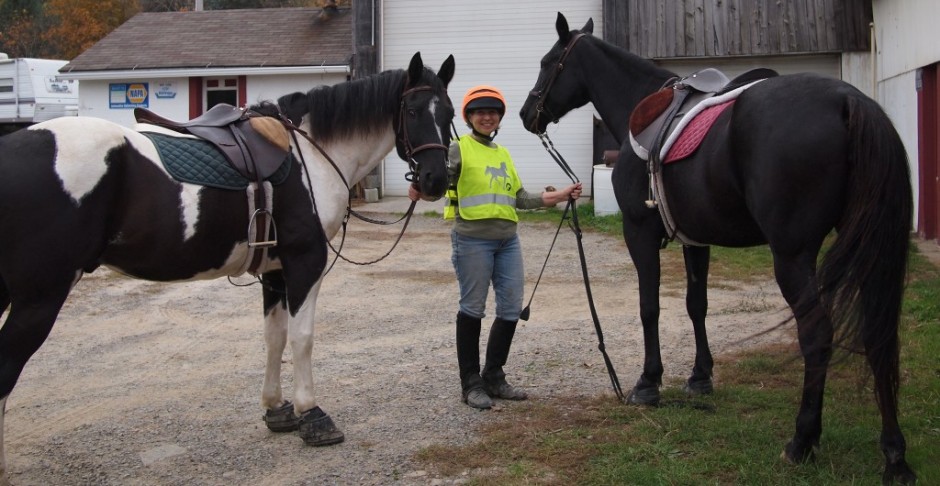
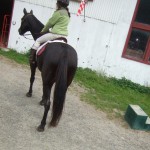
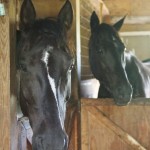
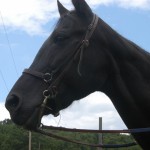
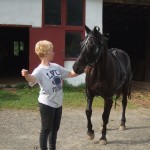
Connie and Annie Shafer walked into the stable and tried out a Standardbred named Pepper. The bay mare in Marlene’s barn stood quietly while the saddle was strapped on. Her ribcage showed through her hide. Welts and sores covered her body. Connie stepped into the stirrup, swung up on Pepper and rode around the arena a few times. Pepper walked calmly and peacefully around the arena.

Even though Pepper was in bad shape, Connie could tell she was a beautiful horse. Pepper’s disposition was what she was looking for; serene. On October 9, 2001, the transaction was completed. Connie wrote out a check for the adoption fee and Marlene handed her a copy of the paper work. Connie took the paperwork and filed it with her other farm records. The sick and starved horse was delivered to Horse Heaven. Pepper’s registered name was YB Normal and her tattoo number was C2459. The story Connie came away with concerning the rescue was that Pepper had been taken off an Amish farm in Ohio with 20 other horses.

In November, Connie brushed Pepper in her stall and noticed that sweat was running off Pepper’s belly. She reached under Pepper to brush off the sweat and Pepper swung around and bit Connie. For some reason, the horse was very sensitive in the girth area.

A short time later, Connie had medical problems that required back surgery which prevented her from riding. Pepper recovered from starvation; she turned into a very quick and sometimes spooky horse. Pepper wasn’t ridden much.

Within a few months, Pepper put on weight. Her ribs weren’t showing any longer but it looked like she was getting a hay belly. By April Pepper had gained a lot of weight, in fact too much.

When Johnn put Pepper out to pasture in the morning he often commented to the horse as she trotted out the barn door, “If I didn’t know better I’d say you were pregnant.”

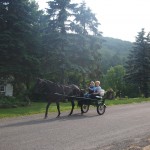
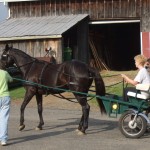
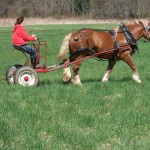
They cut down on her feed and Donna Horton offered to hitch Pepper up to her cart and work off some of the fat. The mare was harnessed to the vehicle and Donna and Connie walked the horse up and down the road trying to burn off the extra calories on the over-weight horse.

On July 11th 2002 at 5 AM Connie went out to get the morning newspaper. She looked across the road into the pasture. There was something in the pasture. Was it a cow or that pesky pony from up the street? But how could the pony have gotten in the pasture? She walked across the road for a closer look and suddenly realized that Pepper had given birth to a foal. She dashed into the house.

“Johnn, Johnn! Wake up! Pepper just had a baby!” Connie shouted running up-stairs.

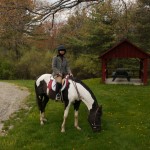
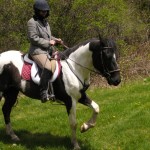
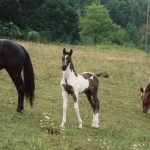
They both rushed out to the pasture to see Pepper’s baby. The cute little colt was only a few hours old and tottered on his long legs. They named the little painted black and white foal Connie and Johnn’s Surprise abbreviated to CJ Surprise.

Connie still loved riding so in 2007 she bought another horse; Jupiter. This time she took the horse on a 2 week trial. Jupiter proved to be the steady, quiet horse that Connie was looking for.

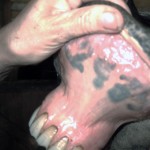
Last week, Connie and I wanted to get Pepper’s racing records. Connie had always had difficulty obtaining Pepper’s records. She couldn’t read the tattoo on her upper lip, and asked if I could help, which I was glad to do.

I googled the US Trotting Association, pulled up their website and selected the Tattoo Search at the top of the page. When I entered YB Normal and the serial number C2459 I came up with a blank – no horse exists with that reg. number and name. A phone number for help was listed on the page and I called. After my initial inquire yielded no results I was transferred to Anne Chunko.

Quickly, Anne came up with answers. YB Normal was a stallion and his reg. was LN727 not even close to the one Connie had listed on her adoption contract. The reg. number C2459 belonged to another stallion named Sea Swirl.

Anne said, “You’ll have to start over. The best thing is to go back to the horse and get the number from the inside upper lip. The best way to do that is take a clean cloth and wipe the inside of the lip. Take a photo, don’t use the flash. You might have to take the horse outside in the sunlight to get a better picture. If you can’t read the number on the photo send it to me. We are pretty good at deciphering tattoo numbers.”

“Thanks, I said. “I’ll try that.”

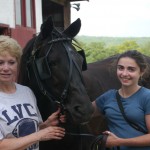
Emma and I went riding that afternoon. After our ride I put Pepper in her stall and retrieved a clean wash cloth and the camera. Emma readied herself with the camera and I gentle turned Peppers upper lip exposing the tattoo. Emma quickly took a picture. We took several pictures in the barn and then walked Pepper outside and took some outside too.

When I got home I ran up to my computer and downloaded the photos. I sent copies to Connie and to Anne at the Trotting Association. They seemed pretty clear and everyone at home came up with the number L2435 but I wanted to be sure so I sent the photo to Anne at USTA.

Quickly, I received an answer from Anne. She said the horse was Mr. Bill’s Jill number L2435. The photo was clear enough for her to read. Suddenly, we knew the name of Connie’s horse.

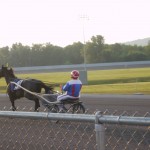
The records Anne emailed me showed that Pepper had been a Pacer. She had run 60 races, was born in Big Rock, Illinois on 4/14/1992. Her sire was Mr. DalRae a horse with total racing earnings of $1,150,807, and her Dam was Barb’s Trick with earnings of $99,292. The foundation mare was Miss Copeland. Pepper won 9 races, came in second 12 times and third 6 times. She earned a total of $14,964 at the track. She raced three years and was retired 5/01/1998 when she was 6 years old.

We learned her former owner was Donald E. Landfair of Fredericksburg, OH. He owned her in 1997. Connie adopted Pepper from the Harness Horse Retirement & Youth Association in Loganton, PA on 10/9/01. What happened to Pepper from 5/01/1998 to 10/9/01? Connie remembered the adoption agency telling her Pepper had been rescued from an Amish farm along with 20 other horses. Was that true? And where did Pepper become pregnant with CJ?

I goggled horse gestation and at cowboyway.com I located a gestation table. According to the table and CJ’s birth date of 7/11/02, Pepper was exposed to a stallion September 2, 2001; about one month before Connie adopted Pepper.

Perhaps the former owner could shed some light on these questions. I googled her former owner, Donald E. Landfair. He was listed under several anti-horse slaughter websites (www.unnecessaryevils.blogspot.com, www.freewebs.com) as a ‘Killbuyer’. A killbuyer is a person who buys horses for resell to slaughterhouses in Canada or Mexico. The former owner’s information left me with more questions. Was Pepper in a kill pen waiting to be shipped to the slaughterhouse?

At this point I wasn’t sure what to think. I emailed Anne at USTA:

‘Hi Anne, We were told the horse came from Ohio and was rescued from an Amish farm along with 20 other horses. That story doesn’t make sense to me because Mr. Bill’s Jill is very skittish when cars pass her on the road. I can’t see her as an Amish cart horse. Is it possible to find out what happened to our horse between 5/1998 and 2001?’

Anne returned my email:

‘Pat, Unfortunately, USTA would not have any records, or way to track what happened during that time period. It could be that Mr. Bill’s Jill was intended to be a buggy horse, but didn’t have the temperament, but that the Amish did try her as such. Or it could be she was and had a bad experience on the road that left her skittish… It’s hard to know, and is likely you may not ever be able to find out. I can say that a lot of Standardbreds that come off the track in the US, especially if they are in NY, OH, or PA, do end up in the hands of the Amish for a short or long period of time.

The only other suggestion I have is, instead of tracking it backward (from the rescue back in time), for you to start tracking it forward (starting with the last registered owner on file). Donald Landfair is no longer a member of USTA, but his wife Virginia is still a member.’

I dialed Virginia Landfair’s number, the phone rang a few times and she picked up. I explained to Virginia who I was and why I was calling.

“I’m trying to find information about Mr. Bill’s Jill a mare that was rescued about nine years ago. You’re listed as the former owner at USTA,” I said.

She spoke to her husband for a moment and then replied, “He said he raced her 10-12 times in Illinois for a few months, once a week. Mr. Bill’s Jill was a very dangerous, bad mannered horse. She was a bad kicker and tore up her stall.”

“I ride her now and she’s a very nice horse,” I replied.

“You should get another horse to ride. She’s old by now and you’re not going to train that out of her. I don’t think horse slaughter is very nice but when you have a dangerous horse like that it’s not a bad idea. You don’t want somebody to get hurt,” she replied.

“Nobody wants to see anyone hurt,” I said. “Does your husband remember what happened to Mr. Bill’s Jill?”

Again she spoke to her husband and then replied, “He sold her to a Mr. Brown, but he must have never raced her since he didn’t register her with the USTA,” she paused for a moment and continued, “You know you can’t race her. They stop racing after 14 years old and she must be older than that.”

“She’s 19. We aren’t planning on racing her,” I replied. “We just want to find out her history.”

Virginia Landfair and I said good-bye and I hung up. I didn’t seem to be any further ahead, although it was clear that Pepper wasn’t on her way to the slaughterhouse when she was rescued. When I checked my email Connie had sent me a message. She had called Marlene Lantz who ran the horse rescue that Connie adopted Pepper from. She had an answer which put the puzzle together.

Her email read:

‘Hi, I just talked to Marlene Lantz, the one who ran the rescue program here. She said that it was an estate. The guy that owned the horses had died a couple of weeks before she went out there. There were a number of horses that had to be put down out there. She personally picked up 9-10 horses and brought them to her place.

She vaguely remembers a black walking horse with a bit of color that had to be euthanized there since he was in such bad shape. There were work horses, standardbreds and all kinds. They had to euthanize at least 10 while they were there since they were in such bad shape and couldn’t even get up. She felt that the horses there hadn’t been cared for long before the owner died.

She didn’t remember the owner’s name but Brown did not ring a bell. The estate was near Youngstown, Ohio in the hills of Pennsylvania. There were no stops. They brought the horses directly here and they were all adopted out in 2-3 weeks of coming here.

She had no stallions on her property. She doesn’t have any of the records since she is out of the program. So, Pep must have been bred at that farm. She doesn’t remember for sure if it was Amish or not. I remember that is what I was told. Hope to talk to you sometime over the weekend. Connie’

A few days later, I was standing in Connie’s back yard. The bird feeder was full of colorful birds and Connie was raking grass. We spoke of what a remarkable week it had been and all the information we had found out about Pepper.

“A friend at work googled Donald Landfair and at www.supremecourtofohio.gov found out he just won a law suit,” she said handing me a copy of the legal judgment. “He won it the day before you called and spoke with his wife.”

I took the paper surprised and curious, “What was it about?” I asked.

“He was unloading a young untrained filly. When he was in the trailer backing her out an Amish wagon came rumbling past. The noise spooked the horse and he was pushed out of the trailer landing in the road. The horse came bolting out of the trailer, but Mr. Landfair still had hold of the lead rope. The horse was prancing around him while he lay on the ground. The trainer saw what was happening, ran over to help and was kicked in the head.”

“Maybe that’s why Virginia was so concerned with kicking horses and somebody getting hurt,” I said.

It has been an eventful week. Pepper is still Pepper but she is also Mr. Bill’s Jill with a racing record and an interesting history. We may never know all the details about what happened to her but we do know most of it. She was a Pacer flying down race tracks in Illinois, Wisconsin and Ohio, sometimes coming to the winning circle and sometimes going to the barn with the losers, pretty much like all of us. Win a few lose a few. Mr. Bill’s Jill will always have a home at Horse Heaven with Connie where I have the pleasure of taking her on trails in the wilds of the Endless Mountains.
Posted in Uncategorized | Tagged , , , , , , , , , , , , , , , , , | 2 Comments

Donna’s Cart

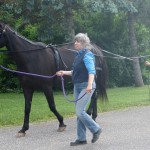
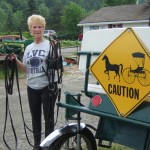
I swung my car into the drive in front of the barn next to the cart. The barn smelled of fresh sawdust on the hot summer afternoon as Emma and I walked toward Pepper’s stall. Donna had Pepper in her stall and all brushed down. Years ago, Pepper trotted at the race track pulling a little sulky; when her racing days ended she became an Amish cart horse, for the last nine years she has been at Horse Heaven where she became a trail horse.

“Hi Donna, how are you?” I said.

“Fine,” she replied. “I’m ready to put the harness on.”

“Can I do anything to help?” I asked.

“In a minute, I need to get the harness,” she replied. Donna walked to the tack room and came back with the equipment.

“I like to go slow. Pepper hasn’t been harnessed and driven for about eight years,” said Donna. “It’s better to go over the basics with her before we get into the cart.”

“That sounds like a good idea,” I replied. “Pepper can be skittish.”

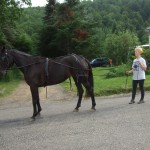
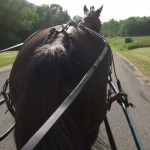
She picked up the harness saddle, a thick narrow bowed piece of leather and laid it just behind Pepper’s withers. From the saddle, Donna attached the back strap running down Pepper’s spine to her tail. She lightly lifted Pepper’s tail, slipped the crupper under and attached it to the opposite side. Pepper stood calmly as if this was an everyday happening. Donna connected the girth and added the breeching strap that ran around Pepper’s haunches. The strap allows the horse to slow the vehicle and is connected to the cart shaft.

“Pepper will push against the breeching when she turns the cart,” said Donna. “Horses usually don’t like the feel of that strap around their hindquarters, but she’s doing real well.”

Donna held up a bridle with big black blinders fixed to either side of the headstall. She put the bit in Pepper’s mouth and pulled the reins through a loop on the saddle. We were ready to go.

“Ok Peppy,” said Donna holding tight to the reins. She turned and handed me a lead rope. “Snap the rope to the bit and lead her out of her stall. I’ll follow.”

When we reached the front of the barn, Donna again checked the harness, tightened the equipment and double-checked that everything was on correctly.

“How did you learn how to work with the cart?” I asked running my hand down Pepper’s forehead.

“My father and grandfather taught me and trained my pony, Domino,” she replied. “It was Easter vacation when he pulled his truck up to our house. In the truck bed sat a little red cart he borrowed from a friend. I remember racing out to get a look at it. I really wanted to work with the cart and used it for a few months until we returned it to the owner.”

“My dad made a cart for my pony and a harness but there were no roads where we lived to use the cart. The tires were bicycle wheels and the it got stuck in the grass,” I said, “so I never really used the cart.”

“You can use bicycle wheels for a cart, but they bend easy,” said Donna.

“So what type of pony did you have?” I asked.

“When I was 8 years old my parents bought a Shetland pony, yearling, named Domino. He was pure black except for a white star and a race that ran down his face,” said Donna.

“I had a pony too,” I replied. “He was a pinto gelding about 13.2 hands.”

“I think my parents bought the pony out of frustration,” said Donna. “I grew up on a farm in North Ghent, PA. I’ve always been small but I’m tough and agile. When I was a very little girl I would go into the barn and put a gunny sack on a calf for a saddle and use baling twine to make a bridle, then I’d ride the calf in its stall. My mother would get after me with a switch for bothering the calves, but I ran faster than she could. One day I had to hide in the dog house all day until I saw my Dad come in from his work in the fields, then I knew it was safe to go into the house.”

“I guess buying the pony solved the problem,” I laughed.

“Domino was a good little pony,” she said, “I trained him to do tricks for the horse show. I would tell him to kneel on one front leg, then on two front legs then to lay down with his legs tucked under him. That’s when I’d jump on his back. He would stand and rear a couple of times for the crowd, then we’d race out of the arena at dead run.”

“That’s pretty amazing,” I said as Pepper shifted her wait and rubbed her head against my arm. “It sounds like you had a lot of fun with Domino.”

“I did,” she replied, “I took him to 4-H horse shows at Burleigh Farm on Oak Hill near East Ulster in PA. I entered him in lots of different competitions; the barrel race, poles, bag race, and hit the can.”

“I’ve done barrel racing, poles, keyhole, but I’ve never heard of the bag race or hit the can,” I said.

“The bag race is like musical chairs on horses. They play music and each contestant has to race to the far side of the arena, jump off, pick up a gunny sack and race back to the finish line. The person without a bag is out, “she said.

“And what about the can race,” I asked.

“In that race there are four barrels placed at the four corners of the arena. You race pass each barrel and knock off the can. The one with the fastest time wins,” replied Donna.

Pepper pulled at the lead rope and shifted her weight as Donna finished tightening the girth and adjusted the reins.

“Ok, you hold onto the lead as I walk behind and drive her up the road. If she gets scared you’ll control her with the lead rope, but otherwise keep it loose. We’ll see how she does.”
We walked Pepper up and down Murray Creek Road several times back and forth in front of Connie’s house. Pepper calmly walked ahead of Donna turning when she needed to turn. I simply walked beside Pepper with a loose rope and listened for Donna’s next instruction.

“She’s doing great! I’m going to take her down to the barn and we’ll hitch up the cart,” said Donna.

“Do I need to do anything special?” I asked walking quickly to keep up with Pepper’s fast walk.

“No, just walk along beside her,” replied Donna.

We walked down the asphalt road, turned onto the gravel driveway and arrived back at the barn. At the barn, Emma and Donna each took hold of the cart. They carefully brought the cart around and behind Pepper. Once the cart was in position the two cart shafts would be attached by the trace straps on the harness.

“The most dangerous part is hitching the horse to the cart because the horse can become terrified. Don’t let Pepper move into the shafts or she’ll get spooked and maybe hurt,” said Donna as the cart rolled slowly towards Pepper. “I don’t want anyone to get hurt.”

“Ok, I’ll hold her tight,” I said squeezing the lead rope.

“I always bring the cart to the horse, that way the horse has less chance of hitting one of the shafts,” said Donna.

I held Pepper tight by the rope, but she wanted to fidget. It took some time to connect the trace to the cart, in the meantime, Pepper wanted to move. I held firm to the rope preventing her from going forward with the harness half attached to the cart.

“If she walks those shafts into the barn she’ll panic,” said Donna working skillfully to hook the traces to the cart. “Hold her firm.”

Finally, the cart was hitched up. Donna and I each held a lead rope; one on each side of Pepper’s head. We carefully lead Pepper in a big turn away from the barn and towards the road.

“We’ll lead her up and down the road until she’s used to the cart,” said Donna.

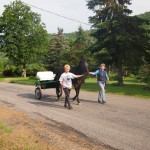
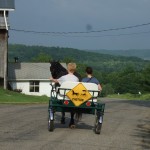
Back and forth we walked along the roadway with Pepper pulling the cart behind her. She walked as her hooves picked up a steady beat against the blacktop and the cart rolled along on its motorcycle wheels.

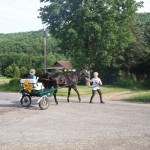
Donna had the cart made several years ago. It is a little heavier than the average cart, but good for going on roads. The cart was made by Carl Bradley who lived in Litchfield, PA. Carl was an expert at welding farm equipment and machinery repairs. About 5 years ago, Johnn Ballentine sandblasted and repainted the cart an emerald green.

To make a turn with the cart Donna first had Pepper turn in the opposite direction then swing back across the road making a tight turn. We practiced turns for a while until Donna felt Pepper was ready to pull the cart with someone in it.

“Ok, Pat you climb in and I’ll lead Pepper. All you have to do is loosely hold the reins,” said Donna.

“That doesn’t sound too hard,” I said quickly climbing into the cart trying not to make it move, sat down and picked up the reins.

I had never driven a cart before. It was a new experience for me, and I felt a little odd sitting behind the horse and not riding on her back. It was fun. Donna led her up and down the road a few times, until Donna felt Pepper was ready for the real ride.

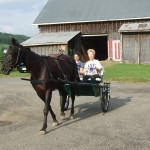
“I’m going to climb in,” said Donna. She quickly climbed into the cart, took the reins and off we went up the road.

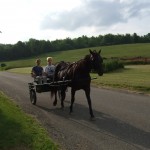
Pepper walked fast and at times broke into a slow trot as the cart bumped along the country road. Donna showed me how to handle the reins and let me drive the cart for awhile. Connie came out to watch and helped turn the cart when Pepper thought she was going back to the barn.

Some distance up the road we saw and hear the roar of two motorcycles headed in our direction. As the motorcycles came closer and closer we knew Pepper would have a problem with the noise and fast vehicles passing her.

“Horse in training,” Donna called to them.

The motorcycles pulled off the street at the intersection where Johnn was raking the lawn. Connie walked over to them. Lucky for us they were neighbors of Johnn and Connie; friends that lived up the street. Pepper continued to pull the cart and everything was fine.

Donna stopped the cart and switched passengers. Emma climbed in and they were off down the road again. Pepper remembered her training and had no problem with the cart. Finally, it was time to put the cart away and we headed for the barn. Donna unhitched the cart and unharnessed Pepper.

We brushed Pepper, gave her a carrot and put her out to pasture with the other horses. Donna and I each took the end of a shaft and walked the cart up Murray Creek Road to the hayloft entrance. It took some effort to pull the heavy cart over the threshold and maneuver it into place in a corner of the barn’s second level. Then Donna covered the cart and we left it snug under a tarp.

“So why did you buy the cart?” I asked.

“I bought the cart for Ember,” she replied. “I used to board at another stable which had an indoor arena. Ember was a half-Arab gelding; light chestnut with a white blaze and white socks, front and back on the right side. He was beautiful just 14.1 hands. He held his head and tail high with a walking on air gait. I called him “a little delicate” because he kept himself so clean.”

As we walked towards the stalls to retrieve our gear, I asked, “Why did you bring your horses to Horse Heaven?”

“I wasn’t happy with some of the management’s bookkeeping practices at the other stable. There were stalls available here so I moved Ember and Lady,” she said. “If Ember would have lived he would be the same age as Lady – 36 years old.”

“What happened to Ember,” I asked.

“He died of colic. It was at night and nobody realized he was sick until it was too late. He was in a lot of pain. The vet came and put him down. He was 26 years old when we buried him behind the barn.”

“That’s too bad,” I said.

We turned into the barn where Emma was waiting for us. The sun was still shining when Emma and I waved good-bye to Donna. We hopped into our car and drove towards route 220 headed for home.

Posted in Uncategorized | Tagged , , , , , , , , , , , | Leave a comment

Wooden Horses

Friday afternoon I found myself in Ontario Beach Park walking towards the lake looking for a historic lighthouse. My sons, daughter and I drove to Rochester for the afternoon. We followed the Great Lakes Seaway Trail which skirts the shoreline of Lake Ontario. The 518 mile scenic route connects places of interest from Lake Erie to the St. Lawrence River. We were looking for the Charlotte-Genesee Lighthouse. We walked across the park towards the mirrored lights and happy pipe organ music of a spinning antique carousel.

I saw a brown park mainenance truck a few feet ahead of us. The driver stopped the truck, hopped out to retrieve an empty plastic bag that someone had carelessly drop. I hurried toward the park employee and pointed to a small structure stripped red and white at the end of a water-break.

“Excuse me, we wondered if that is the lighthouse?” I asked.

“No. The lighthouse isn’t in the park. You have to go back up Lake Avenue, and make turn left into the Holy Cross Church parking lot. The lighthouse is behind the church,” he replied pointing the way we had come. “It’s not opened now. The museum closes at 5 o’clock, but you can walk around the grounds.”

“Ok, thanks,” I answered. I turned towards my children, who are really young adults and said, “Would you mind if we rode the carousel?”

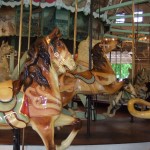
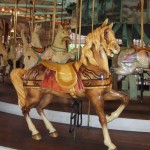
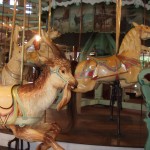
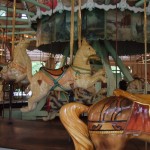
The horses and other animals were spinning on the humid summer afternoon as the merry-go-round mirrors reflected the sun’s rays. My kids humored me as we bought little red tickets for a dollar each, took our place in a very short line, until the bell rang then handed our tickets to a tall man and hurried to find a mount. Of course I chose one of the jumping horses and before long was riding the sculpted beast and thinking of my younger years.

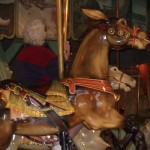
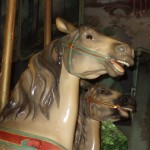
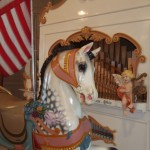
Gustav Dentzel, a German immigrant and woodcarver, settled in the Germantown area of Philadelphia. Gustav’s father was a woodcarver and carousel owner in Germany. The first carousel Gustav made in America he loaded on a wagon and traveled from town to town giving rides. Gradually, he began making carousels for other people which rapidly developed into a booming business. He opened G.A Dentzel, Steam & Horsepower Caroussell Builder in 1867. The carousel animals carved by his business gradually changed over the years becoming more and more intricate and whimsical. The Duchess, a Dentzel Menagerie Carousel, first opened in 1905 and has run continuously since then. The Duchess has 33 horses and an assortment of cats, rabbits, pigs, mule, ostriches, tiger, goat, giraffe and deer. In 1984 the carved creatures populating the carousel were restored to their original grandeur. This year marks its 105th season at Ontario Beach Park in Rochester, NY.

When we rode the Duchess it felt like stepping across time, the pipe organ music played as the horses jumped and whirl around and around. There is something about horses that inspire the imagination, and although other animals populate the carousel it’s the horses that prance and fly gracefully on their brass poles which dominate the merry-go-round. Somewhere deep in our collective conscious the horse holds a special place as a symbol of grace, power and beauty.

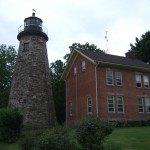
After our ride on the wooden horses, we headed back towards our car parked on the street bordering the park. I pulled into the church parking lot and saw the lighthouse, which sits on a hill overlooking the Genesee River. The 1822 lighthouse tower is made of limestone and built in a tall octagonal shape. The brick building behind the lighthouse was built in 1863 as a residency for the lighthouse keeper. The lighthouse was taken out of service in 1881 and slated to be torn down in 1960’s but some students at Charlotte High School organized a campaign and saved the lighthouse.

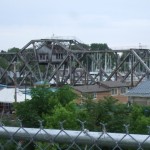
Behind the lighthouse, there is a beautiful view of the Hojack Swing Bridge which crosses at the mouth of the Genesee River. The bridge is an interesting structure built in 1905, the same year as the carousel, by the King Iron & Bridge Company. The bridge was a railroad bridge and allowed trains to cross the river. A bridge keeper was stationed in the bridge and opened it to allow boats to navigate up and down the river to Lake Ontario. There are groups trying to save the bridge. If you’re interested in historic archeology and saving the Hojack Swing Bridge check out The Bridge Project

The sun drifted lower in the sky. We enjoyed our short trip to the shore of Lake Ontario, but were glad to head home.

Footnote: The Hojack Swing Bridge was demolished in the fall of 2012. Although, the Bridge Project tried to save the bridge they were unable to do so. You can read more about it at The Bridge Project.

Posted in Uncategorized | Tagged , , , , , , , , , , , , , , , , , , | Leave a comment

The History of Horse Heaven

Johnn and Connie lived in town in a house on a tree lined street with cement sidewalks, and neighbors within shouting distance. Town was fine but they were dreaming of a place in the country. In 1984, the old Collins Homestead not far outside of Athens, Pa was owned by Red. He decided to divide the 300 acre homestead into subdivisions and sell off parcels keeping a few acres for himself and his trailer. Johnn and Connie came to have a look at one of the sections; the one that had the original farmhouse and barn. By the time they were through looking they ended up owning the place and 50 acres of land. Johnn and Connie kept the house in town for awhile and went back and forth between the two places. Jokingly, they began to call the place in the country the C & J Ponderosa.

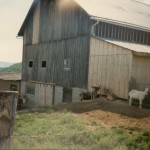
The farm house had been used as a hunting cabin and Red kept ponies in the barn. The barn required repairs; a large part of the roof had rotted and fallen in. An old silo at the end of the barn collapsed and needed to be removed. The house came with an outhouse, no indoor plumbing, no bathroom, no running water, the electric wiring was old and had to be replaced, walls needed insulating and the kitchen had a wood burning cook stove for heat.

“Wasn’t it hard not having a working bathroom,” I asked.

“It wasn’t that hard,” said Connie. “I grew up in Bernice, PA about 50 miles south of here, near Mildred in Sullivan County. Bernice and Mildred are old coalmining towns deep in the wilds of the Endless Mountains. Most of the residents were Lithuanian, Polish, Russian and Italian immigrants who came to work in the mines. Many homes had outhouses and hand drawn water from an outside well.”
“You’re kidding,” I said.

“No, I’m not kidding. We didn’t get in-door plumbing until I was a senior in high school,” Connie replied. “My grandmother lived across the street and our family used her hand dug well until it went dry.”

“Then what did you do?” I asked.

“We put a few milk pails in the back of Dad’s pick-up and drove a couple of miles to a spring,” she said. “For heat we gathered discarded coal at the strip-mines.”

“But it must have been hard,” I said, “especially in the winter.”

“It’s pretty cold when you have to go out in the middle of the night to the outhouse with snow on the ground and it’s below zero. But if that’s what you have to do – you do it.” Connie said, “So when we bought the Ponderosa having an outhouse wasn’t a big deal for me. We lived with it until we were able to put in a septic.”

Johnn and Connie worked hard putting the old place back together. Johnn built stalls in the barn and made extensive repairs to the roof. Connie stripped the woodwork in the house; they added indoor plumbing, new electric service, and insulation. John constructed a garage, body shop and PA inspection station at one end of the barn. Soon he was open for business fixing cars.

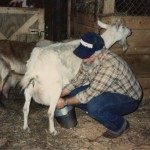
After the major work was completed on the house and barn; Johnn and Connie bought a Nubian goat named Silks. Silks had a turkey for a companion. The two animals hung out together in the pasture near the road watching the cars pass by. It wasn’t long before there were 13 goats on the farm. Connie and Johnn milked the goats and separated out the cream. Connie made and sold ricotta and mozzarella cheese.

One day a child was confronting the cruelty of his parents. His three legged dog was tied to a stake at the gravel pit not far from Johnn and Connie’s farm and left to starve to death. He told his friends and they devised a plan to rescue the dog. The kids ran to the Ponderosa and found Johnn and Connie.

“Mr. Ballentine there’s a dog tied to a stake and starving to death at the gravel pit,” said one of the kids. “Would you save the dog?”

Johnn recognized one of the children. He was the child of their friend who lived up the street. He turned to the boy and answered, “Get the dog and take it to your home. I’ll drop by and pick up the dog.”

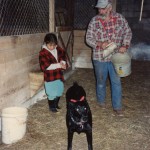
Johnn and Connie named the black Lab Lucky. The kids told them that Lucky had lost his leg in a fight with a Bulldog. Lucky fell in love with Johnn and followed him everywhere, even riding with him on the tractor. Connie and Johnn taught Lucky many tricks; one was when Lucky was asked to ‘give me 5’ the dog lifted his left paw.

Johnn was raised on a dairy farm in Brandymore, PA. He used his knowledge of farming to add more animals to the farm and the Ponderosa grew. The farm consisted of 124 Yorkshire pigs, 84 head of cattle, 300 chickens housed in the upstairs of the barn, and numerous ducks and geese. Connie and John routinely woke at 4 AM to get the milking done. Then John headed into the garage to work on cars and Connie left for her full time job at the Robert Packer Hospital where she worked as a pulmonary function technician.

At this time, there were two horses on the Ponderosa. Johnn had a Belgium draft horse named Champ, and Connie had a Quarter horse named Dolly. Then on a dark and tragic Mother’s Day in 1989, Dolly died. Connie was very upset when she rushed to work that day. At the hospital a young patient came in and sat down for a breathing test.

“Now hold your breath for 10 minutes,” said Connie.

The patient was confused and replied, “If I hold my breath for 10 minutes won’t I die?”

Connie looked at the patient. “I mean 10 seconds.” Salty tears swelled beneath her eyelids, Connie burst into tears, and stammered, “I’m sorry….my horse just died.”

The patient, Sandy Mack, was a horsewoman too. It wasn’t long before the two women were talking about horses and developed a strong friendship. Connie bought a new horse, a chestnut Tennessee Walker from a farm about 3 or 4 miles up the road. She named the horse Ruth. Ruth was an easy going trail horse. Sandy decided to board her horse at the Ponderosa, and the two women rode together on the wooded trails and dirt roads at Roundtop Park.

Johnn built an outdoor arena at one end of the barn, and Sandy began giving English riding lessons specializing in teaching beginning riders of all ages. She came everyday to do barn chores and care for her horses and ponies. Sandy’s daughter Corey came too, and rode with her mother and Connie. Once a year on Thanksgiving, Bruce, Sandy’s husband, came to the farm to ride. Horses were beginning to be an important part of the Ponderosa.

Sandy and Connie rescued a 40 year old neglected pony named Joey. Joey had lots of abscesses. They fixed him up and he was happy at the farm. Lynn O’Brian offered to give Joey a home. She thought he would make a good a companion for her horse. Unfortunately, Joey developed congestive heart failure and had to be euthanized. They brought him back to the farm and he was buried behind the barn.

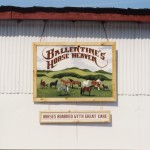
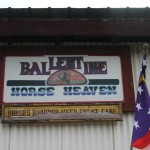
One day Sandy brought Connie a surprise gift; a sign painted by Lynn O’Brian. The sign read ‘Ballentine’s Horse Heaven’ under the sign hung a smaller sign that read ‘Horses Boarded with Great Care’. A large part of the farm was slowly turning into a riding stable.

For many years before moving to Athens, PA, Sandy and her husband Bruce lived in the artist district of Soho in New York City. One pleasant summer day Sandy brought a friend from the city to see the farm. The thin woman fell in love with one of Connie’s Yorkshire piglets. The young playwright, Liz Swados, bought the pig from Connie. She named the piglet Snowball and arranged for board in one of the stalls in the barn. The piglet grew and grew. A pseudo-rabies virus spread throughout the valley requiring all pigs to be tested. Economically it didn’t make sense to keep the pigs so they were sold to the slaughter house. The only pig that was left was Snowball. Snowball was a very happy, friendly pig greeting everyone who entered the barn. The pig ate out of people’s hands, lived a long cheerful life and finally died of old age.

As the years passed, gradually the cattle became less, and the number of horses increased until one day the horses, cats and dogs were the only animals left at Horse Heaven. Champ died and Johnn brought another Belgium horse to the farm and named her Myrtle. Lucky the three legged dog grew old. He liked to wander down by the creek near the house but had difficulty making it back up the hill. Johnn and Connie carried him home, until Lucky developed a tumor in the stump of his lost leg and died. He was buried in the pet cemetary in the yard behind the house. Through the years, other people came to board their horses at Horse Heaven. Eleven years ago Sandy gave away many of her horses to her riding students. She packed her bags, loaded 4 ponies into her horse trailer and drove out of the Valley. Sandy and her husband headed for Minnesota. Connie and Sandy are still friends and remember the days they rode together on Roundtop Park in the Endless Mountains of Pennsylvannia.

Posted in Uncategorized | Tagged , , , , , , , , , , , , , , , , | Leave a comment

Paul and the NYC Carriage Horses

Tuesday we were headed for MoMA on 53rd Street in Manhattan. When we arrived the museum doors were locked. Odd we thought as most museums are closed on Monday. What to do? We walked up the Avenue of the Americas headed for Central Park. It was that typical NYC kind of afternoon, slightly overcast with hundreds of people on the sidewalk hurrying towards important and not so important destinations. There were lots of tourists as we approached the park.

Since the museum was closed why not try the carriage ride? Years ago, when I lived in NYC I had wanted to ride in one of the horse drawn carriages which travel through Central Park. I was under the impression that the price was astronomical and never did. After doing some research on-line, I discovered that it wasn’t that expensive. So we walked towards the park and the carriage horses.

We were stopped by two young concessioners hawking bicycle cart rides through the park. Although, they tried to explain how much better their bicycle ride was compared to the horse drawn carriages we weren’t convinced.

At the intersection of 59th St and Center Drive a good natured Irishman asked, “Would you like to take a carriage ride? Just $50.00 for 4 passengers.”

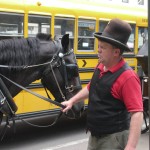
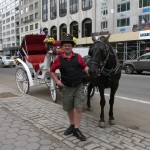
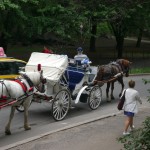
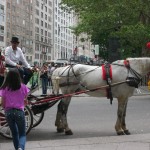
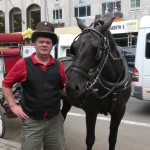
We said yes, and he introduced us to his horse Dream a quiet black Percheron/Morgan mix.

Paul McDaid came to NYC 24 years ago from County Donegal in Ireland. County Donegal is a sparsely populated county, made up of low rugged mountains with a deeply sculpted coastline, sandy beaches, bog lands, woodlands dotted with lakes, fertile valleys and friendly communities. The climate is mild; warm damp summers and mild wet winters. As the son of a blacksmith, Paul has always known horses. He grew up on a farm where there was a horse or two in the pasture. Periodically, he returns to his native country for a visit, but now lives in NYC. His career as a driver and teamster working with carriage horses spans 22 years.

Paul is there all year round even in the winter, unless the temperature reaches 87 degrees or drops below 19 degrees then the horses go back to the stable. The carriages operate seven days a week and into the night to at least 2 AM. The horses are stabled on the Westside of Manhattan in several stables stretching from 37th street to 52nd street. There are 68 carriages. All the carriages are not necessarily out at one time but with Memorial Day week-end approaching it looked like every single carriage was on the street or in the park.

“Where are you from?” asked Paul as he turned Dream toward the street.

“We’re from a little town west of Binghamton. But my sister-in-law Naomi lives in Queens,” I said. “Moe and I are in the city to pick up our daughter from the airport.”

Paul looked at Emma and asked, “So where were you visiting.”

“I was in Argentina and Chile,” Emma replied.

Paul smiled and said, “That’s beautiful horse country.”

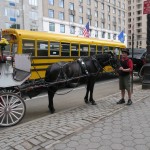
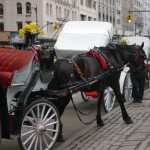
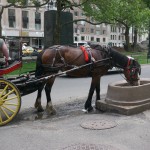
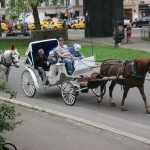
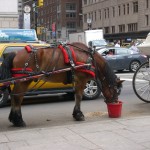
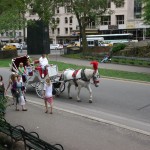
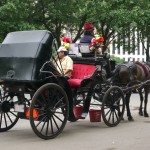
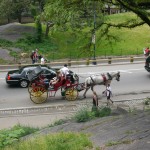
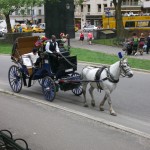
Paul helped us into the landau carriage. He turned Dream down Central Park’s Center Drive but we hadn’t gone far when Dream came to a stop. Paul explained that Dream was getting a drink at the horse trough located by the side of the road.

“So what’s the name of the horse you ride?” asked Paul.

“Pepper,” I said.

He laughed and said, “I have a good friend named Pepper.”

The bicycle carts, taxis and cars drove past as we looked up at the huge rocks worn by years of foot traffic. The ride was leisurely and Paul pointed out many sites where movies were filmed, Wollman Ice Skating Rink, Sheep Meadow, and the Central Park Carousal. We talked about horses as the sound of Dream’s hooves clip clopped on the asphalt.

“Pepper is a standard bred, and started out as a trotter at the racetrack. She was sold and ended up on a farm in Ohio where she was abused and rescued,” I explained.

“It’s a hard time for horses. A lot of owners are having trouble in this economy. They’re just turning their horses loose to fend for themselves.” He said, “Owners can’t afford to feed them.”

“There were two horses turned out in the woods where I live. We have hard winters and there’s not much for them to eat when everything is frozen,” I replied.

“A friend of mine went up to PA on business. When he returned to his truck two horses were hitched to his trailer.” Paul said.

We traveled through the park. The sidewalks were crowded with tourist, people were sitting on the grass, parents pushed strollers and bike riders peddled down the park paths. Nothing bothered Dream she walked leisurely through the park as the traffic passed by.

“Do the police stable their horses in the same stable as the carriage horses?” I asked Paul.

“No, they have their own stables.”

“As horse people do you ever talk with the police about your experiences with horses?” I asked.

“Not really other than to give a tip of the hat and acknowledge each other’s presence. Some older officer friends sometimes bring their kids down for a ride. Other than that no,” he said.

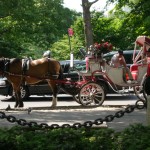
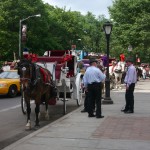
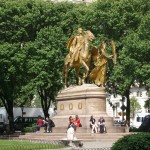
Paul turned onto 59th street and we rode towards Columbus Circle where many carriages lined the street close to the sidewalk waiting for customers. The gilded statue of General Sherman glistened as it towered above the street. We circled around and Paul looked for a space to park the carriage and for us to disembark.

“You should try hitching Pepper to a cart,” Paul said.

“I’ve talked about it with a friend who has a cart but haven’t tried it yet. I’ve never driven a cart horse,” I said.

“It’s not hard,” he replied.

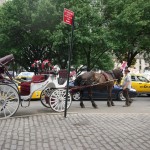
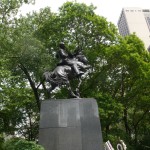
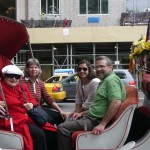
Paul pulled the carriage up to the sidewalk close to where we had started near the statue of Jose Marti immortilized in bronze and mounted on his horse. Paul jumped down and took our picture while we were still in the carriage. He helped us down.

“Would you like to give Dream a carrot?” he asked.

“I’d love to.” I said.

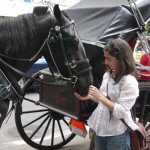
Emma and I fed carrots to Dream. Paul pulled on Dreams harness reins gently positioning her front feet on the sidewalk so she would be out of traffic as far as she could be.

“How did you become a carriage driver? I asked.

“A friend told me about a job driving carriage horses. That’s how I started and I’ve been working here ever since,” he replied.

“What keeps you here?” I asked.

Paul thought for a moment then replied, “The congenial, relaxed and companionable atmosphere.”

Horses and Central Park seem to go together. At one time there was a riding stable in the park. Before automobiles horse drawn carriages were everywhere in the city and the carriages of Central Park have been taking paid customers since the park opened in 1859. There have been accidents – horses hit by cars mostly. Not every horse is suited for the bustling crowded city; it takes a calm, well trained horse to navigate through traffic without freaking out.

We said goodbye to Paul and walked back through the park watching other horse drawn carriages leisurely meander through Central Park. The sky cleared and the pleasant heat from the sun warmed us as we walked toward the subway up 57th street crowded with rush hour traffic. When we reached the subway we were squished into a train headed for Queens, and back to the hectic pace of the bustling city.

Posted in Uncategorized | Tagged , , , , , , , | 2 Comments

Riding with Marilyn and Sam

Marilyn bought Sam from a cowboy who for relaxation rode up into the hills with a six-pack of beer. But what he really enjoyed was team penning. Team penning is a western riding event that gives a team of three riders on horseback 60 to 90 seconds to separate three cattle from a herd of 30 and drive them into a pen. Sam didn’t like herding cattle; in fact Sam doesn’t like anything about cattle, which was how he came up for sale and Marilyn bought him.

Marilyn and Sam have been together for eight years. In those eight years they have had a lot of adventures. Marilyn took Sam to a clinic given by a professional trainer, Stacey Westall. At the clinic, Marilyn learned partnership skills and how to form a connection with her horse. One summer, she loaded Sam into a horse trailer and with a friend went to Barclay Mountain in southern Bradford County, Pa. There is a coal miner’s ghost town on the mountain with defunct mines, cemetery, old stone foundations and stone bridges. They explored the trails and enjoyed the scenery. Then Marilyn came to Horse Heaven and Roundtop Park. She and Sam have been at the stable for four years.

I met Marilyn last spring when most of the activity picks up at the stable. I had just come to Horse Heaven and began leasing Pepper in the fall of 2009. We both liked to ride in the morning so we could do other things in the afternoon. We became good riding friends.

Pepper hadn’t been on many trails. She is a Standard bred. When she was young, Pepper was a trotter at the race track. Sam on the other hand is that great kind of trail horse many people dream of. Whenever we lost the trail or the trail was blocked by a fallen tree, Sam easily blazed a new path, picking his way through the woods and out the other side to find the trail again.

Last summer, Marilyn and I were riding at Roundtop Park. It was one of those long summer days that never seem to end. The sun had dropped below the tree line and was headed toward the horizon but there was still an hour or so of light before nightfall. We were riding up the North ridge and came to the Green Trail. Neither of us had ridden the Green Trail so we decided to try it. The trail meandered through the dense woods, switching back on itself in big half circles. Often we saw part of the trail through a few trees as we looped around. The sun was getting lower and lower in the sky and the woods darker and darker.

“Maybe this trail doesn’t lead back to the road like the others,” Marilyn said.

I saw a trail which looked like it headed in the right direction and said, “Why don’t we take this trail?”

We headed down the trail only to find that the trail doubled back on itself and ended up where we had started. The shadows were getting long. We were feeling very lost in the woods as the sun continued its descent towards the horizon. Panic set in. Neither of us knew where we were and the thought of being lost in the woods at night was scary.

“Let’s just turn around and head out the way we came, “said Marilyn.

“Ok, that makes sense,” I replied.

We both knew it was a long way back, and that time was getting short. The woods were getting dim and gloomy but we rode on. Finally, the horses came to a trail we knew led up to the road. Quickly, we trotted out of the woods. Once we were safe we started laughing and giggling.

“I feel like we’re school girls again,” said Marilyn.

“I do too. It’s funny how fear can make you feel like a kid,” I replied laughing.

We rode towards the barn, happy and chatting as the sun set into the western sky.

The summer of 2010 wore on, but Pepper’s bare feet were sensitive to the gravel on the dirt roads leading to the park. Connie’s farrier, Gene Fletcher, suggested hardening her hooves by cleaning them with a mixture of ½ chlorine and ½ water, and then applying Venice turpentine to the sole. It would take 2 weeks for the hooves to harden up and then riding barefoot shouldn’t be a problem.

Marilyn offered to meet me at the barn after work to hold Pepper and CJ so I could apply the ointment to their hooves. Pepper was pretty good about standing, but CJ wasn’t obliging. He wanted to pull his foot out from my grip and dance around. Marilyn put a stop to that by placing the lead rope around his nose. He settled down so I could work on his hooves.

The summer was hot and dry, the barn dusty and the tack areas were a mess. The five riders at the stable agreed one evening to sweep, dust and rearrange the tack areas. It was what I call a Work Party. The dust flew into the air as we sweep and cleaned. It was a good thing Karen had brought masks for everyone to wear.

After we finished Donna opened the back of her SUV and we helped ourselves to the food. Everyone brought a dish to pass; there was homemade chili, pasta salad, homemade cinnamon rolls, and several types of cookies. Connie stopped by with some tasty blueberry muffins. Everything was delicious. We sat on overturned pails, old folding chairs and whatever else we could find. It was a great picnic.
The summer faded into early fall. Annie, Donna, Marilyn, Karen and I planned to go on a moon ride. Donna and Annie had gone on one earlier and explained how enjoyable it was so now we were all planning a moon ride. By the time I drove up to the barn the black, night had fallen. All the lights were on in the barn and it felt warm and safe. I was late but even though all the horses were saddled everyone was waiting. I hurried and saddled Pepper while everyone went outside to see if the moon had risen. It hadn’t. We waited and watched the night sky; the stars came out over the hills but not the moon. Finally, we gave up and went home. When I turned in for the night I looked out my bedroom window and there was the illusive moon shining bright in the night sky.

Marilyn checked what time the moon would rise and discovered that it was still going to be full for a few days. We could still ride under the full or mostly full moon. Annie and Donna decided not to come so it was just Karen, Marilyn and I who met in the barn, saddled our horses and headed up the road. It wasn’t a clear night, it was a little overcast but there was plenty of light. I was surprised how calm the horses were; even though the road passed through the deep woods they walked and trotted without any problem. It was as if they could see better at night and nothing spooked them.

Karen, Marilyn and I rode together on park trails during the summer, into the fall and throughout the winter. Donna had coined a name for the five riders at Horse Heaven. She called us the Murray Street Riders since the road in front of the barn is Murray Creek Road. In the fall and winter, Marilyn, Karen and I were the only members of the group riding, so we amended the name to the Murray Street Three.

I asked Marilyn, “What was the best time you had riding Sam?”

Marilyn replied, “I’d have to say this past year, and riding through the winter at Roundtop Park.”

Marilyn, Karen and I had a lot of fantastic rides through the changing seasons at Roundtop Park. It was great just riding, enjoying nature and talking about anything and everything. Last week, Marilyn told us that she is giving up riding. There comes a time in every horseback rider’s life when its time to hang up the spurs and take off the cowboy boots. For Marilyn, that time had come and she arranged for Sam’s sale.

It was a beautiful spring day when Sam left Horse Heaven in a horse trailer bound for his new home. He is going to the home of a co-worker and friend of Marilyn’s who loves horses. Her friend has grandchildren who have already ridden Sam. Their adventures are just beginning. Marilyn took Sam’s name plate off his stall door and gave it to one of her friend’s grandchildren. Marilyn will be over to help her friend work with Sam. She is already making plans to teach them how to lunge a horse.

Posted in Uncategorized | Tagged , , , , , , , , , , | Leave a comment

Johnn and the Horses

Johnn and Connie own Ballentine’s Horse Heaven on Murry Street in Athens Township in Pennsylvania. The stable is nestled in the Endless Mountains not far from Roundtop Park. It is rare that I don’t see Johnn when I go up to the stables to ride Pepper or CJ. He is always taking care of the barn, mending fences, tinkering with the well’s pump, cutting wood or working on a piece of equipment in his machine shop.

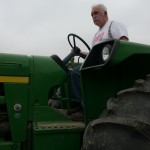
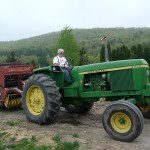
On Friday, he had his John Deere tractor and baler out in the yard. Johnn was getting ready to cut hay when the grass grows tall enough. Every year he cuts and bales hay from their field to feed the horses throughout the seasons. Some of the twine on the baler needed to be replaced and the tire on his tractor was ripped. He’ll need to use a front-end loader to get the bales from the field into the barn but once in the barn they can be rolled into place.
Everyday Johnn cares for the horses. He brings them in from the pasture and puts the horses out for the day. He fills the racks with hay, makes sure the horse’s stalls are clean with new bedding, their pails are filled with water, and that the right kind of grain is given to each horse. He knows which horse is ailing and what medicine it gets. He holds the horse when the ferrier or vet comes. We riders come a couple times a week but Johnn is there every day no matter how much snow, rain or sweltering heat.The horses know Johnn; trust and depend on him. If Johnn calls the herd they come running from the farthest sections of the pasture.
Johnn’s first horse was Champ, a Belgium draft horse, which came from a farm near the Canadian border in New York State. Champ was trained to haul logs out of the forest. The father and son team that owned Champ cut timber deep in the woods where a truck couldn’t go. The horse waited to have the log hitched then went through the woods by himself to the truck where the log was unhitched and loaded. Champ worked between the two men all day until the job was done.

Johnn had Champ for eight years then one day the horse couldn’t get up. It was winter and there was ice. Johnn took the tractor out to the pasture hitched a rope to the Champ and helped him get to his feet. But it wasn’t long before no matter what Johnn did Champ just couldn’t get up. The vet said it was time to put Champ down which they did in February 1995. Champ was 20 years old when he died.

A few months passed and spring came. Johnn and Connie went down to Ulster, Pa to look over the horses owned by Mr. Cole. They saw a one year old filly in the pasture with a lot of other horses. Johnn picked out the yearling from all the other Belgiums in the field. He loved the sorrel filly’s caramel color and named her Myrtle.

When Myrtle was four years old Johnn sent her to school at the home of an Amish farmer in Leraysville, PA. A few weeks later Connie and Johnn had to call in the vet for Myrtle because she had shipping fever. Shipping fever is inflammation and fluid build up in the lungs. It is common when horses are transported for long distances. The vet gave Myrtle a shot for the fever and a few days later Myrtle was fine. The farmer hitched Myrtle up with his 3 mules and trained her to pull a wagon and bale hay.

At the end of summer, Myrtle graduated from her schooling with the Amish farmer. Johnn hitched an arena drag to her harness and off they went to smooth and level the arena. She was so well trained that all he had to do was walk behind her holding the reins. She knew what to do. Then there came a time when the arena wasn’t being used, the grass began to grow, and Myrtle didn’t drag the arena any longer. Now Myrtle spents most of her time between the barn and pasture.
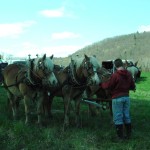
Johnn has plans to put Myrtle back to work this summer; hauling logs from deep in the woods. He has two harnesses ready; a nylon and leather one he purchased and another Connie had the good fortune to find at a garage sale. The man who sold Connie the harness had bought it at an auction for a friend who never came for it. All he wanted was the price paid for the harness which was a good deal. Johnn needs to adjust the harnesses and learn how to work Myrtle with the logs. A man who logs with draft horses is coming to give Johnn a hand with Mrytle to get them started.

Johnn told me about Dewy an old dapple grey draft horse he saw at a pull contest at the Troy fair. An old farmer owned the horse. He used voice commands and the horse did whatever he asked. He just walked out into the arena, said “back up Dewy” and the horse stepped a few steps for the pin to drop in the hitch, then he said “tighten it up Dewy” and the horse stepped forward until the rig was tight. Then the old farmer said, “Take it home Dewy” and the horse pulled all the way across the arena in one long straight pull.

Johnn said,”You just knew that the old farmer must have worked a lot with Dewy. They were a team; horse and man working together in sync. Something you don’t see very often.”

Posted in Uncategorized | Tagged , , , , , , , , | Leave a comment

Mother’s Day Ride

Mother’s Day 2011 was a beautiful spring day with sunny skies and balmy weather. A lot of rain had fallen in the past few weeks, and it was nice to have a day with clear skies. All the rain has caused serious flooding. The Susquehanna and Chemung Rivers overflowed their banks and trees which once grew alongside the rivers were in deep water.

Marilyn wasn’t riding but she said if Moe wanted to ride Sam go ahead. So Moe and I headed to the stables. We walked across the pasture which was very muddy in spots; even places that looked like dry grass were actually very wet. Once we brought the horses into the barn we got out the brushes and cleaned off the mud. John and another man were on the barn roof fixing a hole. The footsteps across the tin roof made the horses a little nervous, and when we took them outside to mount up they were still on edge. Once we were mounted and rode up the road the horses settled down and we started taking pictures.

The trees in the valley were already budded out and leafy, but as we climbed higher into the park it was noticeably different. The trees in the park were not as leafed out and somewhat bare. It’s a little colder at the top of Roundtop so I guess the trees are coming back a little slower. On the other hand, the grass was fresh and green after all the rainfall. It was long and full of dandelions. We decided to let the horses eat some grass while we took pictures.
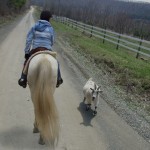
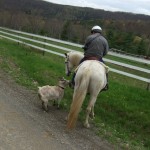
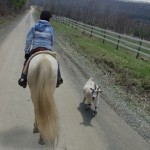
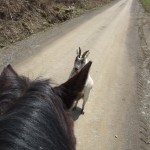
We rode through the park and headed toward the barn turning onto Weaver Road. In the distance we could hear a goat bleating. She was in the pasture with her pony friends. As soon as the goat saw us she scooted under the fence and came out to greet us. The goat walked right up to Sam and stopped. She seems to like Sam, but I’m not sure if the feeling is mutual. Sam bent his head down to smell the goat and the goat started licking Sam on the nose. Sam didn’t like that too much and quickly stepped away from the goat. That’s when the goat decided to come over to CJ. I wasn’t sure how CJ was going to respond to the goat because when CJ first saw the goat coming out of the pasture he shied. Instead of waiting for a confrontation, we walked away from the goat and quickly moved down the road. The goat followed us for awhile but finally decided to go back to her pasture. It’s a very friendly goat and I had the impression she just wanted to say hello.
We made it back to the barn and turned the horses out to pasture. It was a wonderful Mother’s Day and a special thanks to Marilyn for letting us borrow Sam for the day.

Posted in Uncategorized | Tagged , , , , , , | Leave a comment

Endless Mountains Draft Horse Club

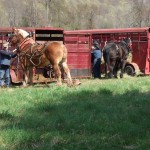
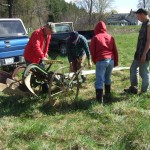
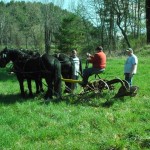
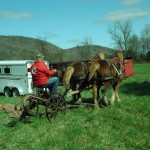
It was early in the day when I drove up route 34 to see draft horses plowing a field just outside Lockwood, NY. The Endless Mountains Draft Horse Club host Plow Days every year in the spring. The club is made up of people who own draft horses and people who do not own horses but are interested in learning about draft horses and participating in events. They host two events every year; Plow Days in the spring and Corn Days in the fall. The events are open to the public with free admission, parking, demonstrations on harnessing and plowing, and horse drawn wagon rides. Additionally, there are food and beverage stands, a flea market and craft booths.

The club has been in existence since 1988 and was founded by Windell Seeley to promote draft horses. They began demonstrating draft horse plowing at the Troy Fair in Bradford County, PA. Their focus is on plowing demonstrates, driving and handling skills used with draft horses. The members are open to helping others learn about draft horses and glad to answer questions. There are approximately 60 members and 10 active horse teams.

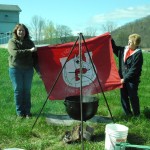
The first people I met were a group of woman setting up a food concession and putting on bean soup cooked over an open fire using a cast iron kettle. Alice Marks the club secretary, and Claudie Wilson, a member since 1993, held up the club’s banner for me to take a photo. They had just put the soup on and were getting the fire going. The field was covered with lush, green grass and ready for the horses to begin plowing. The ground was a little wet but not too bad considering all the rain we have received in the past week. Too much rain isn’t good for plowing in spring, although it’s not as troublesome in the fall because of the colder temperature.

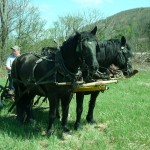
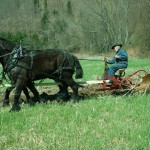
The first team I met was Ken Marks, Lester Coit and Loren Coit. Loren said his father had become interested in draft horses as a kid. He owned two powerful black Percherons, Star and Blaze. They hitched up their horses and turned them towards the lower end of the huge field.

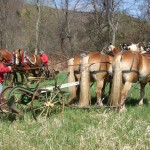
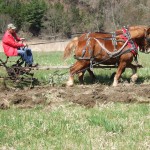
The next team I met was Mr. Weed and his grandson Mason. They have three beautiful Haflingers; Iris, Captain and Fiddle. They were checking the harnesses and preparing to hitch the horses up to a plow. The type of harness they use is called a Tab. Even though the Haflingers are pony size they are still considered a draft horse. The horses are very agile, good at obstacle courses, have great stamina, are easy keepers, and have a mellow disposition.

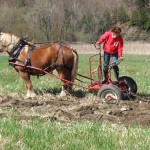
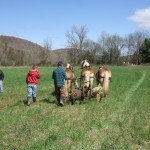
I followed the Weeds and their Haflinger team to the field where the Coits and Mr. Marks were already plowing. The earth was covered with grass, and several teams plowed the field at the same time. The plowshare cut deep into the soil as each team began to plow. The sharp plowshare rolled back the grass creating a neat long furrow and a ridge of soil. The idea is to turn over the upper layer of soil, bring fresh nutrients to the surface while burying whatever is growing on the top. Plowing also helps aerate the soil and allows the ground to hold moister. Once a team reached the end of the field they rested for awhile before turning around and heading back to make a new row.

A short time later, Marlea Hoyt brought her horse, Kate, down to plow the field. Kate is a 14 year old Belguim draft horse. Marlea said her father owned a team of black Percherons. She often helped him with his horses but this is the first year she has tried plowing. She said she’s still learning and it’s not as easy as it looks.

The day was perfect not too hot and not too cold. It was enjoyable to be able to watch the horses plow close up without any visual obstructions. Watching the draft horses work made it easy to imagine what it must have been like years ago before motorized farm equipment replaced the draft horse. It was wonderful meeting the people and watching them work with their horses.

When it was time to leave, I bought some donuts at the concession stand. The bean soup was still cooking when I said good-by to Claudie and headed home. I’m looking forward to seeing the Endless Mountains Draft Horse Club demonstrate harvesting corn with their draft horses in the fall. The club will be at Elsbee Farm in South Waverly, PA Sept. 24 -25, 2011.

Posted in Uncategorized | Tagged , , , , , , , , , , | Leave a comment

The Goat

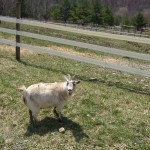
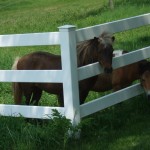
Marilyn and I first saw the miniature goat last fall when the trees were ablaze with color. On our way back to the barn, we rode down Weaver Road past the Slocum farm. A small fat goat with long horns stood in a pasture near two Shetland ponies. As soon as the creature saw us it bleated a few times and headed for the fence.

“I don’t think that fence is going to hold it,” Marilyn said.

And she was right; the goat ducked under the fence and headed straight for us falling in line next to Sam. The little goat walked with great self-assurance, as if she was supposed to be going wherever we were going. The last time CJ encountered goats, he tried to run away, but this time he didn’t seem to mind the goat, settled down and cautiously followed along behind Sam. Even when the goat stepped too close to the horse and Sam kicked; the goat took it in stride and didn’t miss a beat. The little goat just kept marching alongside Sam. After we had traveled a little bit down the road Marilyn stopped.

“I think the goat is going to follow us all the way back to the barn. Why don’t we turn back towards the goat’s pasture? Maybe if we walk up the driveway she will head back home?” she said.

“Ok, it’s worth a try,” I said.

We turned the horses around and walked up the gravel driveway headed for the barn and the goat’s pasture. Sure enough, the goat scurried under the fence and trotted back to her pony friends. We quickly changed direction, taking the opportunity to trot away before the goat could change her mind.

A few weeks later my daughter, Emma, and I rode down Weaver Road near the Slocum farm. A middle-aged woman and the goat stood near a white mailbox next to the road, and we stopped to say hello. Cassandra owned the goat named Roxy, and told us the animal used to live next door. However, the goat’s owners were going through a turbulent divorce and couldn’t keep her any longer. Roxy bleated and peeked out from behind Cassandra as she talked. Roxy certainly had a lot of character.

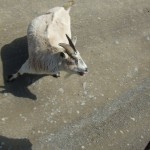
Wintry weather brought snow, sleet and ice. All season long the goat was out of sight, but in early April I again saw Roxy in her pasture with the ponies. The goat saw Pepper and me as we walked down the road towards home. The two ponies watched Roxy made a beeline for the fence. Pepper stopped. She wanted to get back to the barn but the goat blocked her way. The horse stared at the goat hurrying towards us. Pepper arched her neck and snorted. With some encouragement, we walked a little way down the road, and Roxy trotted alongside as if she were out for an afternoon adventure. I stopped to take a picture, and the goat became upset, bleated and stuck out her tongue. Pepper didn’t seem to mind the goat following, however, Roxy needed to go home.

I turned Pepper around to face the goat, hoping that Roxy would also turn around and go back to her pasture. The goat didn’t care for Pepper confronting her, reared up and stood on her back feet. Quickly, I spun the horse around avoiding a confrontation between Pepper and the goat. Roxy continued to follow behind Pepper, but the warm afternoon began to tire the goat. When I turned up the Slocum driveway Roxy gave up the chase and returned to her pasture. Quickly, Pepper and I circled towards home and cantered away.

Curious about the relationship between horses and goats, I searched the web for information. From what I read, it seems that goats and horses can get along – not always. Some racehorses have a goat for a companion on their travels from track to track. Whatever the case, Roxy obviously enjoys the company of horses and horses don’t seem to mind her too much.

Posted in Uncategorized | Tagged , , , , , | Leave a comment