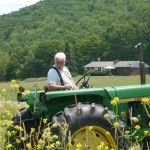
Haying at Ballentine’s Horse Heaven

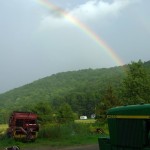
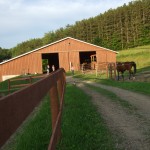
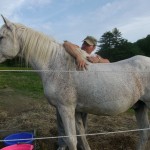
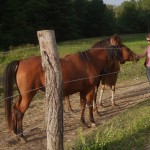
Baling hay seems straight forward – cut it, bale it and put it in the barn, but like everything details matter. Johnn has been baling hay at Horse Heaven since 1985, before that he helped on his family’s farm until he turned 18 and went into the world to other jobs. He knows a lot about farming and hay. On a beautiful summer morning in July, Johnn sat behind his desk in his office. We spoke about cows, horses and the process of baling hay.

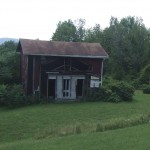
The haying season in Northeastern Pennsylvania runs from June through August. Timothy, Clover and Alfalfa are the predominant components of hay. The field is ready to cut when the grass is in full seed or the clover is in full bloom. This is the point when the grasses are filled with the most nutrients.

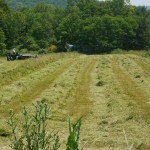
When the grass is tall, standing in the field and ready to be mowed, Johnn pulls out his tractor and hitches up the haybine. The haybine has rubber rollers with intermittent matching tread that crushes and breaks up plant stems; this helps eliminate moister in the grass. The haybine cuts a 9 foot 6 inch swath that comes out of the machine in 5 foot windrows. The windrows are comprised of freshly cut grasses neatly piled in long rows. The freshly cut hay is now ready to dry for a few days depending on the weather. Weather is a critical part of the scenario, since rain can damage the hay causing it to mold.

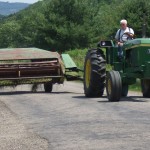
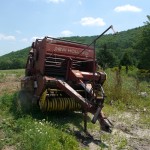
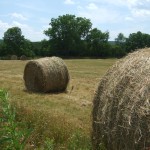
After the hay is cut, Johnn attaches his hay tedder to the tractor. The hay tedder throws swaths of hay across the field, fluffing it up and eliminating moisture, allowing the hay to dry out faster than if it merely sat in the windrows. A day or so later, the hay is ready to rake, which puts it back into neat windrows. Once raked, the baler is attached to the tractor and Johnn runs down each windrow producing big, round bales of hay. Each bale is 5.5 feet by 5 feet and weighs approximately 850 pounds when first cut; after the bale dries it weighs about 400 pounds.The bales are left in the field until they are dry, otherwise, the heat of the drying hay in the barn could spontaneously ignite and cause a fire. Some farmers leave the round bales in the field and don’t store them in a shelter. Johnn always stores the bales in the barn and opens one when he needs hay to feed the horses.

“The weather plays an important part in baling hay, if the grasses are too wet and have too much moisture when baled, the hay will mold. That’s why after the hay is mowed you have to let it dry out for a day or so before you bale,” said Johnn.

“You can’t feed hay with mold to horses?” I asked.

“No, horses have a single stomach and can’t digest hay with mold or other toxins,” he replied. “It can make a horse sick, colic and die.”

“What does the mold look like,” I asked.

“It is white, as white as this cup,” he said tapping his coffee mug. “Now cows are different. Cows have a four chambered stomach and can break down rougher hay. They are more tolerant to mold.”

“I notice that some farmers leave their round bales in the fields and don’t store them in a barn or shelter,” I said.

“Some do. Those bales are probably meant to be fed to cows. If you leave the bales long enough in the field mold will form on the bottom where the bale touches the ground. Horses need better quality hay, free from mold,” replied Johnn.

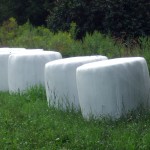
“I’ve also notice round bales wrapped with white plastic. Is that a method of storing hay to protect it from molding?” I asked.

“No, that’s called white wrap. The grass is baled green to make silage,” replied Johnn.

“Silage, I’ve never heard of that,” I said.

“Silage usually comes from a silo. In the silo you put corn, sometimes chopped grass and let it sit until it ferments and forms silage. The silage looks thick and brown and stinks awful. The cows love it. Silage increases milk production, but silage isn’t any good for horses. So in those white wrapped bales the farmer is making silage the same as he would in a silo,” said Johnn.

The nutrients found in hay are important to the health and wellbeing of the horses. Johnn keeps a close eye on it’s quality. The hay will feed them over the long, barren winter. In past years, he has thrown out hay because it was moldy and not fit for horses to eat. One problem with moldy hay is that mold spores can quickly spread to other bales contaminating them as well. The extreme cold in this region of Pennsylvania makes it important to plan ahead. The first day of fall comes a few days from now and after that wintry weather will begin.

Posted in Uncategorized | Tagged , , , , , , , , , | Leave a comment

Gene Fletcher – Farrier at Ballentine’s Horse Heaven

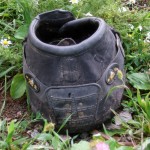
In the summer of 2010, I ordered my first pair of horse boots and made a common mistake. The boots come in different sizes depending on the shape and dimension of the horse’s hoof. The boot manufacturer stipulates that a farrier should take the measurements after the horse is newly trimmed, but since I needed the boots immediately and the farrier wasn’t coming to the barn for a few weeks; I took the measurements myself and ended up with boots that almost fit but were actually too small. By the time I realized my error, it was time for Gene to trim Pepper’s feet so I decided to speak with him about the boots.

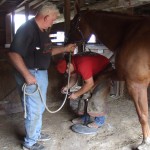
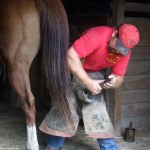
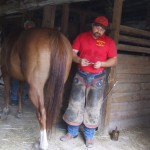
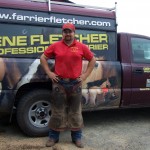
Gene’s truck was parked in front of the barn and the tailgate doors were open exposing a huge anvil, a wide assortment of tools, and lead ropes. I walked into the barn and found Johnn holding Pepper as Gene trimmed her hoof. I explained the problem with the boots and asked if he would measure Pepper’s front feet. He measured her feet, wrote down the numbers on a piece of paper and handed it to me.

“Horse boots aren’t necessary if you toughen up the sole.The hoof’s sole becomes hard or soft depending on the conditions the horse is kept in. There is a simple method which will harden the horse’s soles so they can walk over rocks and not have sensitive feet. The process would take about a month but after two weeks you should see a big difference. Until then, use the boots,” he said.

The preparation was easy but required daily application. My friend Marilyn offered to help so we met every day for a few weeks to complete the treatment. It worked great and before long Pepper’s feet were not as sensitive over the gravel roads. Not only did it harden her soles it eliminated any trace of Thrush she might have had.

I rode two horses that summer; Pepper and Pepper’s offspring, CJ, a green broke gelding. CJ was giving me a few problems so when I encountered Gene again at the stable while he was trimming and shoeing horses I decided to speak with him.

“Gene, I’ve been having some trouble with CJ. At every opportunity, either in his stall when I’m saddling him or when I stand on the mounting block and get ready to step into the stirrup, he head butts my arm. Maybe CJ thinks it’s a game but I’d like to get him to stop. My arm is all bruised up,” I said.

“There’s a simple solution to that problem. Hold your hand open with the fingers together; when he turns his head and comes too close to you just put your fingers between CJ’s neck and cheek. You don’t have to use a lot of force; it’s a natural reaction for a horse to turn away from the pressure. He’ll get the idea and stop invading your space pretty quick because it’s uncomfortable,” replied Gene.

“Ok, I’ll try it. Another thing he does is every time I step up on the mounting block CJ gets nervous and scoots off a few steps, then I walk him around to the block again and he does the same thing. Do you have any suggestions on how to get him to stand still?” I asked.

“As far as the mounting block, he’s probably afraid of it. Horses have a natural fear of anyone or thing that pops up from the ground towards their back or head. It’s a survival instinct. So when you step up on the block it scares him,” he replied.

“How can I get CJ over it?” I asked.

“Take the mounting block into the stall with you and stand on it when you groom CJ. Most horses feel the stall is their safe zone. After awhile he’ll get used to you stepping up on the mounting block. Once he’s used to it, take the mounting block outside and do the same thing. Don’t get on just step up on the block until he stands still. If he moves away pick up the mounting block and follow him, put it down next to him and try again. After a while he’ll get tired of you following him with the mounting block and he’ll stand. Once he stands when you step up on the mounting block get on and stand for a minute or two before you ride off, that way he’ll know you want him to stand still until you’re ready to leave,” he said.

“Ok, I’ll give it a try,” I replied.

The next time CJ turned his head towards me while I was tightening the girth I quickly put pressure at the point between the cheek and neck; right away CJ stopped trying to butt me and stepped back. I was surprised how quickly that worked. It took more time with the mounting block but it was worth the effort because that worked too. He stopped fearing my stepping up on the mounting block and stood for me to get on. CJ sometimes took a step or two but it wasn’t out of fear, more likely he wasn’t standing square and was off balance.

If I have a problem with one of the horses, Gene is the one I ask for advice. He was born into a horse family. His parents owned and loved Appaloosas. They put him on their horses when he was a baby, and as a result, horseback riding formed some of his earliest, childhood memories. When Gene reached 14 the horses were sold. Like so many people, they found it financially hard to keep them. However, that didn’t stop Gene from riding. A neighbor friend still had a couple of horses so he rode with his friend until he graduated from high school and entered the Marine Corp. In the service he had time to think about what he wanted to do with the rest of his life. He knew it had something to do with horses and he decided to become a farrier.

Gene attended Meredith Manor International Equestrian Center in Waverly, WV. His first farrier position was working as an apprentice in West Virginia for a few months. The farrier he worked for didn’t share Gene’s basic philosophy about horses which is “listen to the horse” and through non-verbal communication develop a working relationship with the animal. Gene parted ways with the West Virginia farrier when the man had trouble catching his horse. The horse kept running away from him, so when the man finally caught the horse he tied it to a tree for two days to teach the horse a lesson. Gene decided it was time to start out on his own and headed back to Pennsylvania.

Currently, Gene finds himself busy; his business is booming. He teaches an on-line class through Alfred State College which is part of the New York State University system. Besides his work as a farrier, he trains horses and gives riding lessons. Recently, he finished Entrepreneurship Boot Camp for Veterans at Syracuse University. EBV is a foundation dedicated to helping veterans network, set-up or expand their own businesses. Someday, Gene plans to franchise his business by training farriers who will work under his guidance. His website and blog are filled with information about horses, and designed to educate the public so horses will be well cared for and have a better life.

Posted in Uncategorized | Tagged , , , , , , , , | Leave a comment

Horses at the New York State Fair – 2011

Friday morning Emma and I set out for a long country drive to Syracuse, NY and the New York State Fair. The day was warm and pleasant; although, clouds gathered it wasn’t supposed to rain and by the time we pulled off the highway and into the fair parking lot the sky was blue with just a few white clouds. The lot was filling up fast. We paid our five bucks and the State Fair employee put a pink parking slip on the dashboard as other attendants directed us past rows and rows of cars to the end of the huge lot. I pulled the car alongside a Jeep Cherokee and turned off the engine. A short walk brought us to the entrance at Gate 3.

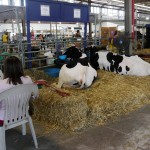
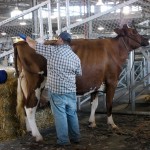
Directly ahead of us stood a huge brick building, the Dairy Cattle Barn, which housed lots of cows, exhibits and a milking parlor. The cows were resting on soft yellow straw and munching hay. I puzzled over a sign which labeled two cows. The sign didn’t make sense to me. The first line read Hy Light and the second line read Denny Fantasy.

“I’m a bit confused about the sign over your cows,” I asked a woman sitting nearby. “What does Hy Light mean?”

She smiled and replied, “It’s the name of my son’s farm which is located near Smithville in Jefferson County, NY. The signs can be a bit confusing. The first line is always the farm name. The farmer’s surname is usually somewhere within the name. Sometimes a name describes the farm for example Hidden Acres or Ten Acres. As for Denny Fantasy – every cow has two names; the first is the name of the sire which in this case is Denny and the second is the cow’s name. The name gives an easy reference to the sire, without referring to registration papers.”

“That’s interesting,” I replied.

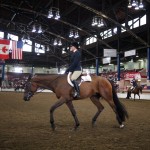
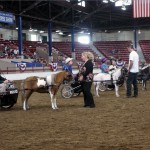
We left the Dairy Cattle Barn and walked across to the Toyota Coliseum where the horse show was in progress. Miniature horses pulling carts walked and trotted around the arena. The drivers were dressed in whimsical outfits and the event had a fairytale quality. A group of judges handed out big, colorful ribbons at the end of the competition. The next class, Plantation Horses under Saddle, came into the arena, and the riders put the Walking Horses quickly through their paces.

The aroma of food waffled through the Coliseum and we decided to take a look at Restaurant Row; just outside the building. There were many food concession stands mixed with merchants hocking their merchandise. A Greek food stand looked good; we purchased a Gyro and found a bench in front of the Country Max Horse Barn. Directly ahead of us was the back of the Coliseum where riders were warming up their horses for the next event. Not far away, a young woman bathed her horse as fairgoers looked on.

We finished eating and stepped inside the Country Max Horse Barns where crowds of people gathered to look at the horses in their stalls. One woman had her stall gate open with a rope across the front to keep her horse in. Lots of children and adults gathered around petting the gentle horse. I stopped to take pictures and spoke with the horse’s owner, Jill Buday from Sullivan County.

“How long have you been coming to the fair?” I asked.

“About 10 years. The State Fair is the only show I regularly come to. My horse, Wick, is more of a pet than a show horse,” she said.

“Are you going to be in the arena today?” I asked.

“I won’t be jumping today. I’m scheduled in the Hunter Jumper class tomorrow,” replied Jill.

“That’s a shame. I’d love to see you and Wick in action. He’s a beautiful horse. I was struck by how calm he was with all the people coming so close to see him,” I said.

“I usually leave my horse’s gate open so people can pet him and visit. I think he likes all of the attention. My sister, Lori Brustman, is more into shows. She has taken her horse to several other states as far as Florida – even to the Quarter Horse Congress in Columbus, Ohio.”

I glanced into the adjacent stall and saw Jill’s sister, Lori, busy braiding her horse’s mane in preparation for the next event. Later, I looked the Quarter Horse Congress” up on-line and discovered that The Quarter Horse Congress is the world’s largest single-breed horse show. The show has thousands of Quarter Horses in attendance over a three week period. Last year, more than 650,000 people went to the show.

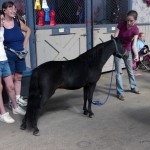
We said good-by and good luck to Jill and walked down the wide aisle between stalls. A bit further we met another young woman who was surrounded by admirers. People towered over the small horse. I remembered seeing her drive a cart pulled by a tiny, black horse in the Coliseum arena a short time before we came into the stables. The horse was very well-mannered and not bothered by the crowd.

“Your pony is very cute,” I said.

“He’s a miniature horse called a Felabella, not a pony,” Alicia Harrington the horse’s owner and handler said good-naturedly.

“I didn’t realize,” I replied. “I saw you earlier in the Coliseum. How long have you been working with your horse?”

“Four and a half years, I started by helping my cousin, Ariel Quistorff, with her mini for a few months, then I got Rajah,” she said.

We said our farewells to the girls and left the stables when my cell phone rang. My husband, Moe, had made it to the fair and said he would meet us at the Dairy Barn. As we walked to meet him, Emma explained that she had seen the tiny horses on her travels in Argentina. The horses were breed in South America over a hundred years ago. The little horses are often used there to pull carts or sit children on to have their pictures taken.

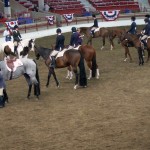
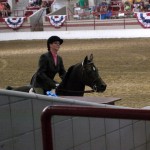
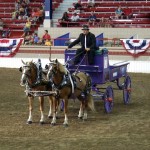
We found Moe and the three of us walked through the crowds in Restaurant Row and the Marketplace Pavilion drifting into the Poultry Barn where we saw soft, fluffy Silkies died pink, blue and yellow. There were rows and rows of cages containing chickens, turkeys, geese, and ducks. We meandered out of the Poultry barn and strolled into the Goat, Llama & Swine Barn, finally emerging from the opposite end of the building into open sky and sunlight. After that there was only one place to go; back to the horse show where we watched the amateur hunters jump, the pleasure horses running walk, the Arabs prance and draft ponys pull a huge wagon. We witnessed only one misshape when a young woman fell from her horse and walked out of the arena unhurt.

The time flew by and before we knew it we were back in our car driving south towards Waverly and home. The first rays of a beautiful pink sunset streaked across the sky. The State Fair was enormous. We had only seen one corner of the total fairgrounds and a few exhibits. The Fair is more than just horses, there are many wonderful exhibits and attractions to see, but I have to say the horses made it a very special day for me.

For more information on the Fair go to New York State Fair

Posted in Uncategorized | Tagged , , , , , , , | Leave a comment

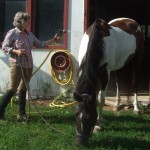
Bathing Horses

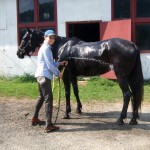
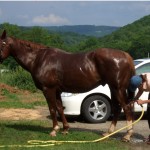
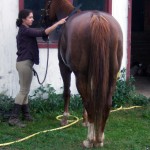
One delightful summer activity we enjoy is giving the horses a cool down bath at the end of a ride. When the temperature tips into the eighty’s even the late afternoon can be hot and muggy. The horses sweat and dirt from the trail clings to them after a long trek through the woods. Even though the last few miles we always walk to help the horses cool down, they are pretty grubby when we return to the barn. The sweat and grime from the trail collects under the girth and saddle pad forming a thin layer of goo stuck to the horse.

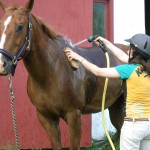
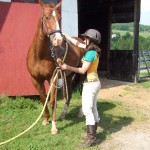
After a ride we turn into the barn and unsaddle, grab brushes, water scrapper and sometimes horse shampoo. One of the riders hooks the long yellow hose to the water pump in the barn and the cool down, clean up begins. A sparkling stream of water covers the horse’s legs first, then as the animal becomes accustom to the water the hose moves upward along the shoulders, neck, back and tail. A refreshing mist bounces off the horse’s hide invigorating the rider as well as the horse. After a nice squirt with the hose, a rubdown with the brush helps to loosen any dirt and caked on mud, then the water scrapper is used to stop that annoying drip, drip, drip, running down the side of the horse and trickling off the belly. As a finishing touch, we usually run the brush all over the horse.

It’s important to remember when riding a barefoot horse that too much water on hooves can soften the soles. It’s a constant battle keeping the horses soles in good shape. Soft soles mean the horses feet are more sensitive to gravel and rocks on the road and trail. So lightly goes water on hooves.

Following the bath, the radiant summer sun pleasantly warms and dries the horses. We let them nibble the green blades and seed-heads in the grassy patches near the barn. A wide assortment of flying pests irritates the horses as they munch happily away at the tall grass. The flies are quick but if we’re lucky a swift swat takes care of the problem. The horses enjoy the fresh grass, but before long it’s time to turn them out to pasture.

We linger at the barn door watching the horses walk across the dry dusty patches in the pasture. The squeaky clean horses meander into the open field to rejoin the herd. As it occasionally happens, one of the horses decides to roll in that bare dusty spot near the barn. He probably feels we didn’t eliminate all the itchy places with the water and brush or maybe he just wants to dry off. In any case, down he goes and up he comes covered in dirt. He shakes off the excess dirt and happily trots out to join up with his buddies. It can be a bit frustrating to see him roll in the dirt after we spent so much time cleaning him, but what can you do? He’s just a horse.

Posted in Uncategorized | Tagged , , , , , , | Leave a comment

Horses Do Lie Down

In the middle of June the weather started to heat up, so riding became either an early morning or late afternoon activity. One morning, around 8:00, Emma and I were at Horse Heaven. The horses were still in the barn waiting for Johnn to turn them out for the day. We hurried to get our tack together and as I passed Jupiter’s stall I noticed he was lying down with his feet tucked under him. His eyes were half shut and he was snoozing. All of the other horses were up and moving around but not Jupiter. I stood by his stall watching him when all of a sudden he laid completely down with his neck stretched out and his legs flung out from under him.

“Emma! Jupiter doesn’t look too good,” I said setting down my saddle next to his stall.

Before I received an answer from Emma I ran the short distance to the barn office and found Johnn sitting behind his desk sipping coffee.

“Johnn, I think there is something wrong with Jupiter,” I said the words rushing out of my mouth, “He’s completely stretched out in his stall!”

Johnn took another sip of his coffee and calmly replied, “He’s just sleeping. I have a really hard time getting him up in the morning. I usually have to go into his stall and nudge him a few times to wake up.”

“You’re kidding,” I said.

“No, he’s a late sleeper,” Johnn replied.

I left Johnn’s office, walked across the dirt driveway and back into the barn. Emma was standing at Jupiter’s stall holding a brush in her hand. I looked into the horse’s stall and not only was he still stretched out, now he was moving his legs and lips. Obviously, he was engaged in some kind of dream state as he moved into deeper REM sleep.

“Johnn says he’s just sleeping. Why don’t we brush Pepper and maybe by that time, Jupiter will be ready to go,” I said picking up the brush bag.

The days passed one by one, each hotter than the next. The ground, once wet and soggy from all the rain we had in the first weeks of June, began to dry out. It was early evening and still sizzling when Karen and I saddled the horses and rode out of the barn at Horse Heaven.

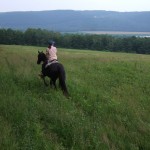
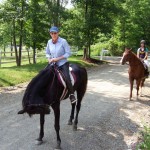
We rode up Pump Station Hill Road until the horses reached a trailhead that led into the woods near Round Top. This was CJ’s second summer riding in the park. He enjoyed the woods and followed behind his mother, Pepper, without any problems. The steep trail led up the side of the mountain through white pines, honeysuckle bushes, and an assortment of maples and oak trees. At the top of the ridge, we came to an open field that stretched across the Susquehanna River basin. The grass was very high and budding out with seeds waving in the gentle breeze. We circled through the woods and came to a service road. The service road led down a gentle rolling hill to an open expanse of newly mowed grass. In the middle of the lawn, directly in front of a deserted house, stood an old water pump, and a bit further on were a couple of old barns.

Once past the abandoned homestead we turned onto the power line access road. We galloped up the road dotted with telephone poles and overgrown with weeds. CJ moved ahead of Pepper taking huge leaping strides across the soft ground until we reached another trailhead at the top of the hill leading into the woods.

I looked down at CJ’s front hoof and said, “Oh crap! CJ lost a boot. It must have happened when we galloped up the hill.”

“It probably came off in the tall grass,” replied Karen turning Pepper around.

We rode back down the power line passing the telephone poles surrounded by weeds, looking for the boot. My heart sank as I thought what the loss represented; both financial and in time. It took several days or weeks to get a replacement boot, which meant CJ wouldn’t have a boot to help protect his feet from the gravel road. I was surprised; the Old Macs that he wore had never fallen off before although last year, Pepper’s Edge boots had often come off. Usually, Pepper’s boot only slide off the hoof and hung on her pastern, ripping the gaiter, which meant the gaiter had to be repaired. Last year, the company ran out of replacement gaiters and it took weeks before I finally managed to get one shipped.

“I love and hate these horse boots,” I said looking from side to side into the grass trying to see the Old Mac.

“I don’t see it,” said Karen as she reached the end of the hill near the old barn. Do you think she lost it near the old homestead?”

“No, probably not,” I replied disappointed. “We might as well head back into the park.”

We turned around and retraced our route past the telephone poles. Halfway up the rise Karen dismounted and held up the horse boot.

“I found it!” she shouted.

“Great! I’m so glad you found it!” I shouted relieved.

I dismounted. Karen handed me the boot and I said, “It looks ok. It just slipped off.”

Karen held the horses while I buckled the boot onto CJ’s hoof and then swung back on.

“Do you want to try riding down the line of telephone poles instead of going back up the hill? We can pick up the trail on the other side of that field,” I said pointing to a huge meadow that opened up past the old homestead.

“Ok, let’s give it a try,” said Karen.

Near the bottom of the hill, at the fields edge there was a bog with deep mud and cattails. Swamp plants grew in the soft earth. CJ grabbed a few bites of a strange looking weed. I thought to myself, ‘I hope they aren’t poisonous’ and reined him in.

We turned the horses toward less marshy ground and headed down the edge of the field across acres and acres of open grassland. The sun was low in the afternoon sky and the heat of the earlier day lapsed into a pleasant warmth that enveloped us. The grass made a rustling sound as the horses passed through. We came to the entrance of the woods which were dark and cool compared to the open field.

A few feet from the trailhead CJ surprised me. All of a sudden, I felt him tuck his back feet under himself, in an instant my feet were flat on the ground, so I did what seemed practical and dismounted. I turned towards CJ wondering what could be wrong, when he laid his head completely down into the grass. What the heck is going on here! In a split second hundreds of weird thoughts raced through my mind; ‘CJ must be poisoned by that weed he ate! What will I tell Connie? This can’t be happening….’ Then I realized, even if he was dying from a strange poison weed he wasn’t going to just lie there. No matter what his problem was he was going to stand up, so I pulled hard on the reins and shouted, “Get up CJ!”

Karen turned around and said, “What are you doing?”

CJ raised his head, stretched his front legs, and suddenly stood up. I put the reins over his neck, my foot in the stirrup, climbed back into the saddle and said, “I’m not sure. One minute he was up and the next he was down.”

“That can become a bad habit. I’m reading a book on horse vices and lying down is one of them,” she said.

“I never heard of that,” I replied adjusting my position in the saddle.

“It’s a bad one. I used to have a horse that laid down all the time. It was a pain,” she said turning Pepper towards the woods.”

“I’ll watch out for that,” I said. “I thought he was dying, similar to the other day when Jupiter was asleep in his stall.”

“No,” said Karen “It takes a lot to kill a horse.”

“That’s good to know,” I said.

“What did you do when your horse lay down while you were riding? I asked.

“I had to hit him to get him to stand up. We would be riding along and all of a sudden he’d just decide to lie down,” said Karen. “It was really frustrating.”

“I never knew anyone who had a horse like that. Although once I was riding with a girl whose horse tried to roll in the creek with her in the saddle, but that was only in water,” I said.

We rode through the dense woods, the trail weaving through honeysuckle branches and rose bushes. The trail passed near a shear precipice, the horses walked by and picked up a trot heading towards the baseball diamond in the middle of the park. The sun sank to the horizon as the warm summer night approached soon to fill the woods with darkness. The tree tops hummed with the songs of the cicadae, as we traveled down the gravel road through the park steering a course toward home.

Posted in Uncategorized | Tagged , , , , , , , , , , | Leave a comment

The Allusive Bear

The first week in June, Karen, Emma and I saddled up and rode towards Round Top Park. The road passed between a trailer and a white, clapboard farm house. Just after we passed the farm house on Sutliff Hill Road, we saw at the hillcrest a middle-aged woman wearing glasses walking towards us. We stopped when she came up alongside the horses.

“Have you seen the bear?” she asked her voice edged with fear.

“No, but I heard there is a big black bear in the area,” I said.

“It’s huge! He’s been hanging around our place near the back door,” she said looking over her shoulder. “I’m surprised to see you riding with that creature prowling around.”

“We ride by here often and haven’t seen it,” I said. CJ shifted his weight and rested his back foot on the dirt road.

“Every morning that bear walks right down the middle of Weaver Hill, then cuts across the field and goes downhill past our house. He smells absolutely horrid,” she said visibly nervous. “After he leaves our place, he heads towards the stream at the base of the ridge near Murray Creek Road.” She glanced down the hill towards her house and the open fields dotted with bushes and trees.

“That’s near our barn,” I said. “A large bear was up on Connie’s back porch trying to get the birdfeeders a few times this week. She said it was the biggest bear she had ever seen.” I replied glancing down at the woman.

“She’s right. It’s big and ugly,” the woman replied. “I hope you don’t run into him.”

“I hope we don’t either,” I said watching the woman turn away from us and hurry down the road.

We continued up the hill a short distance when suddenly, a deer bolted through the fields and backyards near where the woman had indicated she had seen the bear. The deer traveled at lightning speed, crossed the road and leapt into the woods which bordered Round Top. I looked in the direction the deer had come for the bear but nothing was moving; the horses were jumpy and everything was deadly quiet as we rode on into the park.

We finished our trail ride and came back via Weaver Road without seeing the bear. The day was muggy and sizzling, hot. The horses were dripping sweat and sticky with dirt. When we reached the barn, Karen hooked up the hose to the well’s hand pump, and we took turns bathing the horses.

About a week later, Karen left work early and we rode on a hillside covered with open fields near Oakfield Drive. The fields had paths mowed through the knee high grass. We cantered, trotted, and jumped puddles nestled in the soft earth. At a rise overlooking the countryside, we stopped and marveled at the beauty of the fields and hedgerows dotted with trees and surrounded by mountains.

“I was up in the park the other day hiking alone,” Karen said. “While I was walking I kept thinking about the bear and what I would do if I meet it on the trail.”

“What would you do?” I asked.

“I don’t know – run I guess,” she replied.

“I know the feeling. The other day, Emma and I were riding on the Green Trail; the trail that winds around and around like a maze. Every time the trail twisted and turned on itself I wondered if we would come face to face with the bear. Luckily we didn’t see him,“ I said.

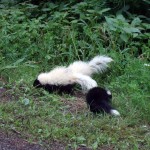
Weeks later at the end of June, Emma and I were on our way to Horse Heaven. We planned to administer a treatment to harden the horses’ hooves which Gene Fletcher, the stable’s farrier, recommended . I slammed on the breaks when a baby fawn jumped in front of the car and bounded into the tall grass in an adjacent field. The woman in a car behind us screeched to a stop, jumped out and followed the fawn into the field with her camera. A little further down the road I pulled the car into the gravel when I saw several baby skunks standing at the edge of the road. Finally, I turned the car into the driveway in front of the barn.

After we had finished with the horses it started to rain. Emma, Johnn and I stood in the barn talking and waiting for the downpour to stop. Heavy rain poured out of the sky, pounding on the tin roof and running into the gutters.

“We saw several baby skunks near the road on our way up to the barn,” I said as the raindrops bounced off the hard asphalt on the road a few yards away.

“I saw them down there too, on Round Top Road,” replied Johnn.

“Can they spray at that age?” I asked thinking how adorable they looked.

“It’s my understanding that everything is working as soon as they are born,” replied Johnn. “So I wouldn’t go picking them up.”

“That’s good to know,” I replied, immediately discounting the thought of taking one home for a pet. “Just before we saw the skunks, a tiny fawn jumped in front of our car and hopped into the tall grass alongside the road.”

“There’s a lot of wildlife in the woods. That’s for sure,” said Johnn.

“Several days ago a woman told us she saw the bear up by her house. She said it walks right down the middle of Weaver Road, crosses her field and makes a beeline of Murray Creek Road. Have you seen the bear lately?” I asked.

“No, I haven’t seen it,” John replied. He paused for a moment then continued, “This time of year, bears make a big circle looking for food. There isn’t a lot for them to eat so they can travel pretty far. When the berries get ripe they’ll stay put and won’t travel so much.”

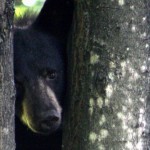
Its August now and every ride this summer I’ve looked for the bear, but didn’t even see a glimpse of him. From what I understand, most bears sleep during the day either in a tree or under bushes. They come out in late evening, night or early morning. Wherever the bear is, I haven’t seen him and nobody I know has seen much of him lately either. We’re all pretty happy about that.

Posted in Uncategorized | Tagged , , , , , , , | Leave a comment

The Horse Clinic and Georgia’s Hard Decision

People sell or give horses away for a variety of reasons, a child outgrows a pony, a young adult leaves for college, illness strikes , financial problems loom, the family moves out of town, a need to make a profit, but sometimes a horse and owner come to a turning point in their relationship. The horse and owner no longer connect. The horse owner realizes that a hard decision must be made; work with the horse or sell. That was the position Georgia found herself in.

I met Georgia in the spring of 2007 when my daughter and I decided to take English Hunt lessons at Windy Ridge Stables with Veda Tupy. Georgia boarded her horse, Whiskey, at the stables and took lessons once a week. Whiskey, a Quarter Horse gelding, and Georgia were always together in the arena practicing or just hanging out. After I left Windy Ridge and moved to Ballentine’s Horse Heaven, I didn’t see Georgia very often. A few days ago, I bumped into Georgia at the store.

“How’s Whiskey?” I asked.

“I’m selling him,” she replied.

I did a double take and said, “I can’t believe it! You’re parting with Whiskey.”

“I know. I didn’t think I’d ever sell him. I thought he was my forever horse, but I came to the realization that things just weren’t working out. It was a hard decision to make, but yes, Whiskey’s for sale. I just bought another horse and can’t afford to board two horses,” she replied in a serene voice filled with determination.

“What happened?” I asked still unable to believe what I was hearing.

“It’s a long story. I’ve been having problems with him for the last two years when Whiskey became the alpha horse in the pasture. To compound the problem, about seven months ago I had a medical emergency. The doctor demanded I stop riding horses for at least six months. Due to the medical problem, I couldn’t spend a lot of time with Whiskey. Meanwhile, he became more distant and obstinate. When I resumed riding, I rode Whiskey for lessons every other week. He acted up and tested me all the time. He would take the bit in his mouth and buck. I didn’t feel at ease on him. That’s when I decided to take Whiskey to Kathy Huggins horse clinic in Millville, PA, to work through the problems I was having and regain the bond we had lost,” she said.

“That sounds like a good idea,” I replied. “I have a riding friend who took her horse to a clinic and said she learned a lot.”

Georgia attended Kathy Huggins’s horse clinic the second week in June for 5 days. Kathy ran the clinic at Cedar Creek Training Stables in Millville, PA and was certified by John Lyons. There are several nationally known trainers, Monty Roberts, Pat Parelli, Clinton Anderson and John Lyons to name a few, who run clinics, workshops, sell tapes and books on how to train a horse through the “partnership” method. They all use techniques which when I was younger were called ‘gentling a horse’. Gentling or connecting with the horse in a psychological way was the opposite of ‘breaking a horse’. Breaking a horse was an old cowboy method which basically was get on, hope for the best and if nothing else bully the horse rodeo style into submission. Gentling a horse was viewed as a more humane method which resulted in a calm, well trained animal.

Georgia drove down to Millville and met two women taking the training program with her. They were working on becoming certified trainers. Georgia was at the clinic to build her confidence and learn how to handle Whiskey. The clinic taught the riders how to work with horses through classroom lectures and hands on training exercises. Kathy’s method was designed to train the rider to handle his/her own horse.

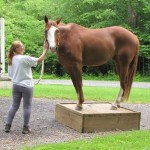
The group worked on a variety of exercises with their horses. One exercise was getting the horse to drop his head by gently putting a little pressure on the lead rope then releasing the pressure as soon as the horse lowered his head. Another exercise required the horse to quietly walk into a trailer by using slight taps from a lunge whip until the horse entered. Several other trials were performed; the horses walked over a see-saw board, crossed a stream and stood on a raised wooden platform. They put dots on the horse’s shoulders, nose, and hips to show pressure points used to move the horse in various directions on command. To experience a trailer ride from the horses viewpoint; the women rode inside a horse trailer. Unable to balance themselves with their hands while the trailer rocked back and forth gave them a good picture of what the horse was experiencing.

On the first day of the clinic, Whiskey and Georgia walked past a series of poles set up in the arena. Georgia reined Whiskey to the left but the horse wanted to go right; when he couldn’t Whiskey started to buck. Georgia landed on the hard ground hitting one of the poles. He performed badly a second time after Georgia unloaded him from a horse trailer. He pulled the lead rope out of Georgia’s hand and reared straight up. Whiskey kept testing and pushing Georgia during the clinic.

As the days progressed, Kathy began to see problems between Whiskey and Georgia. Kathy told Georgia that she had to make a decision. Did she want to work with Whiskey for the next 10 years until she could maybe get him to where she wanted him or sell Whiskey and purchase a calmer horse? You can work with Whiskey to reduce his testing but it won’t be much fun. The horse and rider’s personalities need to match. The rider needs to be comfortable with the horse and the horse needs to trust in the decisions made by the rider, otherwise there will be trouble.

Kathy gave Georgia an email address of a woman in Lockport who a few months ago had to make the same hard decision. Georgia and the woman emailed back and forth about their horses. The woman’s horse, Denver, didn’t like other people or horses. One day, the woman was brushing Denver in his stall when her husband brought another horse into the barn. They walked by the stall where she was working with Denver. The horse spooked and broke the woman’s leg. Her husband told her Denver had to go. He was too dangerous. The woman bought another horse. One day, she was riding her new horse when the horse stopped and started moving her hooves very fast in place. The woman dismounted and found that the horse had been stung many times by bees on the belly. Even though her new horse had been stung, the mare didn’t bolt or buck. The woman was happy with her decision and felt she had found a much better horse than the one that broke her leg.

The clinic taught Georgia a lot about horses and herself. She didn’t get the results she was hoping for with Whiskey. She didn’t get a way to work with him but she found out that sometimes it’s ok to walk away from a situation that isn’t going to get any better. As Georgia drove towards home, she realized Kathy made sense. The practical thing to do was sell Whiskey and get a gentler horse. It wasn’t the reason Georgia went to the clinic, but she realized that Whiskey was no longer a good match for her. At this point she had lost her confidence, and was scared to get on Whiskey. It was too stressful to ride the horse. She learned that Whiskey was what trainers call a sporadic bucker – a horse that occasionally bucks when he doesn’t get his own way. Whiskey needed a more assertive rider, one that would keep him on task. Georgia did not see herself as that type of rider; nor did she constantly want to struggle with the horse.

Kathy promised to help Georgia find a new horse. Shortly after Georgia returned home, she saw a mare on Craigslist. The horse was in Big Flats, not far from where she lived. Georgia made the decision to see the horse by herself. This time when she purchased a horse, she wanted to evaluate it without anyone influencing her. If she liked the horse, then she would ask other people to check out the animal.

Georgia liked what she saw. Kathy made the trip from Millville to look over the horse. The horse was owned by a little 9 year old girl. The parents were selling the horse because their daughter had lost interest in riding; although, she enjoyed going down to the barn to braid the horse’s mane. Kathy put the mounting block under the horse and the mare bumped into it but wasn’t spooked. She rode the horse and found the horse quiet and responsive. Kathy felt the little sorrel mare was a trust worthy animal; one Georgia could work with.

Georgia bought the horse and named her Hannah. The new horse was an eight year old, Quarter horse/Arab mix, 14.2 hands high. A few days later, they loaded Hannah into a trailer and headed back to Windy Ridge. When the little girl saw her horse leaving, she became very sad and ran into the house crying. It’s hard giving up a horse. Now Georgia had that same hard decision to make. She couldn’t afford two horses; Whiskey must be sold.

Whiskey needed a new home. The Windy Ridge stables wouldn’t purchase him because he couldn’t be used for jumping and his sporadic bucking made him a poor candidate for a lesson horse. What will happen to Whiskey is unclear. Georgia fears that he could go to slaughter if the right person doesn’t buy him; she wants Whiskey to go to a good home. She looked at the alternatives; find him a home with a more assertive rider, give him away to a good home, take him to auction or an equine rescue facility. In the short term, Whiskey was taken out of the pasture with the other geldings and has a miniature donkey for a companion. The sun still shines at Windy Ridge but Whiskey’s days there are numbered.

Posted in Uncategorized | Tagged , , , , , , , , , | 2 Comments

Hunter’s First Ride

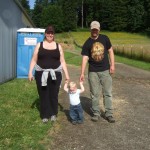
My grandnephew, Hunter, had never ridden a horse. After talking with my niece, Jessica, and nephew, Matt, to see if it was ok with them; Jessica and I started a look on-line to see where he could get a riding lesson. They live in La Center, WA so the logical first step was to check out riding stables in the La Center area. Bingo! There was one within a short drive of Jessica’s house. I called Ruff Ranch and Michelle answered. She specialized in teaching young children how to ride which was perfect because Hunter was only 7 years old.

It was Saturday at 4:30 in the afternoon and my family visit was almost over. I had one more day until I packed my bags and caught a flight home. In the morning it drizzled but by afternoon the clouds parted and the sun shown down upon the rich green landscape. We drove out to meet Michelle Ruff along a twisting road which led through evergreen forests dotted with pastureland in the foothills of Hazen Valley in Washington State. We arrived, meet Michelle Ruff and walked into the cozy ranch office.

“My goal in teaching children to ride is to make the experience pleasurable. If Hunter becomes afraid or feels uncomfortable with the horse and wants to get off then I stop the lesson. I have learned that going slow and explaining the horse to the child is the best way to give a riding lesson. Years ago, the first child I taught was a little girl. I just put the girl on the horse and I lead her around. I noticed after about 10 minutes that she was holding her breath. So I stopped and asked her if she was ok. – The little girl let out her breath and said, ‘I feel ok now but I thought I was going to puke!’ Her mother who was watching asked, ‘Do you mean you felt like you were going to throw-up.’ ‘No!! I thought I was going to really PUKE!’ – After that experience I realized children need a slower approach to horseback riding. I make sure that the child isn’t scared and is having a good time, otherwise their first lesson with the horse isn’t going to be enjoyable,” said Michelle.

“It makes sense that you explain what he should expect during the lesson,” replied Jessica. “We want him to have a good experience.”

“I have a lot of fun working with children. A group of pre-teen girls help out with the stable work and we go on trail rides together,” said Michelle. “Horses are a good self-esteem builder as well as aiding in the development of a child’s work ethic.”

“I noticed on-line you also have a horse therapy program,” I said. “Back home I volunteered for a program that helps mentally challenged individuals, which I found personally rewarding.”

“Yes, it’s called Summit Equine Assisted Therapy. We have therapy programs that include at risk youth, autism, marriage and family, PTSD, and grief management,” said Michelle. “It’s amazing to see how horses can help people.”

Michelle lifted a helmet from a closet, turned to Hunter and said, “Horses are big animals and we need to make sure that we are safe when we are around them.”

“I know it’s good to be safe,” replied Hunter as Michelle helped him try on the riding helmet to make sure it fit.

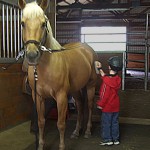
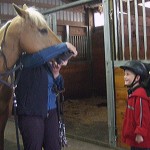
We walked through a small stable and entered another barn where a palomino Quarter horse was patiently waiting. Michelle picked up a halter and lead rope. She showed Hunter how to put the halter on the horse.

“This is Gary,” said Michelle affectionately patting the horse’s neck.

Gary was a very gentle horse. He stood quietly as Michelle put on the halter, led him out of his stall and hooked the crossties. The palomino stood patiently while she retrieved a couple of brushes from a tack box. She handed Hunter a brush and they began to work on the horse.

“We always brush the horse before we ride,” she said instructing Hunter on its use.

“When we work with horses Hunter, we have to be careful and not jump around. They are bigger than us and can accidently hurt us if we aren’t careful,” said Michelle running her hand along the horses back.

The horse was ready to saddle. Michelle explained how to put the blanket on, lifted the saddle onto Gary’s back, and explained the importance of the cinch in holding the saddle on the horse. Michelle retrieved a bridle from a nearby hook and showed Hunter the bit. She gently pulled the horse’s lips up exposing Gary’s big, long teeth and gums.

“The bit fits in the space behind the horse’s teeth and rests against the tongue. It’s very important to remember not to pull too hard or jerk on the bit because you can hurt the horse,” explained Michelle.

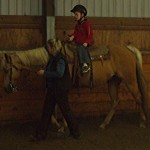
Hunter and Michelle walked the horse into a large enclosed round-pen, just the right size for a young person’s first ride. They walked the horse around the enclosure.

“Before we get on the horse we want the horse to ‘blow out’ so we walk the horse until he is relaxed and expels air from his lungs. Then we check the saddle and tighten up the cinch before we get on,” explained Michelle.

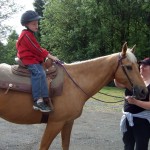
Michelle brought the horse to a stop, checked the cinch, tightened it and led Gary to the mounting block. Hunter stepped up on the block, put his foot in the stirrup and swung on. Michelle showed Hunter how to hold the reins in his left hand and let his right hand rest on his thigh; then off he went on Gary. Michelle walked beside the horse talking with Hunter and helping him guide the gelding; after that it was time for Hunter to try riding on his own. Next, Michelle explained how to make Gary walk in a figure eight which helped Hunter practice turning the horse.

“Would you like to trot Gary?” asked Michelle looking up at Hunter.

“Ok,” said Hunter sitting up straight not sure what to expect.

“Give Gary a kick and say trot,” replied Michelle stepping away from the horse.

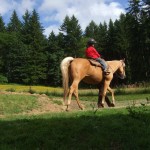
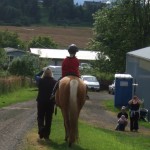
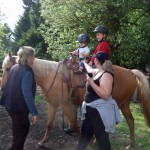
Gary trotted a few steps with Michelle jogging alongside, and then the horse went back to a walk. Michelle made sure Hunter wasn’t scared, and after that they trotted again. Michelle worked with Hunter and the horse until she was confident that he felt at ease on Gary. It was time to go outside for a short ride. Michelle walked next to the palomino as Hunter rode down a long dirt road leading to the front gate. Dad, Mom baby Dylan and I followed. Near the front gate, in the wide parking area in front of the ranch office Hunter stopped the horse.

Matt was holding baby Dylan when Michelle turned to him and asked, “Would you like the baby to have a short ride?”

Matt thought for a moment and replied, “Sure.”

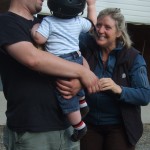
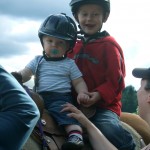
Michelle handed the horse’s reins to Jessica while she hurried to the ranch office to retrieve a small riding helmet. Jessica, Matt and Michelle fitted the helmet onto baby Dylan’s head. Michelle instructed Hunter to scoot over the saddle’s cantle to give room for his brother to sit on the horse with him. The palomino was surrounded by adults as he slowly walked in a circle. Dylan’s parents each placed a reassuring hand on the baby and walked close to the horse. The baby smiled and gurgled and held tight to the horn.

“When people ask me how long I’ve been riding I’m not sure what to say since my first ride was as a baby,” said Michelle bringing the horse to a halt.

“That’s the same for me. My older cousins had horses and whenever we visited they put me up on their horse and rode around a little bit,” I replied watching baby Dylan lifted from the horse by his father.

It was time to put Gary back in his stall. Hunter rode the horse up the sloping hill to the barn. In the barn, Michelle hitched the horse to crossties and off came the saddle. Michelle and Hunter brushed the gentle palomino, and then lead him back to his stall.

Michelle turned to Hunter and asked, “Would you like to feed the horses?”

Hunter smiled and said, “Ok.”

He picked up an armful of hay, walked to Gary’s stall, and placed the hay in front of the horse, after that, he feed a grey pony and another horse. The job was done and it was time to leave behind the horses, barn and round-pen. The sun was shining and the birds singing as we walked back down the hill towards the ranch office to return the helmet. The office was cool and pleasant when we stepped through the door. The black helmet was returned to the cabinet and Hunter’s first ride came to an end. Matt and Hunter stepped outside to feed grass to the horses in a nearby pasture.

Michelle, Jessica and I chatted for a while and then Michelle asked, “Do you think Hunter would like to volunteer to brush the horses?”

“I think he would love to,” said Jessica smiling.

“Give me a call and we’ll set up a time,” said Michelle. Her voice was as warm and friendly as the day had been.

We walked to our vehicle, hugged and thanked Michelle and started the car engine. Michelle opened the gate for us, and we waved good-bye as the car pulled out of the Ruff Ranch driveway. Hunter’s first ride was a delightful and heartwarming experience for us. Will he become a horseman? Only time will tell.

For more information about Russ Ranch take a look at Ruff Ranch Stables

Posted in Uncategorized | Tagged , , , , , , , , , , | Leave a comment

Riding the Wind

Frigid temperatures faded gradually blending into cool March weather. The sky filled with white puffy clouds, moving rapidly across the sky and casting shadows on the ground. Instead of wearing my winter outfit, I pulled on a sweatshirt and headed for Horse Heaven. All winter the horses stood near the barn door waiting to go in, but today they were on the hillside trotting and galloping. They held their heads high as their manes flew in the wind. The herd stopped, snorted and suddenly broke into a canter. The horses had spring fever.

I walked down the hill, put a halter on Pepper, returned to the barn and saddled up. Pepper whinnied for the herd as soon as we trotted away from the pasture. She tensed every muscle with excited as we headed for the park. Her hooves tapped on the dirt road and when we reached the hilltop, I heard the wind roar. The wind rushed up the road streaming over the ridge screaming like a steam engine ready to take off. As we crested one hilltop and rode down the other side, we heard another wind bellowing across the opposite side of the mountain. The two winds blended in a strange opera of shrill howling noise.

The wind obliterated every other sound. Nervous and anxious, Pepper gathered energy, every step higher and faster. Several times I turned in the saddle and looked back up the road mistaking the wind for a car or truck. With the airstream at our backs everything became calm; I heard the wind but didn’t’ feel it. However, when the road turned and headed towards the wind I felt the warm breeze rush over us and my pulse quickened.

The warm weather during the last few weeks melted the ice and snow resulting in water running off the mountain and filling the ditches alongside the road. Small slender waterfalls cut into the muddy hillside. Sunlight sparkled on the cascading water. The bubbling, gurgling liquid mixed with the sounds created by the wind. The ditches swelled with fast moving water headed towards the Susquehanna River.

We turned up the road leading to the park entrance and everything changed. The trees groaned and swayed like gruesome misshapen skeletons. The sky darkened as the wind gathered the clouds and bunched them together. Deep shadows danced in the woods and crisscrossed the gravel road. Leafless branches clanked against one another and dead brittle twigs broke off and fell to the ground. On a trail deep in the woods two young men laughed. Their voices, clear and eerie, floated on the wind. I heard the squeal of their four-wheeler’s tires spinning; stuck in the mud.

Pepper became nervous but walked up the road and around the gate until we reached the pond. Small choppy waves ripped across the water’s surface. I glanced at the treetops bending and creaking. Gently, I squeezed the reins for Pepper to stop. We turned around. It was too windy to ride any further. She practically jumped for joy as we headed back down the road. The weird noises in the park were left behind and we cantered towards the barn.

Posted in Uncategorized | Tagged , , , , , , | 1 Comment

Pam Watros and Meadowgate Equine Rescue

In the fall of 2008, I was volunteering at the Susquehanna River Archeological Center in Waverly, NY when a fellow volunteer told me about her experience helping rescued horses in Newfield, NY.

“I drive up once a week and brush the horses,” she said.

“That sounds great,” I replied.

At that time I was riding at Windy Ridge Stable and taking English/Hunt lessons with Veda Tupy the coach for the Binghamton Equestrian Team. Horses have a way of getting into your blood and helping out at a rescue facility sounded pretty good to me. I called Pam Watros, the director and founder of Meadowgate, an eighty acre horse rescue facility.

“Many of our rescued horses have been abused. They are not like other horses you may have dealt with.” said Pam.

“I can understand that,” I said.

Do you have experience with horses?” asked Pam.

“I had a horse when I was young and I currently ride at a local stable,” I replied.

“Well, can you come help me feed the horses at 8:00 AM on Saturdays?” she asked.

I hesitated for a moment. The idea of getting up early and driving 40 minutes on Saturday morning wasn’t exactly my first pick for time and day to volunteer. However, I really wanted to help out and if that was the only slot open then I’d do it.

“I’ll be there Saturday at 8:00,” I said and hung up the phone.”

My alarm jolted me awake and I jumped out of bed, threw on my clothes and headed up route 34 towards Meadowgate. I met Pam and we started to work. First we collected the empty grain pails from the pastures, returned to the barn, filled the grain buckets and piled hay into the back of the Utility Terrain Vehicle.

“Before the UTV, I loaded hay in a wheelbarrow and pushed it up the hill through the ruts in the road to the pastures.” Pam said. “This is so much easier.”

“I can’t believe you did this with a wheelbarrow,” I replied quickening my pace to keep up with Pam.

“You do what you have to do with whatever you have,” Pam replied.

We hopped into the cab; Pam put her foot on the gas and headed the vehicle up a steep hill toward the pastures. At the top of the hill we bent low and crawled under the electric fence lugging the grain pails. The buckets were left for the horses waiting in the pasture to be fed. We walked to the back of the UTV, gathered an armful of hay and threw it into the pasture.

“How did you get involved with rescuing horses?” I asked getting back into the UTV. Pam turned the key in the ignition and we headed towards another pasture.

“I was looking at a Quarter Horse for my daughter Jaimi at Carol Cook’s stable. Carol rescues Thoroughbreds. She told me some stories about the horses she’s helped and how she started,” Pam replied. “Ordinary horses in our area didn’t have a rescue facility so I felt there was a need that wasn’t being met,” said Pam.

The work feeding the horses was finished. Pam pulled the UTV into the barn. We walked towards the tack room where the western saddles hung in a long row against the wall. I picked up my jacket from a hook near the bulletin board.

“Rescuing horses seems like a massive undertaking,” I said putting on my jacket.

“I started the process in 2004 to establish a non-profit 501(C) organization. First I researched if a horse rescue was needed in our area. I sent out letters to vets, law enforcement agencies and farriers,” Pam said walking towards the huge sliding barn doors.

“Did they actually respond to you,” I asked.

“I didn’t get much response except from law enforcement. Their answer was yes but they didn’t offer any help in setting up an equine rescue facility. I hired a lawyer to setup Meadowgate. At first we were an umbrella organization of the Community Foundation of Thompkins County. Now we are an independent non-profit,” Pam said smiling. She pulled the massive barn doors open so we could step outside.

“Where did you gain the knowledge to manage such a large barn?” I asked as we walked down the gravel driveway towards our vehicles.

“When I was 19 years old I got a job at the front desk of Laquinta Motor Inns in Atlanta Georgia. One of the project supervisors had a farm in Texas. We started talking about horses and he told me about a woman in Texas who had a farm with 50 horses. I contacted Alice at Dreamland Acres Farm and went to work for her. She had Hanoverians, Arabs, Welch Ponies, and Welaras which are a cross between an Arab and Welch Pony. I became her barn manager and gained a great deal of experience in farm management overseeing the care of her horses,” said Pam.

“Are you still in contact with Alice,” I asked.

“I keep in touch with her daughter,” Pam said. “Alice died of cancer several years ago.”

We fed the horses Saturday mornings throughout the fall, winter and into spring. It took us about an hour to complete the morning feeding. When the cold winter weather started to turn balmy and spring came we stayed and worked with the horses. Sometimes Hannah, Pam’s young daughter, would join us.

Often Pam asked, “If you have extra time you can take Apache out and let him eat some grass.”

On Saturday mornings I usually did have extra time and would reply, “Sure.”

Apache was a 5 year old appaloosa with Equine Motor Neuron disease; a condition created by a former owner who hadn’t feed Apache any green hay or grass for over 2 years. He came to Meadowgate as a stallion very under nourished. Pam had him gelded and was bringing up his weight when Apache started having uncontrollable muscle spasms. He fell against the wall of his stall and laid down a lot. Pam had no idea what was happening to the horse so she called Cornell Vet School. They sent a vet down to run some tests. Everything came up negative until a biopsy was performed. The vet cut a muscle sample from under Apache’s tail and sutured the incision. The results came back. Apache was diagnosed; he had Equine Motor Neuron disease.

“What is Equine Motor Neuron disease?” I asked.

“A rare condition caused by the nerve cells along the spine dying. It’s a progressive disease. Right now we are giving him vitamin E supplements and as much green grass as we can,” Pam said.

Apache pulled at his lead rope and ate another mouthful of grass. Pam held on to Stitch standing near the horse’s good eye. It was quiet except for the swish of the horse’s tails swatting flies.

“And what’s Stitches story?” I asked.

“When Stitch was 6 months old her mother stepped on her neck by accident. Her owner was a vet so he performed an emergency tracheotomy, cutting a hole in her neck for her to breathe. When she was 2 years old another owner had her. A dog ripped off part of her nose and a vet sutured it back on. She had a broken shoulder and is blind in one eye,” said Pam.

We walked Stitch and Apache down the road a bit to find a place where the grass was tall and lush. The horses enjoyed the meadow. Woodlands surrounded the pleasant horse pastures nestled in the Arnot Forest.

“What about the other rescued horses?” I asked looking back up the road towards horses standing on the sloping hillside.

Pam said, “Buddy is a Quarter Horse/Morgan mix. His owner tried to run him over with a jeep.”

She stroked Stitch’s mane and continued, “Buddy has major trust issues, but we’re working with him. Mandie and Brandie are two feral horses which were running wild through the woods and farmer’s fields. Feral horses are a common problem; owners who can’t afford to feed their horses turn them loose thinking the animals can fend for themselves in the countryside.”

We walked the horses back towards the barn. When we reached the barn, Pam switched off the electricity to the fence and we lead the horses back up the hill. Apache pulled at his lead rope and snatched a last bit of grass before we turned him loose in his pasture.

“How do you rescue a horse?” I asked.

“We only rescue a horse if the Humane Society, SPCA or law enforcement has investigated and found that laws have been broken. You can’t just go up to someone’s home where it looks like horses aren’t being cared for and take their horses. Horses are legally considered livestock and as such are considered property. People have rights to their property and taking animals without a legal reason is a criminal offense. After law enforcement has done their investigation, they call us to come and get the animals. The police are present when we take the horses and bring them back to Meadowgate,” said Pam.

One spring day Pam and I were in the barn throwing hay into the back of the UTV. The morning mist was heavy; hanging over grass thick with dew. As we performed the routine barn chores, Pam told me about The Mentally Challenged Program at Meadowgate.

The program gives mentally challenged individuals a chance to work with horses,” she said. “Would you be interested in helping out with the program?”

“When would you need me?” I asked brushing hay off my shirt.

“Wednesday mornings at 9:00 starting next week if you can make it,” she said “We have a trained instructor, Julianne Wrolstad, who works with the group.”

“I’ll give it a try,” I said as we headed outside to wash the stall water buckets with a hose.

On Wednesday Julianne was waiting for me in the barn. She was a tall graceful young woman with long blond hair. A few minutes later a white van pulled into the driveway and the mentally challenged group stepped out of the vehicle. Julianne helped everyone with helmets. She had a variety of activities for the group to try. My job was simple; hold one of the ponies or just be there to lend a hand. The following year, I was ready to help again but the program was postponed until 2012.

Some mornings Adam Crown would be at the stable taking care of his white Arab horse named Kelsey. He boarded Kelsey at Meadowgate and was often there. One morning Adam met us for a big job. We pulled out metal fence posts and detached the electric wire to rearrange the pastures. Unfortunately I had to leave before the job was done. Before I drove away I glanced back up the hill, and for a moment watched Pam and Adam reattaching the electric fencing to the metal posts.

Fall foliage spread over the Southern Tier of NY adorning the trees with jeweled orange and yellow crowns. I drove through the woodlands toward Meadowgate to attended Don Warner’s 2009 natural horsemanship training clinic. The driveway was jammed with cars, but I found a parking space near the front gate. I walked into the barn. There were two round pens set up between the stalls. In one of the round pens Don was working with a horse explaining to a big crowd how to overcome the animal’s innate fears. Adam was in the other round pen working with a horse. The morning session ended and the group broke for lunch.

The crowd walked around the outside of the barn to the classroom where summer horse programs were given. The room was crammed with people and there was a long table filled with food. Many people had already piled their plates and were sitting at tables eating, while others waited in a line. Anne McCarty, a fellow volunteer, was just ahead of me. The hum of conversation vibrated off the walls.

I sat next to Anne and we fell into a conversation about horse ownership. I had decided to buy a horse. Not an easy decision since I would have to board the horse. I had already looked at several horses, some at Meadowgate, some at on-line sites, and one Arab named Chicky owned by DJ Sheldon at Rapture Arabians in Groton.

“Maybe you don’t want horse ownership. You just want to ride. I know a woman who has a horse to lease and she doesn’t live far from you,” said Anne.

“I hadn’t thought about that. I have a half-lease now, but the time I am allowed to use the horse is very restricted.” I reply.

“Here,” she said taking a piece of paper out of her purse and jotting down a name and number. “Call Connie – I think she might be able to help you.”

When I got home I called Connie and before I knew it signed a lease to ride a bay Standardbred mare named Pepper. I made a trip to see DJ and told her that although I loved Chicky leasing made more sense for me than horse ownership. It wasn’t long before a buyer from Albany with an indoor arena snapped up the beautiful dapple grey Arab with a gait as light as air. A few months later I stopped volunteering at Meadowgate and spent the major part of my free time riding Pepper.

I hadn’t seen Pam for almost two years. A few days ago I traveled the long windy road to Meadowgate to see her. I noticed some big changes right away. A new arena stood where one of the pastures had been. We sat on a bench at the end of the arena surrounded by horse pastures and flanked by woodlands.

“How are Apache and Stitch?” I asked.

“A few months ago we had to euthanize Stitch and Apache. Apache was in a lot of pain and not getting any better. Stitch was having trouble with her blind eye. Instead of putting her through the pain of another surgery, we put her down. She was 14 years old and Apache was 7,” she said, “That was a hard day.”

“That’s too bad,” I said thinking about the pretty appaloosa that loved to eat grass. “ And Buddy, how is he doing?” I asked.

“Buddy still has trust issues, but he’s coming along. He’s especially good with halter training. You can walk him anywhere,” Pam said.

“And Mandie and Brandie, the Saddlebred feral mares – are they still at Meadowgate?” I asked.

“Yes, they are over at my parent’s farm. They are up for adoption,” she said.

“Are you still running summer programs for kids?” I asked the sunlight dancing across the hillside.

“We still have the Horses & More Summer Enrichment Program for kids in 2nd through 4th grade. They learn horsemanship skills, wildlife education, and basic first aid. And we have the Ponderosa Pals Youth program which is an individualized program for kids that have been physically, mentally or verbally abused,” she said pausing for a moment before continuing, “In a few weeks we are organizing a series of 2 to 4 hour trail rides to raise money. It’s $10 per person. People trailer their own horse.”

“That sounds exciting. I’d love to come and ride with everyone, but nobody at our stables has a trailer,” I said.

“We are also digging a dry hydrant to be used by the community,” Pam continued pointing to a bulldozed area on the other side of the pasture.

“What is a dry hyrant?” I asked gazing at the deep hole.

“It’s a pond where firefighters can hook-up their hoses to get water in case of a barn or residency fire in this area of the county,” she said. “There aren’t any fire hydrants out here.”

“A barn fire would be terrible,” I said. The summer sun warmed us as we sat on the wooden bench and talked. “How long do you plan on rescuing horses?” I continued.

“As long as I can – it’s a lifetime commitment,” Pam replied.

My daughter, Emma, and I took pictures for the blog. We visited with a new arrival to Meadowgate; a yearling pony/Quarter Horse mix named Colton. In the distance, I saw Adam working with Kelsey and walked over to say hi. Soon it was time to say goodbye to Hannah and Pam. We walked through the barn and out the other side to where our cars were parked. I knew that Pam would be there tomorrow morning working with the horses, supplying a valuable service to the community and enriching our region of New York State. Pam and Hannah smiled and waved as we drove away down the long gravel road towards home.

For more information about take a look at Meadowgate

.
Posted in Uncategorized | Tagged , , , , , , , , , , , , , , , , | 3 Comments